

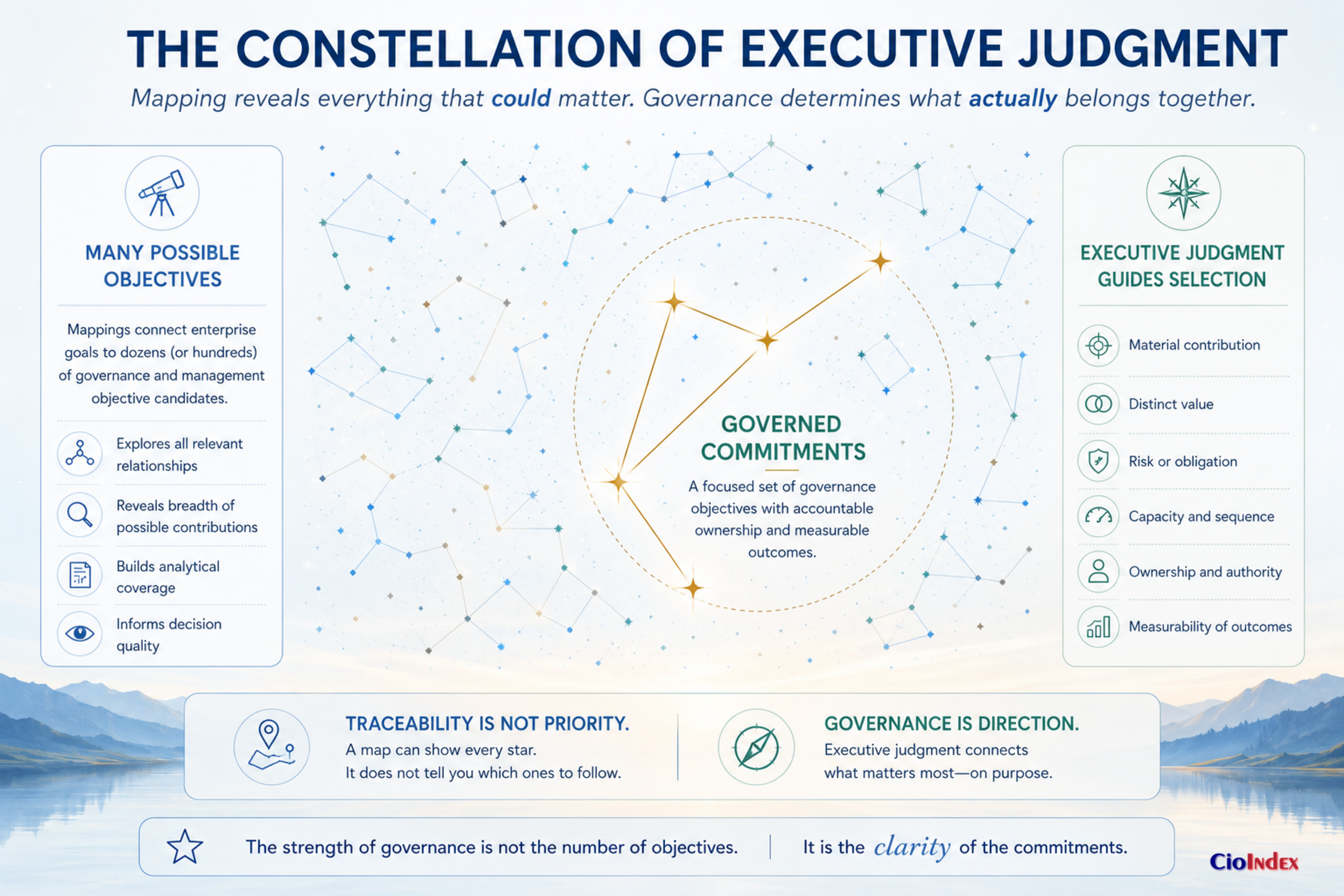
The COBIT goals cascade is usually drawn as a clean chain: stakeholder needs inform enterprise goals, enterprise goals map to alignment goals, and alignment goals connect to governance and management objectives. The chain is useful. The mistake is treating it as though the map has already made the decision.
A mapping can show that an objective is relevant. It cannot establish that the objective matters more than the alternatives, can be funded now, has an owner with authority, or will produce the intended enterprise outcome. Mapping establishes relevance; governance establishes commitment.
That distinction matters because a mechanically complete cascade can create an impressive but unmanageable governance agenda. Broad priorities generate overlapping goals; overlapping goals generate dozens of plausible objectives; and the resulting portfolio can look rigorous while hiding unresolved trade-offs, nominal ownership, and more work than the organization can absorb.
The governing principle for CIOs is therefore simple:
The COBIT goals cascade creates traceability, not priority. Priority is earned through evidence and executive judgment at every translation step.
This article explains how to use the COBIT goals cascade as a governed translation process rather than a mapping exercise. The reader leaves with a six-move decision cycle, two operating cases, a five-test diagnostic, and a practical decision record for converting enterprise priorities into a small, defensible set of governance and management objectives.
What Is the COBIT Goals Cascade?
The COBIT goals cascade links stakeholder needs and enterprise priorities to enterprise goals, alignment goals, and governance and management objectives. In COBIT 2019, the framework uses 13 enterprise goals and 13 alignment goals; the term alignment goals replaced the earlier COBIT 5 label IT-related goals. The change reinforces an important idea: information and technology outcomes are not the concern of an isolated IT department. They are contributions to enterprise performance. (ISACA COBIT 2019 governance-strategy guidance)
At a high level, the cascade moves through four connected levels:
| Level | Executive question | Typical output |
|---|---|---|
| Stakeholder needs and enterprise priorities | What outcomes, obligations, risks, and expectations matter most? | Evidence-backed priority statements |
| Enterprise goals | Which enterprise outcomes best express those priorities? | Selected and qualified enterprise goals |
| Alignment goals | How should information and technology contribute? | Interpreted I&T contribution goals |
| Governance and management objectives | What must be governed or managed differently? | A reconciled set of objective candidates |
This sequence gives leaders a common language for connecting business intent to governance action. It also creates an audit trail: a governance objective can be traced backward through the alignment and enterprise goals that justified it.
That traceability is valuable, but it is not prioritization. A relationship in a mapping table establishes possible contribution. It does not establish timing, funding, ownership, feasibility, relative importance, or expected value. The cascade organizes the field of choice; executives must still make the choice.
Why Mechanical Mapping Fails
The most tempting use of the cascade is also the least useful: select enterprise goals, follow the mapping tables, retain the resulting objectives, and call the portfolio aligned. It feels disciplined because every step can be documented. It fails because the difficult judgments have merely been carried forward.
That approach creates three problems.
First, the cascade can amplify ambiguity. If an enterprise priority is vague—“improve customer experience,” “strengthen resilience,” or “accelerate innovation”—several enterprise goals may appear plausible. Each of those goals can map to multiple alignment goals, which can in turn produce a broad field of governance and management objectives. The uncertainty has not disappeared. It has multiplied and acquired framework terminology.
Second, mapping strength can be mistaken for decision strength. A primary relationship may indicate that an objective is strongly associated with a goal. It does not prove that the enterprise has the evidence, resources, capability, or executive commitment required to make that objective a current priority.
Third, a complete cascade can reward coverage over choice. Governance teams may feel safer retaining every plausible objective because excluding one appears less rigorous. The result is a portfolio in which everything is important, and therefore nothing is truly prioritized.
This is cascade amplification: unresolved upstream priorities produce an even larger downstream set of plausible objectives. The remedy is not to ignore COBIT’s mappings. It is to treat every translation as a governed decision. Coverage is analytical; priority is executive.
Governed Translation Versus Mechanical Mapping
| Dimension | Mechanical mapping | Governed translation |
|---|---|---|
| Starting point | Generic strategy statements | Evidence-backed stakeholder and enterprise priorities |
| Use of mappings | Treat relationships as answers | Treat relationships as candidate-generating evidence |
| Treatment of overlap | Retain every mapped objective | Combine, narrow, sequence, or exclude candidates |
| Trade-offs | Hidden inside a long list | Explicitly debated and documented |
| Capacity | Considered after selection | Used as a selection constraint |
| Ownership | Assigned after the portfolio is built | Tested before an objective is approved |
| Measurement | Attach available metrics | Define the enterprise outcome and evidence chain |
| Review | Repeat the exercise periodically | Revisit when assumptions, risks, or priorities change |
Governed translation does not reject the framework. It uses the framework more rigorously. COBIT supplies a structured translation mechanism; the enterprise remains accountable for the quality of the inputs, the interpretation of the relationships, and the choices made from the candidate set. A mapped objective remains a candidate until leaders accept its trade-offs, ownership, and evidence burden.
The Six-Move Goals Cascade Decision Cycle
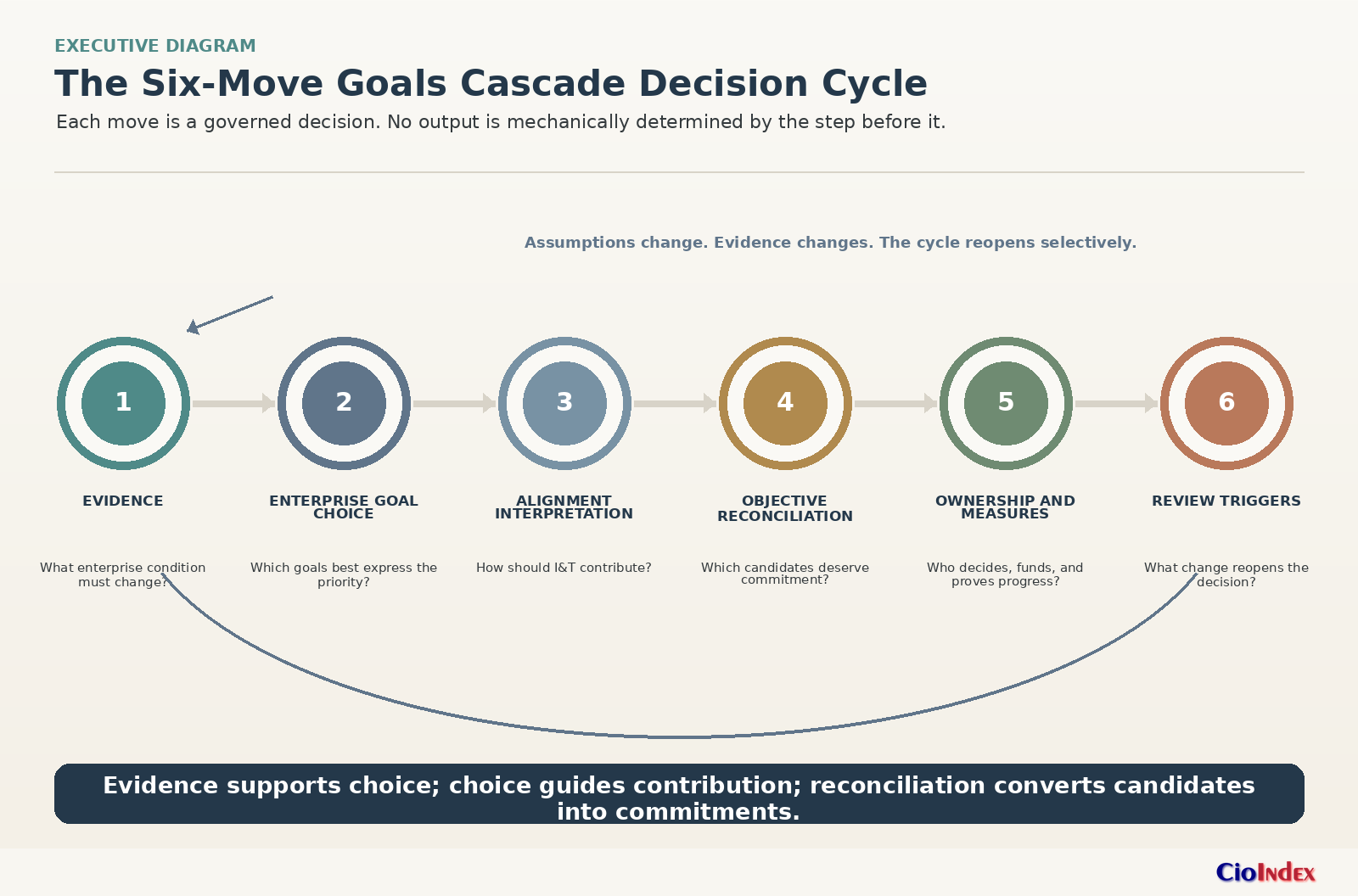
A practical cascade moves through six governed decisions:
Evidence → Enterprise goal choice → Alignment interpretation → Objective reconciliation → Ownership and measures → Review triggers
Each move narrows uncertainty and creates the basis for the next. Evidence supports goal choice; goal choice defines the intended I&T contribution; that contribution generates objective candidates; reconciliation converts candidates into commitments; ownership and measures make the commitments operational; review triggers keep the decisions current. The cycle fails whenever one output is treated as mechanically determined by the previous one.
1. Establish the Stakeholder and Strategy Evidence
Do not begin with the COBIT goal tables. Begin with the enterprise condition they are meant to change.
The evidence base should explain what the organization is trying to achieve, what can prevent it, and whose expectations materially shape the decision. Depending on context, that may include:
- board and executive priorities;
- customer and citizen outcomes;
- regulatory or contractual obligations;
- enterprise risk and resilience concerns;
- financial and operating performance;
- transformation or growth commitments;
- acquisition, sourcing, or ecosystem dependencies;
- technology constraints and I&T-related issues;
- stakeholder conflicts that cannot be resolved through wording alone.
The purpose is not to collect every available strategy, risk, and performance document. It is to expose the claims that will drive goal selection. In many executive workshops, phrases such as ‘improve customer experience,’ ‘strengthen resilience,’ and ‘accelerate innovation’ are all accepted as priorities because no one is required to define the consequence, tolerance, or trade-off. That ambiguity becomes expensive once it enters the cascade.
A useful evidence statement is specific enough to influence choice. For example:
The enterprise must maintain uninterrupted access to regulated customer services during a major third-party outage, while keeping recovery investment within the approved two-year capital envelope.
The statement makes the governing tensions visible: continuity, third-party dependence, regulation, and financial capacity. Those tensions must remain visible throughout the cascade. If they disappear behind generic goal labels, the translation has lost the decision it was meant to preserve.
Quality test
Before selecting an enterprise goal, ask:
- What observable enterprise condition makes this priority material?
- Which stakeholder owns or experiences the consequence?
- What evidence supports the claim?
- What competing priority might change the interpretation?
- What would cause leaders to revise the priority?
If those questions cannot be answered, the cascade is starting with an aspiration rather than a decision-grade input. Weak evidence does not become stronger because it has been translated into framework language.
2. Select and Qualify Enterprise Goals
COBIT’s enterprise goals provide standardized outcomes for translating diverse stakeholder needs into a common governance vocabulary. The task is not to identify every goal that could be related. It is to select the goals that best express the enterprise’s material priorities in the current planning horizon.
Two disciplines improve the choice.
The first is qualification. Record why a goal applies, which evidence supports it, and what it means in this enterprise. A goal label without context can be interpreted differently by finance, operations, risk, product, and technology leaders.
The second is relative priority. Leaders must decide whether a goal is primary, supporting, deferred, or merely contextual. Without that distinction, downstream mappings will produce an undifferentiated candidate pool.
A practical enterprise-goal record should include:
- the selected goal;
- the stakeholder or strategic evidence behind it;
- the intended enterprise outcome;
- the planning horizon;
- the principal risk if it is not achieved;
- conflicts with other goals;
- the accountable executive sponsor;
- the reason it is primary, supporting, or deferred.
This is the first major executive trade-off. An organization may simultaneously value innovation, cost control, compliance, customer continuity, and workforce capability. The cascade cannot make all five dominant without producing a portfolio too broad to govern. Priority requires an explicit willingness to constrain something else.
The priority challenge
Ask the executive team to complete this sentence:
This enterprise goal deserves priority now because ________, and we are willing to defer or constrain ________ to support it.
If leaders will not name the trade-off, the goal has not been prioritized. It has only been endorsed. Endorsement creates a list; priority creates a commitment.
3. Interpret Alignment Goals as I&T Contributions
Alignment goals describe how information and technology contribute to enterprise outcomes. They are not simply ‘IT goals’ delegated to the CIO. Their meaning depends on the enterprise outcome, the mechanism of contribution, and the boundary of I&T responsibility.
This translation step should answer three questions:
- Contribution: How can information and technology materially influence the enterprise goal?
- Mechanism: Through which capability, decision, behavior, or control does that contribution occur?
- Boundary: What remains outside the responsibility of I&T governance?
Consider an enterprise priority related to service continuity. Several I&T contributions may be relevant: resilient services, dependable suppliers, secure information, recovery capability, or reliable operational data. The correct interpretation depends on the failure mechanism the enterprise is trying to control.
If the material exposure is a concentration of critical services in one provider, the contribution is not merely “improve availability.” It may require governance over sourcing concentration, exit capability, service architecture, contractual obligations, and recovery testing. The alignment goal helps organize the contribution, but enterprise evidence determines its meaning.
This is also where organizations accidentally transfer ownership. An alignment goal may be interpreted as evidence that the CIO owns the entire enterprise outcome. The CIO may own critical enabling capabilities, but customer continuity, regulatory compliance, operational resilience, and transformation value usually depend on decisions across several functions. The cascade should clarify contribution, not create an accountability escape route.
Interpretation record
For each selected alignment goal, document:
- the enterprise goal it supports;
- the specific I&T contribution expected;
- the causal or operating mechanism;
- the business and technology co-owners;
- the contribution boundary;
- the evidence that would show progress;
- assumptions that could invalidate the interpretation.
This record prevents the cascade from becoming a requirements handoff from executives to IT. Alignment identifies contribution; it does not absolve the enterprise of shared ownership.
4. Reconcile Governance and Management Objective Candidates
Mapping selected alignment goals to governance and management objectives generates candidates. This is where the cascade often expands sharply. Applied examples published by ISACA show that a small set of alignment goals can produce a much larger set of unique objectives, making focus and prioritization essential. (ISACA Journal)
Do not accept the candidate list unchanged. Reconcile it through six filters. The purpose is not to prove that every objective is useful; it is to determine which objectives deserve commitment now.
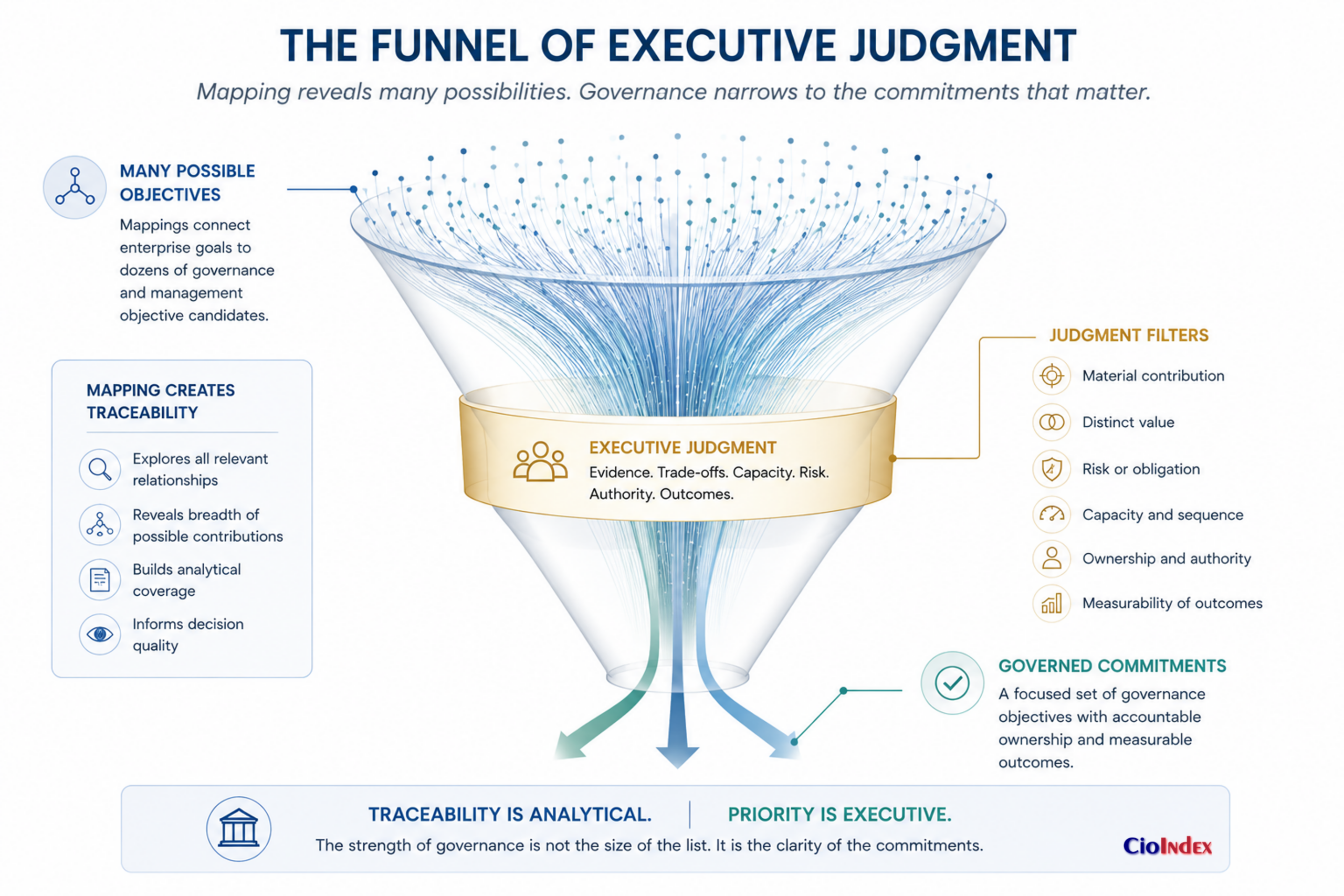
Material contribution
Does the objective materially influence the enterprise outcome, or is the relationship technically valid but strategically peripheral?
Distinct value
Does the objective add a separate governance contribution, or is its value already covered by another candidate?
Risk and obligation
Would deferring the objective create an unacceptable risk, legal exposure, or control weakness?
Capacity and sequence
Can the enterprise absorb the objective now? Does it depend on another capability, decision, or operating change?
Ownership
Can an accountable owner accept the objective and make the required decisions? An unowned priority is not a priority; it is an unresolved expectation.
Measurability
Can leaders define evidence that connects the objective to the enterprise outcome? Completion measures alone are not enough.
After applying the filters, place each candidate into one of four dispositions:
- Keep: material, distinct, actionable, owned, and measurable now.
- Combine: materially overlaps with another objective and should be governed as one decision package.
- Defer: relevant but not currently fundable, sequenced, or ready.
- Exclude: does not materially contribute within the defined scope or planning horizon.
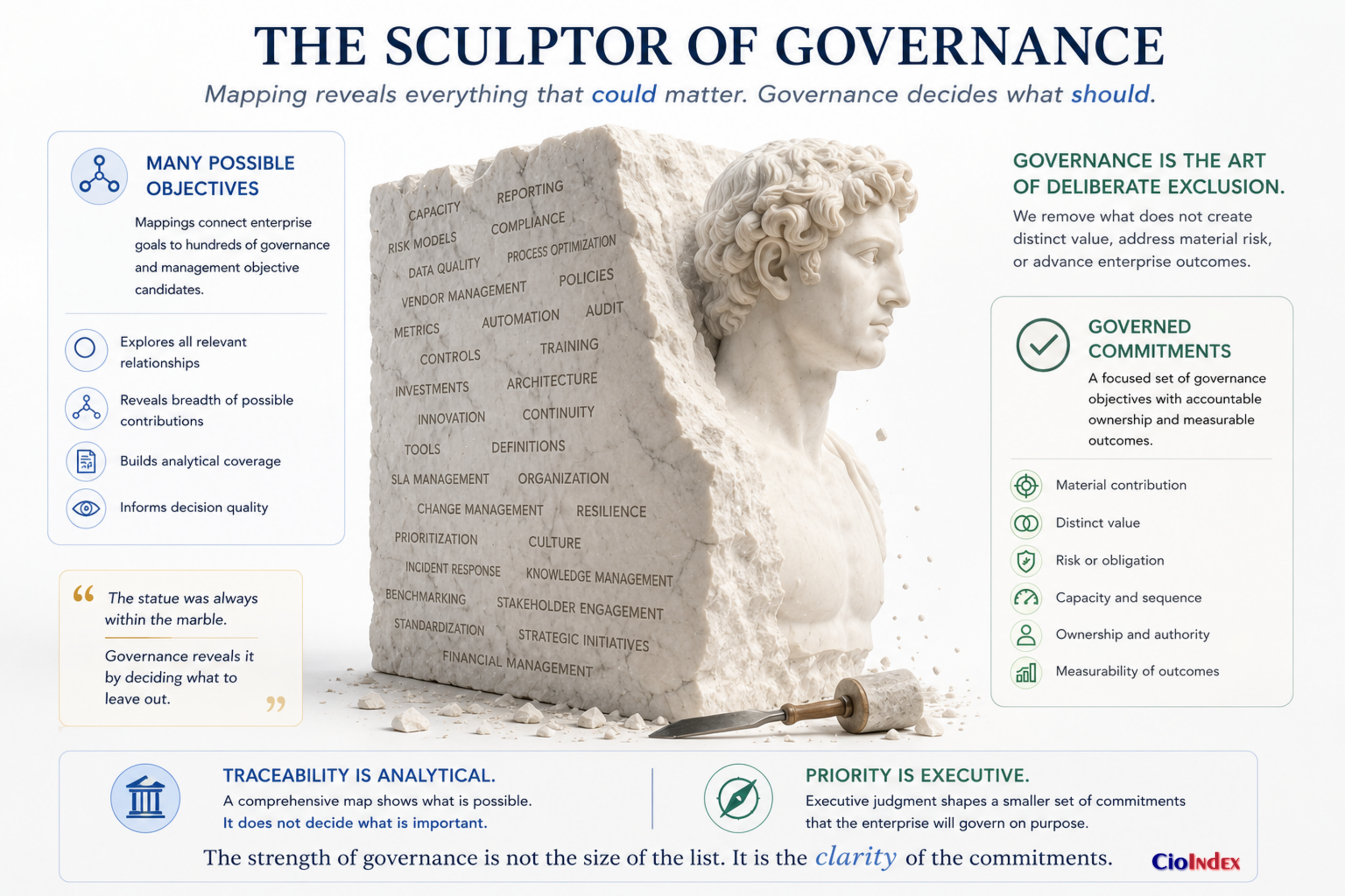
Exclusion is not evidence that an objective is unimportant in general. It is evidence that governance has made a bounded choice for this enterprise, at this time, for this outcome.
Recognition Case: When Complete Mapping Produces an Unfundable Backlog
A regulated services organization identifies five enterprise priorities: customer trust, regulatory compliance, service continuity, cost discipline, and digital growth. The governance team maps them carefully and produces a broad set of related alignment goals and governance and management objectives.
The steering committee is pleased. Every executive priority is represented. The mapping workbook is complete. Coverage appears strong.
Exclusion does not mean that an objective is unimportant in general. It means governance has made a bounded choice for this enterprise, for this outcome, in this planning horizon. Recording that choice is what turns omission from an accident into a decision.
The candidate portfolio contains more objectives than the organization can fund or govern. Several objectives compete for the same architecture, security, risk, data, and change capacity. Ownership is nominal: the CIO is listed against most technology-related objectives, while business leaders remain sponsors rather than decision owners. Measures focus on plans, assessments, controls, and project milestones rather than customer continuity or regulatory outcomes.
A regulated services organization identifies five enterprise priorities: customer trust, regulatory compliance, service continuity, cost discipline, and digital growth. The governance team maps them carefully and produces a broad set of alignment goals and governance and management objectives.
The steering committee initially sees success. Every executive priority is represented, the workbook is complete, and no sponsor has been told that their concern is secondary. This is a familiar governance comfort: universal inclusion feels safer than explicit choice.
But the positive signal creates the wrong inference. Completeness is being mistaken for governability.
The candidate portfolio contains more objectives than the organization can fund or absorb. Several compete for the same architecture, security, risk, data, and change capacity. Ownership is nominal: the CIO appears beside most technology-related objectives, while business leaders remain sponsors rather than decision owners. Measures track plans, assessments, controls, and project milestones rather than customer continuity or regulatory outcomes.
Nothing in the mapping is necessarily incorrect. The failure is the absence of reconciliation. The map has described relevance without resolving commitment.
The governance team returns to the enterprise evidence and identifies one near-term non-negotiable: continuity of regulated customer services during a third-party disruption. That decision changes the portfolio. Compliance, resilience, supplier, architecture, and recovery objectives that address the same exposure are combined into one governed outcome. Other valid objectives are deferred because they do not materially change the exposure in the current horizon.
The final portfolio is smaller but more defensible. It shows what the enterprise will govern now, who must decide, what evidence will demonstrate progress, and which priorities have been consciously deferred.
The lesson is not ‘map less.’ It is ‘do not confuse analytical coverage with executive choice.’ A complete map may still describe an unfinished decision.
- enterprise outcome owner: accountable for the business result;
- A cascade becomes operational only when each selected objective has an owner with authority, a decision forum, and an outcome measure. Until then, it is still analysis.
- Ownership should identify who can change the conditions that matter. That often requires distributed responsibility rather than one name beside an objective. A technology leader may own platform resilience, procurement may own supplier terms, operations may own service continuity, finance may own investment constraints, and risk may own tolerance and challenge.
- challenge function: tests evidence, risk, and compliance;
- funding authority: approves resource commitment;
- review forum: resolves conflicts and changes priority.
Measures should preserve the same traceability. A governance activity can be completed without improving the enterprise outcome. A policy can be approved, an assessment completed, or a control deployed while the underlying risk remains unchanged.
Use a measure ladder:
- Activity: Was the governance work performed?
- Capability: Can the organization now perform or control something better?
- Measures should preserve the same traceability. Governance activity can be completed without changing the enterprise condition. A policy may be approved, an assessment completed, or a control deployed while the underlying exposure remains unchanged. Completion is evidence of activity, not proof of value.
- Enterprise outcome: Is the priority being advanced?
- Decision confidence: Is the evidence strong enough to retain, scale, revise, or stop the objective?
The strongest cascade does not merely connect goals to objectives. It connects objectives to accountable decisions and observable enterprise consequences.
6. Define Review Triggers
The goals cascade is not a permanent translation of strategy. It is a time-bounded interpretation built on assumptions.
Review should occur when those assumptions change. Useful triggers include:
- a material strategy change;
- The strongest cascade therefore does more than connect goals to objectives. It connects objectives to accountable decisions, operating change, and observable enterprise consequences. That is the point at which traceability becomes governance.
- new regulation or contractual obligation;
- The goals cascade is not a permanent translation of strategy. It is a time-bounded interpretation built on evidence, assumptions, and capacity constraints.
- repeated failure against an enterprise outcome;
- a major sourcing or ecosystem change;
- a new technology dependency;
- evidence that an objective is not producing the expected contribution;
- resource constraints that make the portfolio infeasible;
- a change in stakeholder expectations.
Do not rerun the entire cascade for every operational event. Instead, record which evidence, enterprise goals, alignment interpretations, and selected objectives the event could affect. That preserves stability while allowing targeted revision.
Do not rerun the entire cascade for every operational event. Instead, identify which evidence, enterprise goals, alignment interpretations, and selected objectives the event could invalidate. That preserves stability without turning the cascade into a historical artifact.
- the condition;
- the evidence source;
- the owner who raises the review;
- the forum that decides;
- the part of the cascade to revisit;
- the possible actions: retain, revise, combine, defer, or retire.
Decision Case: Choosing Priorities During Enterprise Integration
An acquisitive manufacturer is integrating a recently purchased business. Executive priorities include integration speed, operational continuity, cybersecurity, data standardization, and cost synergy.
The goals cascade identifies several plausible enterprise and alignment goals. The objective candidates include architecture, security, service management, data, portfolio, supplier, risk, and change-related work.
The problem is not relevance. Every candidate can be defended. The problem is sequence: which objectives establish the conditions for the others, and which simultaneous changes would increase rather than reduce enterprise risk?
The enterprise cannot fully standardize data, consolidate platforms, redesign controls, replace suppliers, and harmonize service management at the same time without increasing operational risk. Leaders must decide which governance objectives establish the conditions for the others.
Using the six-move cycle, the team makes three choices:
- It keeps objectives that protect operational continuity and establish decision rights for integration.
- It combines overlapping architecture, data, and portfolio objectives into one governed integration design package.
- It defers selected optimization objectives until critical dependencies and ownership are stable.
The decision is not a generic choice between security and speed or standardization and continuity. It is a governed sequence: protect the operating system of the enterprise first, establish decision rights and dependencies, and then pursue optimization from a stable base.
The Priority-to-Objective Decision Record makes that sequence explicit. Executives can see which priorities drove the choice, what was deferred, which risks were accepted, and what evidence will trigger the next stage. The record preserves not just what was selected, but why the selection remains defensible.
The Five-Test Goals Cascade Translation Test
Use this diagnostic before approving the cascade. It tests whether the work has progressed from traceable mapping to an executable governance decision.
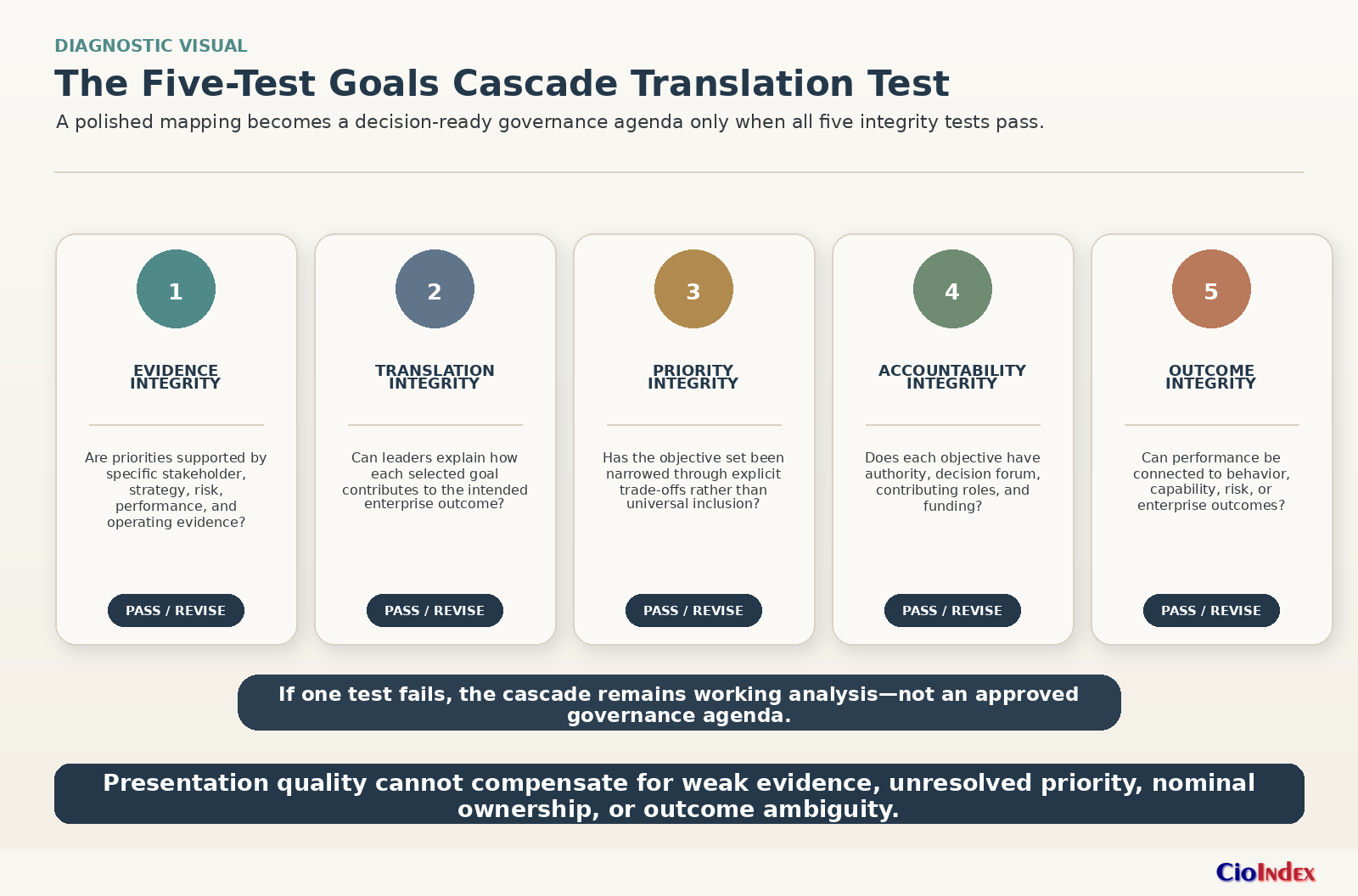
Test 1: Evidence integrity
Are the enterprise priorities supported by specific stakeholder, strategy, risk, performance, and operating evidence? Or are they generic aspirations that anyone could endorse?
Test 2: Translation integrity
Can leaders explain how each selected enterprise goal and alignment goal contributes to the intended outcome? Or does the chain depend only on the existence of a framework mapping?
Test 3: Priority integrity
Has the candidate objective set been narrowed through explicit trade-offs? Or has every relevant objective been retained?
Test 4: Accountability integrity
Does each selected objective have an owner with authority, a decision forum, contributing roles, and funding? Or is ownership a label added after selection?
Test 5: Outcome integrity
Can the enterprise connect objective performance to behavior, capability, risk, or business outcomes? Are review triggers defined?
A cascade is decision-ready only when all five tests pass. A polished mapping that fails even one should remain working analysis, not become an approved governance agenda. Presentation quality cannot compensate for weak evidence, unresolved priority, nominal ownership, or outcome ambiguity.
The Priority-to-Objective Decision Record
A reusable decision record keeps the reasoning from disappearing into a spreadsheet. For each selected objective, capture:
| Field | Purpose |
|---|---|
| Enterprise priority | States the stakeholder or strategic need |
| Enterprise goal | Records the selected COBIT enterprise goal and qualification |
| Alignment interpretation | Explains how I&T contributes |
| Candidate objective | Identifies the governance or management objective |
| Disposition | Keep, combine, defer, or exclude |
| Decision rationale | Makes trade-offs and assumptions visible |
| Enterprise outcome owner | Names accountability for the business result |
| Objective owner | Names accountability for the governance work |
| Measures | Connects activity, capability, behavior, and outcome |
| Dependencies | Identifies sequence and capacity constraints |
| Accepted risk | Records the consequence of deferral or exclusion |
| Review trigger | Defines when the decision must be revisited |
The record need not become bureaucratic. Its value is preserving the logic that is usually lost between strategy workshops, mapping exercises, portfolio decisions, and implementation. When conditions change, leaders can revisit the assumption or trade-off that changed rather than reopening the entire framework from memory.
Relationship Between the Goals Cascade and COBIT Design Factors
The goals cascade and COBIT design factors are related, but they answer different questions and should not be collapsed into one method.
The goals cascade helps establish initial governance scope by translating stakeholder needs and enterprise priorities into candidate governance and management objectives. Other design factors refine the wider governance-system design using additional contextual, strategic, and tactical conditions. Applied COBIT guidance describes the goals cascade, risk assessment, and current I&T-related issues as inputs to initial scope, with other design factors refining the design. (ISACA Journal)
That creates a clean ownership boundary:
- Use the goals cascade to establish why an objective matters and how it connects to enterprise priorities.
- Use COBIT design factors to tailor the broader governance system, including priorities, capability implications, and component variants.
A CIO may use both, but should preserve separate decision records. The goals cascade documents why an objective matters and how it was derived from enterprise priorities. The design-factor process documents how the wider governance system is tailored to context. Combining the records obscures whether a decision came from strategic priority or design condition.
Common Failure Modes
These failures share one pattern: the organization preserves the appearance of alignment while avoiding the commitments that make alignment operational.
Starting with the framework instead of the enterprise
Teams choose familiar goals before examining stakeholder evidence. The cascade then validates the team’s existing agenda rather than translating enterprise priorities.
Treating all selected enterprise goals as equal
Equal labels create unequal consequences. Without primary, supporting, and deferred classifications, downstream mappings expand uncontrollably.
Confusing an alignment goal with IT ownership
Alignment goals describe I&T contribution to enterprise outcomes. They do not transfer complete accountability to the CIO.
Retaining every mapped objective
This converts a prioritization aid into an unbounded governance backlog. Relevance is necessary but not sufficient.
Measuring framework activity rather than enterprise effect
Assessments, policies, controls, and projects may be completed without changing the intended business outcome.
Hiding trade-offs inside scoring
A score can compress evidence, but it cannot replace a decision about risk, capacity, timing, or ownership.
Failing to record exclusions and deferrals
When the rationale is not preserved, excluded objectives return as unresolved demands and deferred work loses its trigger for reconsideration.
Treating the cascade as permanent
Strategy, risk, regulation, sourcing, technology, and stakeholder expectations change. A cascade without review triggers becomes a historical artifact.
Questions CIOs Should Ask Before Approval
Before accepting a goals cascade, ask:
- Which enterprise priorities are truly primary, and what have we chosen not to prioritize?
- What evidence supports each enterprise-goal selection?
- How does each alignment goal describe a material I&T contribution?
- Which mapped objectives were combined, deferred, or excluded—and why?
- Can the remaining portfolio be funded and governed within current capacity?
- Who owns the enterprise outcome, the objective, the contribution, and the challenge function?
- What measure would show that the objective is changing the enterprise condition?
- Which assumptions are most uncertain?
- What event would trigger a review?
- If the answers are weak, the mapping may be complete while the governance decision remains unfinished. The approval question is not ‘Can we trace every objective?’ It is ‘Can we defend every commitment?’
Frequently Asked Questions
It is a strategy-to-governance translation mechanism, not a substitute for enterprise strategy. It helps connect stakeholder needs and enterprise priorities to enterprise goals, alignment goals, and governance and management objectives. Leaders must still decide which priorities matter, what trade-offs are acceptable, and which objectives are fundable.
Does COBIT 2019 still use the goals cascade?
Yes. COBIT 2019 retains the cascade and uses enterprise goals, alignment goals, and governance and management objectives. Current ISACA commentary continues to describe the cascade as connective tissue between enterprise goals, I&T alignment, and governance action. (ISACA 2026 COBIT governance retrospective)
How many enterprise and alignment goals are in COBIT 2019?
COBIT 2019 uses 13 enterprise goals and 13 alignment goals. The count is version-specific, so the article and any internal method should be reviewed if ISACA publishes a new COBIT release or changes the official mappings. (ISACA COBIT 2019 governance-strategy guidance)
Apply the reconciliation filters: material contribution, distinct value, risk and obligation, capacity and sequence, ownership, and measurability. Then place each candidate into one of four dispositions—keep, combine, defer, or exclude—and document the rationale. The goal is not a shorter list by default; it is a governable portfolio.
How is the goals cascade different from COBIT design factors?
The goals cascade translates enterprise priorities into initial governance-objective candidates. Design factors refine the broader governance-system design using additional enterprise conditions. The goals cascade is one important input to that wider tailoring process.
Should every mapped objective be implemented?
No. The mappings establish relationships and candidate relevance. Enterprise leaders still need to prioritize using evidence, risk, capacity, ownership, dependencies, and expected outcomes. A mapped objective is not an approved commitment.
Conclusion: Make the Logic Traceable and the Choice Explicit
The COBIT goals cascade gives CIOs and governance leaders a disciplined way to connect enterprise priorities with information and technology governance. Its value is not that it removes judgment. Its value is that it makes the basis of judgment traceable.
Used mechanically, the cascade can amplify ambiguity and produce a complete-looking portfolio that no one can fund, own, sequence, or measure. Used as a governed translation process, it exposes the evidence, interpretations, trade-offs, dependencies, and assumptions behind each selected objective.
Begin with stakeholder and strategy evidence. Qualify the enterprise goals. Interpret alignment goals as specific I&T contributions. Reconcile the objective candidates. Assign ownership and outcome measures. Define the conditions that will trigger review.
Preserve that reasoning in a Priority-to-Objective Decision Record so later leaders can distinguish a deliberate choice from a forgotten omission.
The final test is not whether every mapping was followed. It is whether executives can explain why each selected objective matters now, what enterprise condition it is expected to change, who owns the result, what was consciously deferred, and what evidence would cause the decision to be revised.
The question to carry into the next governance meeting is therefore simple: Which objectives have earned commitment—not merely relevance—and what evidence would cause us to keep, change, defer, or retire them? That is the difference between a goals cascade that documents alignment and one that actually governs it.