

Executive Summary
IT sourcing strategy helps CIOs decide where technology capabilities should live, how they should be governed, and which internal capabilities must be retained even when delivery is externalized. The core discipline is not outsourcing; it is capability design across cost, risk, speed, control, and business value.
Key Takeaways
- Sourcing decisions should start with business capability, not supplier category.
2. The right model depends on capability, cost, risk, speed, and control trade-offs.
3. Ownership and delivery can be separated, but accountability cannot be outsourced.
4. Vendor selection should follow sourcing logic, not replace it.
5. Sourcing governance must be designed before contracts are signed.
What Is an IT Sourcing Strategy?
IT sourcing strategy is the executive discipline of deciding how technology capabilities should be acquired, delivered, governed, and evolved. It is not simply a question of whether to outsource. It is a set of choices about where capability should live, how much control the enterprise needs, what risks it can accept, and which vendor relationships genuinely improve business performance.
IT sourcing strategy is the executive discipline of deciding which technology capabilities should be owned, partnered, externalized, or consumed as market services, and how those choices should be governed so the enterprise retains capability, control, resilience, and business alignment.
Many organizations still approach sourcing one contract, one renewal, or one cost-reduction exercise at a time. That approach creates a familiar pattern: fragmented vendors, duplicated tools, weak accountability, hidden transition costs, and a delivery model that reflects historical accidents rather than current business needs. The result is often higher complexity disguised as flexibility.
A stronger sourcing strategy starts with a different premise. The goal is not to buy technology cheaply. The goal is to assemble the right portfolio of internal teams, service providers, cloud platforms, strategic partners, commercial products, and specialist capabilities to deliver business outcomes with the right balance of capability, cost, risk, speed, and control.
For CIOs, the core question is not, ‘What should we outsource?’ It is, ‘Which capabilities matter enough to own, which can be sourced externally without weakening the enterprise, and what governance model will keep the whole system aligned over time?’
This guide treats IT sourcing strategy as a capability-portfolio discipline. It gives CIOs a practical decision model, explains how to classify technology capabilities, and shows how to evaluate sourcing patterns, vendors, risk, governance, and review cadence without reducing the conversation to labor arbitrage or procurement mechanics.
The simplest way to understand the discipline is this: IT sourcing strategy is not about who does the work. It is about who owns the capability, who controls the risk, and how the enterprise stays intelligent enough to steer the work over time.
IT Sourcing Strategy vs. Adjacent Sourcing Disciplines
IT sourcing strategy should not be confused with every activity connected to suppliers. IT sourcing, procurement, outsourcing, vendor management, and RFP execution are related disciplines, but they answer different questions. This distinction matters because strategy should set the executive logic; the other disciplines should execute within that logic.
The table below is a boundary-setting map, not a substitute for separate articles on procurement, outsourcing, vendor management, or sourcing models. Its purpose is to keep this article focused on the strategic question: where should IT capability live, and how should it be governed?
| Adjacent discipline | Question it answers | Relationship to IT sourcing strategy |
| IT sourcing | How does the organization obtain IT products, services, labor, or capabilities? | The broader umbrella activity. IT sourcing strategy defines the executive logic behind sourcing choices. |
| IT procurement | How does the organization buy, contract, and commercially manage suppliers? | An execution function. Procurement should support the sourcing strategy, not substitute for it. |
| IT outsourcing | Which IT work should be performed by an external provider? | One possible sourcing pattern. Strategy decides when outsourcing is appropriate and how it should be governed. |
| Vendor management | How should supplier performance, relationships, and obligations be managed after selection? | A governance discipline. Vendor management operationalizes part of the sourcing strategy. |
| RFP and supplier selection | Which provider should be selected for a defined need? | A downstream activity. Supplier selection should follow capability, risk, cost, speed, and control decisions. |
Start With Business Intent, Not Supplier Categories
Every sourcing decision should begin with the business outcome the capability is supposed to support. A customer analytics platform, a service desk, a cybersecurity monitoring function, and a core ERP environment may all involve external providers, but they do not create the same strategic exposure. Their required responsiveness, differentiation value, regulatory burden, and integration depth are different. The sourcing logic should be different as well.
This is where many sourcing strategies drift off course. Leaders classify options by supplier type before they classify the capability by business importance. Once the discussion starts with offshore, managed service, SaaS, systems integrator, or staff augmentation, the organization is already thinking in market categories rather than executive decision logic.
A better sequence is to ask four business-first questions:
- Is this capability strategically differentiating, operationally essential, or largely commodity?
- How much enterprise-specific knowledge is required to perform it well?
- How costly would failure, delay, or poor quality be to the business?
- How quickly does this capability need to evolve as business needs change?
Those questions force the sourcing discussion into the right frame. A capability that is strategically differentiating and heavily dependent on enterprise context usually deserves stronger internal ownership, even when external partners contribute components of the solution. A commodity capability with standardized service expectations can often tolerate more externalization, provided governance remains disciplined.
IT Sourcing Strategy Framework: The Five-Lens Decision Model
A practical IT sourcing strategy needs a repeatable way to compare unlike options. The CIO may be comparing internal delivery, staff augmentation, a managed service provider, a SaaS platform, a systems integrator, or a multi-vendor hybrid model. These options cannot be judged by price alone because they change different parts of the operating model.
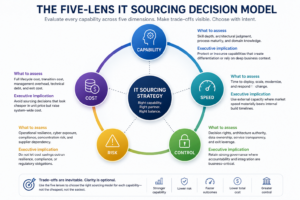
The most useful executive lens is a five-part decision model: capability, cost, risk, speed, and control. These lenses do not always point in the same direction. Their value is that they make the trade-offs visible before the organization hard-codes them into contracts, staffing plans, and service models.
| Lens | What to assess | Executive implication |
| Capability | Skill depth, architectural judgment, process maturity, and domain knowledge needed. | Protect or insource capabilities that create differentiation or rely on deep business context. |
| Cost | Full lifecycle cost, transition cost, management overhead, technical debt, and exit cost. | Avoid sourcing decisions that look cheaper in unit price but raise system-wide cost. |
| Risk | Operational resilience, cyber exposure, compliance, concentration risk, third-party risk, and supplier dependency. | Do not let cost savings outrun resilience, compliance, or regulatory obligations. |
| Speed | Time to deploy, scale, modernize, and respond to change. | Use external capacity where market speed materially beats internal build timelines. |
| Control | Decision rights, architecture authority, data ownership, service transparency, and exit leverage. | Retain strong governance where accountability and integration are business-critical. |
This model changes the quality of executive conversation. Instead of debating sourcing in generic terms, the leadership team can discuss the exact shape of the trade-off. A vendor may offer lower operating cost but weaker transparency. An in-house team may provide better integration judgment but slower access to scarce skills. A cloud-native service may improve speed while increasing dependency on a limited number of providers. Strategy becomes clearer when the trade-off is explicit.
Classify Capabilities Before Choosing Sourcing Models
CIO Decision Rule
Own what differentiates the enterprise. Govern what creates risk. Partner where the market provides depth or speed. Externalize what is standardized and measurable. Retain enough internal intelligence to challenge, integrate, and steer every sourced capability.
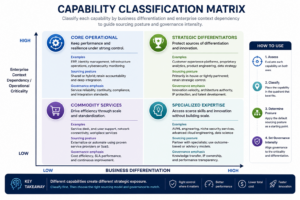
Once business intent is clear, the next decision is capability classification. Not every technology capability deserves the same sourcing pattern. CIOs need a portfolio view that distinguishes what must be owned, what can be partnered, and what can be safely consumed as a market service.
| Capability type | Default sourcing logic | What CIOs should retain |
| Strategic differentiators | Own internally or tightly govern a partner-supported model. External providers may contribute skills, platforms, or capacity, but the enterprise should control priorities, roadmap, and architectural direction. | Architecture authority, product or capability roadmap, business knowledge, data standards, and key decision rights. |
| Core operational capabilities | Use a hybrid or governed service model when standardization and reliability matter more than uniqueness, but do not lose internal accountability. | Service ownership, risk oversight, performance transparency, escalation authority, and continuity planning. |
| Specialized expert capabilities | Partner selectively where the market provides depth, scale, or episodic expertise that would be inefficient to maintain permanently. | Knowledge transfer, standards, internal sponsor ownership, and the ability to challenge vendor assumptions. |
| Commodity services | Standardize, automate, externalize, or consume as a platform where business differentiation is low and market offerings are mature. | Vendor governance, cost visibility, security requirements, service-level accountability, and exit options. |
These categories do not dictate a single answer, but they point toward different sourcing defaults. Strategic differentiators usually require tight internal ownership of architecture, priorities, and operating knowledge. Core operational capabilities often justify hybrid models, where delivery may be shared but governance remains internal. Specialized expert capabilities are good candidates for partner leverage when the market can provide depth more efficiently than a permanent in-house team. Commodity services are the most natural place for standardization, automation, and selective outsourcing.
The important nuance is that ownership and delivery do not have to sit in the same place. A CIO can retain ownership of service design, data standards, security controls, and roadmap decisions while using external providers for execution capacity. That distinction prevents the common mistake of outsourcing accountability along with labor.
The Sourcing Decision Matrix: When to Own, Partner, or Externalize
Capability classification becomes useful when it changes the decision conversation. The matrix below gives the CIO a disciplined starting point for deciding when to own, partner, externalize, or use a hybrid multi-sourcing model. It does not replace judgment; it makes the judgment visible.
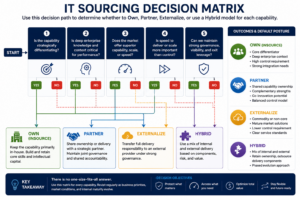
| Decision direction | Best fit | Warning signs | Governance requirement |
| Own or tightly control | The capability is differentiating, context-heavy, data-sensitive, or central to business agility. | The organization is trying to externalize the work because internal capability is weak rather than because the market is a better long-term owner. | Retain architecture, roadmap, prioritization, security, data, and business relationship ownership. |
| Partner strategically | The capability requires scarce expertise, transformation capacity, co-innovation, or scale that the market can provide faster than the enterprise can build. | The partner becomes a substitute for internal strategy rather than an extension of it. | Define joint outcomes, knowledge transfer, decision rights, and executive-level performance reviews. |
| Externalize or consume as a service | The capability is standardized, mature, measurable, and not a source of competitive differentiation. | Service transparency is weak, exit cost is high, or the provider controls critical knowledge the enterprise can no longer inspect. | Maintain service ownership, SLA governance, cost transparency, security obligations, and exit provisions. |
| Use hybrid multi-sourcing | No single model balances resilience, specialization, cost, and control. Different parts of the capability require different treatment. | The organization lacks the internal integration capability to manage multiple providers or platforms. | Strengthen service integration, architecture governance, vendor coordination, and cross-provider accountability. |
Choose the Right Sourcing Pattern for Each Capability
After the ownership direction is clear, the CIO can select the sourcing pattern. The sequence matters. If the organization chooses the pattern first, it usually ends up rationalizing a preferred supplier category instead of designing the right operating model.
- In-house delivery works best where enterprise knowledge, cross-functional integration, and decision speed are critical.
- Staff augmentation is useful when leadership, architecture, and operating model remain internal but execution capacity needs to expand quickly.
- Managed services are appropriate when outcomes can be clearly specified, measured, and governed through service levels and operating controls.
- Strategic partner models work when the organization needs expertise, co-innovation, or transformation capacity that goes beyond transactional delivery.
- SaaS or platform consumption fits standardized capabilities where adopting market process is more valuable than customizing heavily.
- Hybrid multi-sourcing is necessary when no single model adequately balances resilience, specialization, cost, and control.
The choice should reflect the economics and operating logic of the capability, not the organization’s inherited bias. Some companies overvalue internal control and maintain undifferentiated services the market can deliver more efficiently. Others overvalue externalization and discover too late that they have lost architectural coherence, negotiating leverage, or the ability to explain how mission-critical services actually work.
How CIOs Build an IT Sourcing Strategy
An IT sourcing strategy becomes actionable when it translates portfolio logic into a repeatable sequence of executive decisions. The sequence should start with the business capability, not with a vendor shortlist, and it should end with governance, not with contract signature.
- Define the capability in business terms and identify the outcome it must support.
- Classify the capability as differentiating, core operational, specialized, or commodity.
- Assess it through the five lenses of capability, cost, risk, speed, and control.
- Decide which ownership responsibilities must remain internal regardless of delivery model.
- Compare sourcing patterns based on total economic value and governance fit, not just price.
- Evaluate vendors against the target operating model rather than a generic RFP checklist.
- Design governance, reporting, transition, and exit provisions before the relationship begins.
- Review the portfolio periodically as business needs and market options evolve.
This sequence keeps sourcing in the executive domain. Procurement, legal, security, finance, and vendor management all have critical roles, but they should support the sourcing strategy rather than define it by default.
Separate Contract Price From Total Economic Value
A sourcing strategy that focuses only on contract price will often create false savings. CIOs need a fuller economic view that includes transition effort, retained management overhead, integration rework, quality variance, security obligations, change-request economics, and exit complexity. The cheapest proposal on paper can become the most expensive operating choice once those factors are visible.
This is especially true in multi-vendor environments. Each additional provider may improve competition or access to specialist skills, but it can also raise coordination cost. Someone has to integrate roadmaps, resolve incidents across boundaries, arbitrate responsibilities, track architecture drift, and maintain service visibility. If those costs stay hidden, the sourcing model will look more efficient than it really is.
A disciplined CIO asks three cost questions before approving a sourcing shift:
- What is the full lifecycle cost, not just the bid cost?
- What internal capability must be retained to make the external model work?
- What is the financial impact if the vendor underperforms or if we need to switch providers?
This broader view also improves board-level communication. It reframes sourcing from ‘How much did we save?’ to ‘What economic position did we create, and at what strategic cost or benefit?’
Treat Risk as a Design Variable, Not a Procurement Checkpoint
Risk is often reviewed late in the sourcing process, after the preferred commercial direction is already obvious. At that point, risk teams are asked to approve or mitigate a model they did not help design. A stronger sourcing strategy brings risk into the decision at the same time as capability and cost.
For CIOs, the most relevant sourcing risks usually fall into five groups:
- Concentration risk: too much dependence on one provider, one hyperscaler, or one specialist partner.
- Knowledge risk: too little internal understanding of the processes, data flows, and architecture that matter most.
- Operational risk: weak service continuity, poor incident coordination, or unclear accountability across towers and vendors.
- Compliance and security risk: misaligned controls, shared-responsibility confusion, and cross-border or sector-specific obligations.
- Commercial risk: rigid contracts, poor exit provisions, adverse pricing mechanics, and limited leverage at renewal.
The right answer is not always to eliminate these risks. Some are worth taking if they materially improve speed or access to scarce capability. The strategic task is to choose them consciously and put the right controls around them. That may mean dual-vendor arrangements for critical services, stronger enterprise architecture controls, retained security oversight, or explicit exit playbooks before the contract is signed.
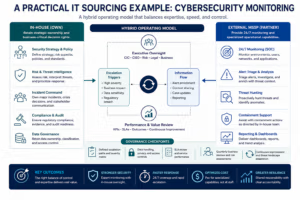
A Practical IT Sourcing Strategy Example: Cybersecurity Monitoring
Consider a CIO evaluating cybersecurity monitoring. A narrow sourcing conversation might ask whether a managed security service provider is cheaper than maintaining an internal security operations center. That is a useful financial question, but it is not enough to shape strategy.
The better question is which parts of the capability require internal judgment. Threat prioritization, incident escalation, regulatory accountability, business continuity coordination, and security architecture authority may need to remain close to the enterprise even if monitoring, alert triage, tooling, and specialist analysis are supported by an external provider.
Through the five-lens model, the trade-off becomes visible. The provider may improve speed and specialist depth. It may reduce the cost of maintaining 24/7 coverage. But it may also increase dependency, create knowledge risk, and weaken control if escalation rules, data access, and accountability are not designed carefully.
The sourcing strategy might therefore choose a hybrid model: externalize parts of monitoring and triage, retain internal ownership of security policy, incident command, enterprise risk interpretation, and architecture standards, and govern the relationship through clear escalation paths and executive review. The result is not simply outsourced security. It is a deliberately designed security capability.
Retain Internal Capabilities That Keep the Enterprise Intelligent
Even aggressive sourcing strategies require a capable internal core. The question is not whether to keep internal capability, but which capability must remain inside for the enterprise to stay governable and adaptive. In most organizations, at least five internal capabilities deserve protection:
- Architecture and integration authority
- Vendor and service governance
- Cybersecurity oversight and policy control
- Business relationship management and demand shaping
- Financial and performance transparency across the portfolio
Without these capabilities, the CIO may still have suppliers, contracts, and service reports, but not real control. The organization becomes externally enabled yet internally blind. It can consume services, but it struggles to steer them.
This is why sourcing strategy should be linked directly to workforce strategy. Each externalization decision should be paired with a retained-capability decision. If the enterprise moves a capability outward, what judgment, governance, and architectural knowledge must stay inward for the model to remain viable?
Make Vendor Decisions Through an Executive Scorecard
Vendor selection should be an extension of sourcing strategy, not a separate procurement event. The best vendor is not simply the lowest bidder or the most technically sophisticated provider. It is the provider whose delivery model, cultural fit, commercial structure, and operating discipline support the capability strategy the CIO is trying to build.
An executive scorecard helps prevent the selection process from being dominated by feature lists or price concessions alone. The scorecard should weigh questions such as:
- Does the provider understand the business outcome, not just the service tower?
- Can the provider operate cleanly inside the governance model the enterprise needs?
- Will the provider improve capability maturity, or only provide labor capacity?
- How transparent is the pricing, service reporting, and change-control model?
- What dependencies, lock-in points, or concentration risks does the relationship create?
- How credible is the provider’s transition plan, talent model, and executive sponsorship?
This approach is especially important when comparing unlike options, such as a managed service provider versus a SaaS platform plus a systems integrator. Those options cannot be evaluated on a simple apples-to-apples cost basis. They need a decision model that includes governance fit, operating complexity, resilience, and long-term flexibility.
CIO IT Sourcing Strategy Scorecard
The following scorecard turns the strategy into a practical executive review tool. CIOs can use it before a major sourcing decision, during portfolio review, or when preparing a board-level explanation of the sourcing model.
| Dimension | CIO question | Red flag |
| Capability | Does this capability create differentiation or require deep business context? | The provider becomes the de facto strategy owner. |
| Cost | Have transition, retained management, integration, change, and exit costs been included? | Bid price is treated as total cost. |
| Risk | What operational, cyber, compliance, concentration, and knowledge risks are created? | Risk review happens after the sourcing model is already chosen. |
| Speed | Does external sourcing materially improve time-to-capability or responsiveness? | Speed gains are offset by coordination delays or weak accountability. |
| Control | Which decision rights, data controls, architecture standards, and roadmap choices must remain internal? | Architecture, data, or roadmap control moves outside without explicit approval. |
| Governance | Who owns business outcomes after the contract is signed? | There is no named internal owner with decision authority. |
| Exit leverage | Can the organization transition away without unacceptable disruption, cost, or knowledge loss? | The provider controls critical knowledge, tooling, or data flows the enterprise cannot inspect or recover. |
Design IT Sourcing Governance Before You Sign the Contract
Governance is where the sourcing strategy becomes real. Many sourcing problems are governance problems in disguise. The provider may be competent, but the operating model around the provider is weak. Escalation paths are vague. Service integration is underpowered. Architecture decisions happen in parallel rather than in sequence. Business stakeholders buy around the model. Finance sees contract costs but not end-to-end service economics.
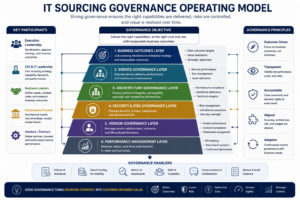
That is why governance should not be treated as post-award administration. It is part of strategy design. Before the deal is finalized, the CIO should be clear on decision rights, service ownership, architecture approval, reporting cadence, change authority, risk review, and performance management.
At minimum, each major sourced capability should have:
- A named internal owner accountable for business outcomes
- Clear service, architecture, security, and commercial governance forums
- Defined escalation paths across the enterprise and the supplier
- Measures for outcomes, not just activity volume or ticket closure
- A documented exit or transition approach for material dependencies
Good governance does more than control vendors. It creates managerial clarity inside the enterprise. It tells internal teams how to work with external providers without surrendering accountability or creating parallel authority structures.
IT Sourcing Metrics and Portfolio Review Cadence
A sourcing strategy is not a one-time program. It is a portfolio that needs periodic review as business priorities, cost structures, risk conditions, and vendor markets change. A model that made sense during a transformation program may no longer make sense once the environment stabilizes. A provider that was strategically valuable for scale-up may become constraining during optimization. A capability that used to be commodity may become differentiating when data, automation, or regulation changes its role.
CIOs should review the sourcing portfolio on a regular cadence, not only at renewal time. That review should combine financial, operational, risk, and capability measures. Useful questions include:
- Which capabilities have become more strategic or more commoditized since the last review?
- Where has cost transparency improved, and where is it still obscured by multi-vendor complexity?
- Which vendor relationships are strengthening capability, and which are simply preserving legacy effort?
- Where is concentration risk rising beyond comfort?
- Which retained internal capabilities need reinforcement to govern the portfolio effectively?
- Which sourcing choices are helping the business move faster, and which are slowing change?
This turns sourcing into a living management discipline. Instead of inheriting yesterday’s vendor footprint, the CIO actively reshapes the portfolio as the enterprise changes.
Frequently Asked Questions About IT Sourcing Strategy
What is the purpose of an IT sourcing strategy?
The purpose of an IT sourcing strategy is to decide where technology capabilities should live and how they should be governed. It helps CIOs determine what to own, what to source externally, what to partner for, and what controls must remain internal.
How is IT sourcing strategy different from IT outsourcing?
IT outsourcing is one possible delivery choice. IT sourcing strategy is broader because it decides whether outsourcing, insourcing, managed services, SaaS, staff augmentation, strategic partnerships, or hybrid multi-sourcing best fits the capability.
How is IT sourcing strategy different from IT procurement?
IT procurement focuses on buying and contracting. IT sourcing strategy defines the executive logic behind what should be bought, owned, partnered, governed, or retained internally.
What should CIOs keep internal when using external providers?
CIOs should usually retain architecture authority, security oversight, service ownership, business relationship management, financial transparency, vendor governance, and decision rights for strategically important capabilities.
When should a capability be externally sourced?
A capability is a stronger candidate for external sourcing when it is standardized, mature, measurable, not strategically differentiating, and available from a market provider with better scale, expertise, speed, or economics.
What are the biggest risks in IT sourcing strategy?
The biggest risks are supplier concentration, loss of internal knowledge, weak service integration, unclear accountability, security and compliance exposure, vendor lock-in, poor exit provisions, and hidden management cost.
How often should CIOs review the sourcing portfolio?
CIOs should review the sourcing portfolio on a regular cadence, not only at renewal time. The review should test whether capabilities have become more strategic, more commoditized, more risky, more costly, or harder to govern.
Yes. Here is the revised version using the updated skill logic.
CIO Index Expert Perspective: The Retained Intelligence Test for IT Sourcing Strategy
The Decision Logic Beneath the Strategy
The strongest IT sourcing strategies do not simply decide what should be outsourced, insourced, partnered, or consumed as a service. They decide what the enterprise must remain intelligent enough to govern after delivery changes. That is the discipline running through this article: sourcing is not just a market decision; it is a capability, risk, cost, speed, and control decision that changes how the enterprise operates over time.
That matters more now because third-party dependence, supply-chain exposure, vendor transparency, and governance accountability have become central executive concerns. NIST’s Cybersecurity Framework 2.0, for example, added “Govern” as a core function and expanded attention to cybersecurity supply-chain risk management, reinforcing that external dependency must be governed as part of enterprise risk, not treated as a downstream vendor-management issue. (Wikipedia)
The Real Decision
The real decision is not “What should we outsource?” The real decision is “What must we continue to understand, own, and control even when someone else performs the work?”
That includes architecture authority, security oversight, service ownership, financial transparency, business relationship management, performance interpretation, and exit leverage. Once those capabilities weaken, the enterprise may still have suppliers and contracts, but it loses the internal intelligence required to challenge vendor assumptions, manage risk, redesign services, or explain how critical capabilities actually work.
CIO Guidance
Use the sourcing strategy as a retained-intelligence test before approving major sourcing decisions.
| Strategic Question | What It Reveals | Weak Signal | Stronger CIO Move |
|---|---|---|---|
| What capability are we really sourcing? | Whether the decision concerns labor, service delivery, platform capability, expertise, or business-critical judgment. | The conversation starts with supplier categories instead of capability importance. | Define the capability in business terms before comparing providers or models. |
| What must remain internally owned? | Whether the enterprise can still steer the capability after delivery changes. | Architecture, risk, roadmap, data, or escalation authority move outside by default. | Name retained decision rights before the sourcing model is finalized. |
| What new dependency are we creating? | Whether the sourcing choice improves capability or creates hidden fragility. | The business case highlights savings but underplays knowledge loss, lock-in, or concentration risk. | Evaluate lifecycle cost, reversibility, supplier concentration, and operational resilience together. |
| How will we govern after contract signature? | Whether the model is manageable in practice. | Governance is reduced to SLA tracking or vendor reporting. | Define service ownership, escalation, performance transparency, risk review, and exit provisions before signing. |
This is where experienced CIOs separate sourcing strategy from sourcing activity. A provider can deliver a service; it cannot replace enterprise accountability. Before any major sourcing shift, the CIO should be able to say exactly what capability is moving outward, what judgment remains inward, and how the organization will know whether the model is still working.
Strategic Implication
The long-term test of IT sourcing strategy is not whether it reduces cost or expands capacity in the short term. It is whether the enterprise becomes more capable without becoming less governable.
That is why the article’s capability-portfolio view is the right executive frame. The strongest sourcing strategies allow the enterprise to use vendors, platforms, partners, and managed services without losing the knowledge required to steer them. They preserve enough internal intelligence to make future decisions, not just manage today’s contract.
IT sourcing strategy is the discipline of deciding not only where technology work should be performed, but what intelligence, ownership, and governance the enterprise must retain to remain in control of the capabilities it depends on.
Conclusion: The Test of a Strong IT Sourcing Strategy
CIO Index Perspective: The most important sourcing decision is rarely the contract decision. It is the retained-intelligence decision: what must the enterprise continue to understand, own, and govern so it can steer capabilities delivered through a mixed internal and external ecosystem?
An effective IT sourcing strategy gives the CIO a disciplined way to answer one of the most consequential questions in technology leadership: where should capability live, and under what terms should it be governed? The answer is rarely all-internal or all-external. It is almost always a deliberate mix.
The value of strategy lies in making that mix intentional. When sourcing decisions are grounded in capability logic, total economic value, risk design, and governance clarity, the enterprise gets more than vendor efficiency. It gets a technology operating model that is easier to scale, easier to control, and better aligned to business priorities.
That is the real test of IT sourcing strategy. Not whether the organization signed a cheaper contract, reduced headcount, or selected a more impressive supplier. The test is whether the CIO built a stronger capability system: one that knows what to own, what to partner for, what to externalize, and how to govern the whole portfolio as business needs change.
The strategic question is not whether IT should sit inside or outside the enterprise. The question is whether the enterprise remains intelligent enough to steer what it no longer directly performs.