

Digital strategy chooses where digital capabilities will change enterprise value. IT strategy commits the information and technology capabilities needed to enable, protect, operate, and sustain those choices. The CIO’s real task is not to collapse the two strategies into one vocabulary. It is to make the boundary between them capable of carrying real decisions.
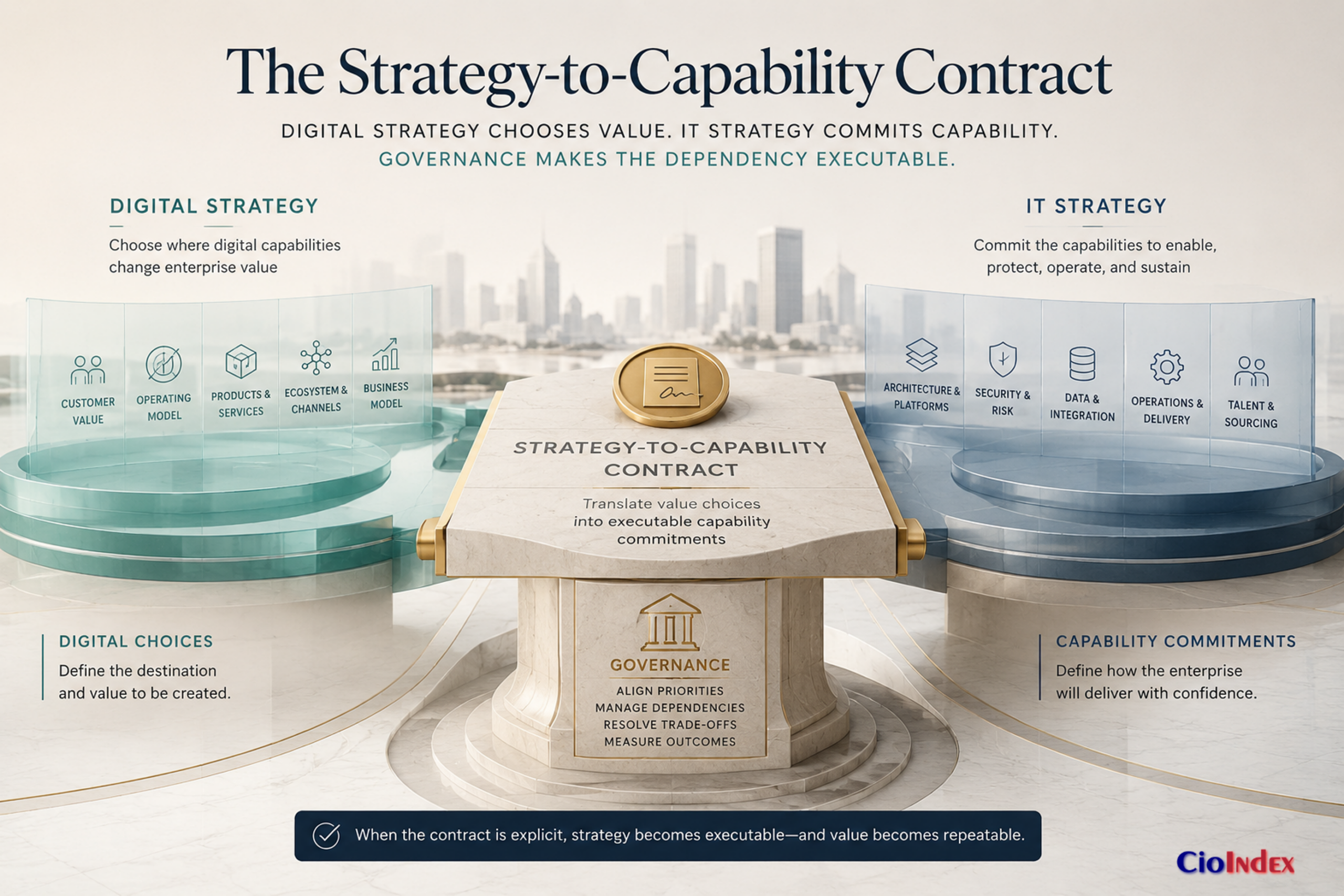
That boundary is often drawn incorrectly. Digital strategy is described as external and market-facing; IT strategy as internal and operational. But an internal automation initiative can be a digital strategy choice when it changes enterprise economics or the operating model. A customer-facing platform decision can be an IT strategy commitment when the real question concerns reuse, reliability, security, integration, or lifecycle risk.
The more reliable distinction is the strategic object: what set of choices is being made, what commitments follow, and who is accountable for the dependencies between them. Digital strategy decides how digital capabilities will change value. IT strategy decides what durable capabilities and operating commitments must exist for the enterprise to deliver that value credibly.
The distinction matters because neither strategy can succeed independently. Digital ambitions create requirements for data, architecture, platforms, security, talent, sourcing, integration, service management, and investment capacity. IT choices, in turn, expand or constrain what the enterprise can promise to customers, employees, partners, and business units. When that interface remains informal, organizations create attractive digital bets that cannot scale, technology roadmaps that do not advance enterprise value, and portfolios full of hidden dependencies.
| “Digital strategy chooses the value change. IT strategy commits the capabilities. Governance makes the dependency executable.” |
The governing question for CIOs is therefore simple: can the boundary between the strategies carry real decisions? The comparison, Strategy-to-Capability Contract, failure patterns, operating cases, configuration choices, and diagnostic that follow are designed to answer that question.
Digital Strategy vs IT strategy: The Difference in One View
| Dimension | Digital strategy | IT strategy |
|---|---|---|
| Strategic object | How digital capabilities change enterprise value | How information and technology capabilities enable, protect, and sustain enterprise objectives |
| Core question | Where will digital change the customer proposition, operating model, products, channels, ecosystem, or business model? | What technology, data, architecture, security, operating, sourcing, and workforce capabilities are required, and how will they be governed? |
| Typical outputs | Digital value propositions, business-model choices, experience priorities, platform plays, and digitally enabled operating-model changes | Target architecture, capability roadmaps, investment priorities, operating model, sourcing direction, security posture, and service or platform commitments |
| Primary decision horizon | Market, customer, product, operating-model, and enterprise-value choices | Capability, resilience, architecture, delivery, risk, economics, and technology-lifecycle choices |
| Ownership | Context-dependent; often shared among business, digital, product, strategy, and technology leaders | Usually CIO-led, but shaped jointly with business, risk, finance, security, data, and product leaders |
| Success measures | Adoption, revenue, experience, cycle time, ecosystem leverage, operating performance, and strategic optionality | Capability readiness, reliability, security, cost, speed, technical health, delivery performance, and enablement of business outcomes |
| Primary failure risk | Attractive digital bets without executable capability commitments | Coherent technology plans that optimize IT but do not materially advance enterprise value |
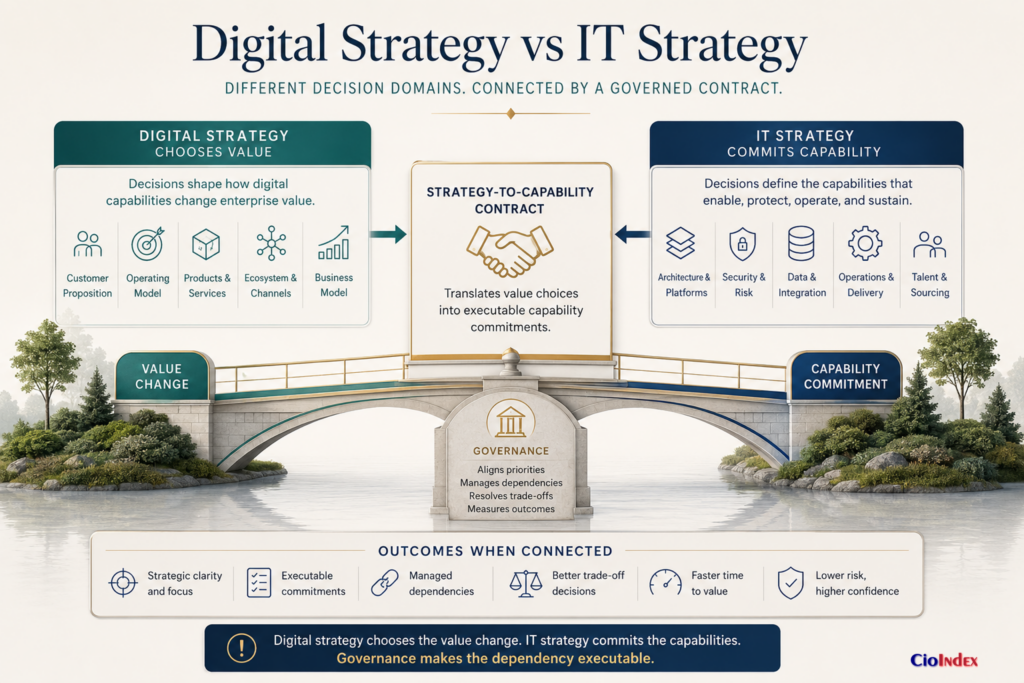
MIT CISR has described digital strategy as business strategy inspired by the capabilities of accessible digital technologies.1 Gartner’s public guidance on IT strategic planning describes IT strategy in terms of how IT will help the business meet its objectives.[[FN2]] Those formulations establish a useful boundary: digital strategy is not a collection of technology projects, and IT strategy is not a plan to keep infrastructure running.
The two strategies overlap because both concern enterprise change. They differ because they organize that change around different decision domains. Digital strategy begins with value and competitive choices. IT strategy begins with the information and technology capabilities needed to enable, protect, and sustain enterprise choices. The CIO’s responsibility is to make decisions in one domain create explicit commitments in the other.
The Real Distinction is the Strategic Object—Not the Department
Organizations often try to define the strategies by drawing an organizational chart around them. Digital strategy belongs to a chief digital officer, product organization, business unit, or corporate strategy function; IT strategy belongs to the CIO. That may be a practical allocation of work, but it is not a reliable definition.
Ownership varies with enterprise history, operating model, digital maturity, regulatory context, and business model. A digitally native company may not need a separate digital strategy because digital choices are embedded in business strategy. A diversified enterprise may require several market-specific digital strategies but one common technology-platform strategy. A regulated institution may centralize architecture and cybersecurity decisions while distributing product strategy. A smaller organization may place both domains under one CIO without producing separate documents.
The better test is not who owns the document. It is what the strategy is deciding. A strategy is operating as digital strategy when it decides where and how digital capabilities will change value. It is operating as IT strategy when it decides what enterprise technology and information capabilities must exist, at what levels of performance, risk, scale, and cost.
This distinction prevents two common errors. The first is treating anything customer-facing as digital and anything operational as IT. The second is assuming that one executive owner eliminates the need for a boundary. Even when the CIO owns both strategies, value choices and capability commitments remain different kinds of decisions. They use different evidence, involve different stakeholders, and fail in different ways.
What each strategy must commit to the interface
The point of distinguishing the strategies is not to create two isolated planning exercises. It is to clarify what each side must contribute before the enterprise can make a credible commitment.
What Digital Strategy Must Commit
Digital strategy should make a small number of consequential enterprise choices. It should not become a catalogue of technologies or a renamed project portfolio. To support execution, it must commit four things to the interface with IT strategy.
1. The value change
Digital strategy must state where digital capabilities will materially change value. That may mean reducing friction in a customer journey, creating a data-enabled service, moving from product sales to recurring outcomes, redesigning an end-to-end process, opening a platform to partners, or enabling a more adaptive operating model. The test is not whether technology is involved. The test is whether the digital capability changes how value is created, delivered, captured, or scaled.
2. The strategic bet
The strategy must identify which opportunities deserve concentrated attention and capacity. Enterprises often label dozens of initiatives strategic because each has a plausible business case. That is prioritization failure, not strategy. A credible digital bet identifies the target value pool or operating outcome, the customer or stakeholder affected, the differentiating capability, the assumptions that must prove true, the time horizon for evidence, and the conditions for expanding, revising, or stopping the bet.
3. The operating-model implication
A digital proposition rarely succeeds through technology deployment alone. It may require new product ownership, cross-functional teams, redesigned decision rights, different funding, new data stewardship, partner integration, revised controls, or changes to frontline work. MIT CISR’s research on digital organizations emphasizes the broader organizational design required to execute digital strategy.3
This is where many digital strategies become aspirational. They describe the desired experience or business result without specifying how the enterprise must operate differently. The plan then reaches the CIO as a request for a platform, application, or data product even though the unresolved constraint is governance, process ownership, incentives, or organizational capacity.
4. The outcome logic
Digital strategy must define success in business and operating terms. Adoption alone is rarely enough. A new channel can shift transactions without improving economics. Personalization can increase engagement while adding complexity and control risk. Automation can reduce activity time in one function while moving exceptions downstream. Leading indicators such as usage, adoption, cycle time, model performance, or digital engagement must therefore connect to the economic, customer, risk, and operating outcomes the enterprise actually values.
What IT Strategy Must Commit
IT strategy converts enterprise direction into durable capability commitments. It is neither the implementation appendix to digital strategy nor an inward-looking technical plan. It must commit four corresponding elements to the interface.
1. The capability portfolio
IT strategy should identify the information and technology capabilities the enterprise must be able to rely on. Depending on context, these may include digital identity, data products, integration, cloud platforms, product engineering, cybersecurity, observability, automation, AI enablement, enterprise applications, workplace services, or resilience. The purpose is not to list systems. It is to state what the enterprise must be able to do repeatedly at the required levels of performance, security, scale, and cost.
2. Architecture and platform choices
Digital bets create pressure for speed and local optimization. IT strategy must decide where the enterprise will standardize, where it will permit variation, and how it will prevent short-term delivery from destroying long-term adaptability. These choices include shared platforms versus business-unit solutions; build, buy, partner, or consume as a service; data ownership and interoperability; integration and API patterns; identity architecture; cloud direction; product and service boundaries; technical-debt thresholds; and lifecycle or exit commitments. They are strategic because they shape future option value, not merely current implementation cost.
3. The technology operating model
IT strategy must define how technology work will be governed and delivered. A platform-based digital strategy cannot be sustained by project-only funding. A product-led enterprise cannot operate effectively if teams have no persistent ownership of products and platforms. A federated digital model cannot work if local autonomy is unsupported by common architectural guardrails and shared services. The operating model must address portfolio governance, product and platform ownership, engineering practices, service accountability, security integration, data governance, vendor management, and the relationship between centralized and distributed technology teams.
4. Risk, resilience, and economics
Digital strategy naturally emphasizes opportunity. IT strategy must make the constraints visible without becoming the department of “no.” It should set the risk posture for cybersecurity, privacy, resilience, third-party dependency, model risk, technology concentration, and regulatory compliance. It should also make the economics of the technology estate explicit: where cost is structural, where simplification is required, and how investment will be balanced among growth, innovation, modernization, resilience, and technical health. A credible IT strategy protects strategic ambition from avoidable fragility and identifies which capabilities must be strengthened before a digital bet can scale safely.
The Strategy-to-Capability Contract
Once the two decision domains are clear, the central problem changes. The enterprise no longer needs another alignment meeting. It needs a governed interface that turns value choices into executable capability commitments. The Strategy-to-Capability Contract is that interface.
This is not a legal contract. It is a governance mechanism that makes the obligations between digital strategy and IT strategy explicit. It answers five questions:
- What value choice has been made? The business or digital strategy must state the intended change in customer, operating, ecosystem, or economic value.
- What capabilities must exist? The enterprise must identify the business, data, technology, security, process, and workforce capabilities required.
- Who owns each commitment? Decision rights must distinguish accountable owners, contributors, approvers, and escalation paths.
- How will dependencies be funded and sequenced? Shared platforms, data foundations, controls, and operating-model changes must appear in the portfolio rather than being assumed to emerge.
- What evidence will govern continuation? Business outcomes and capability health must be reviewed together.
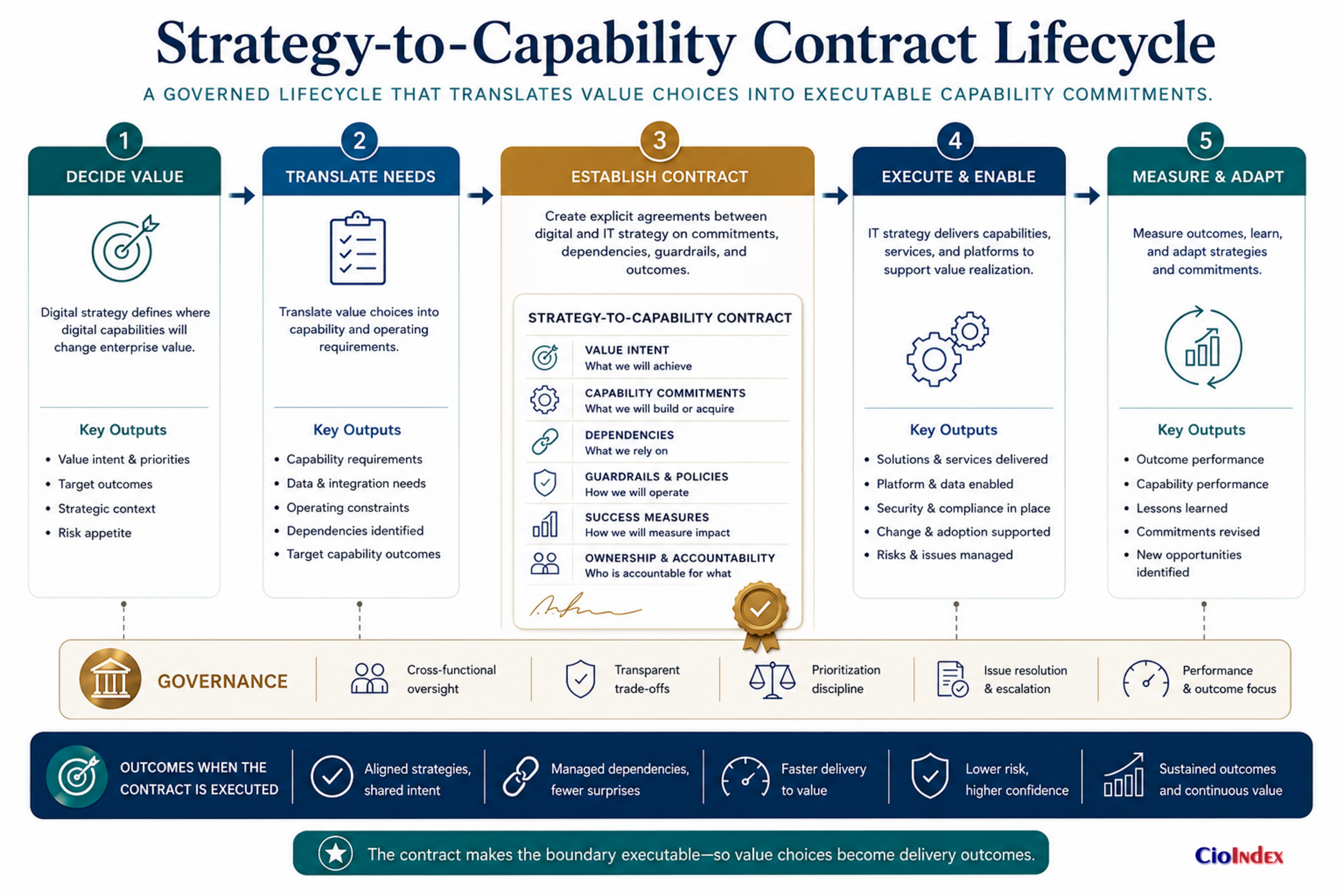
The contract creates a two-way chain of traceability: enterprise choice → digital value proposition → required capabilities → architecture and operating commitments → portfolio investments → measurable outcomes and learning.
Without that chain, digital strategy throws requirements over the wall. IT strategy responds with a roadmap based on available capacity, existing standards, and known risk. The resulting negotiation is called alignment, but it is usually late-stage reconciliation between plans developed separately.
Continuous cocreation is a stronger pattern. McKinsey’s 2026 technology agenda reports an association between higher-performing CIOs and collaboration with CEOs in shaping business strategy.4 That evidence does not prove that collaboration alone causes performance. It does reinforce the practical requirement that technology leaders participate while strategic choices are being formed, not only after priorities have been announced.
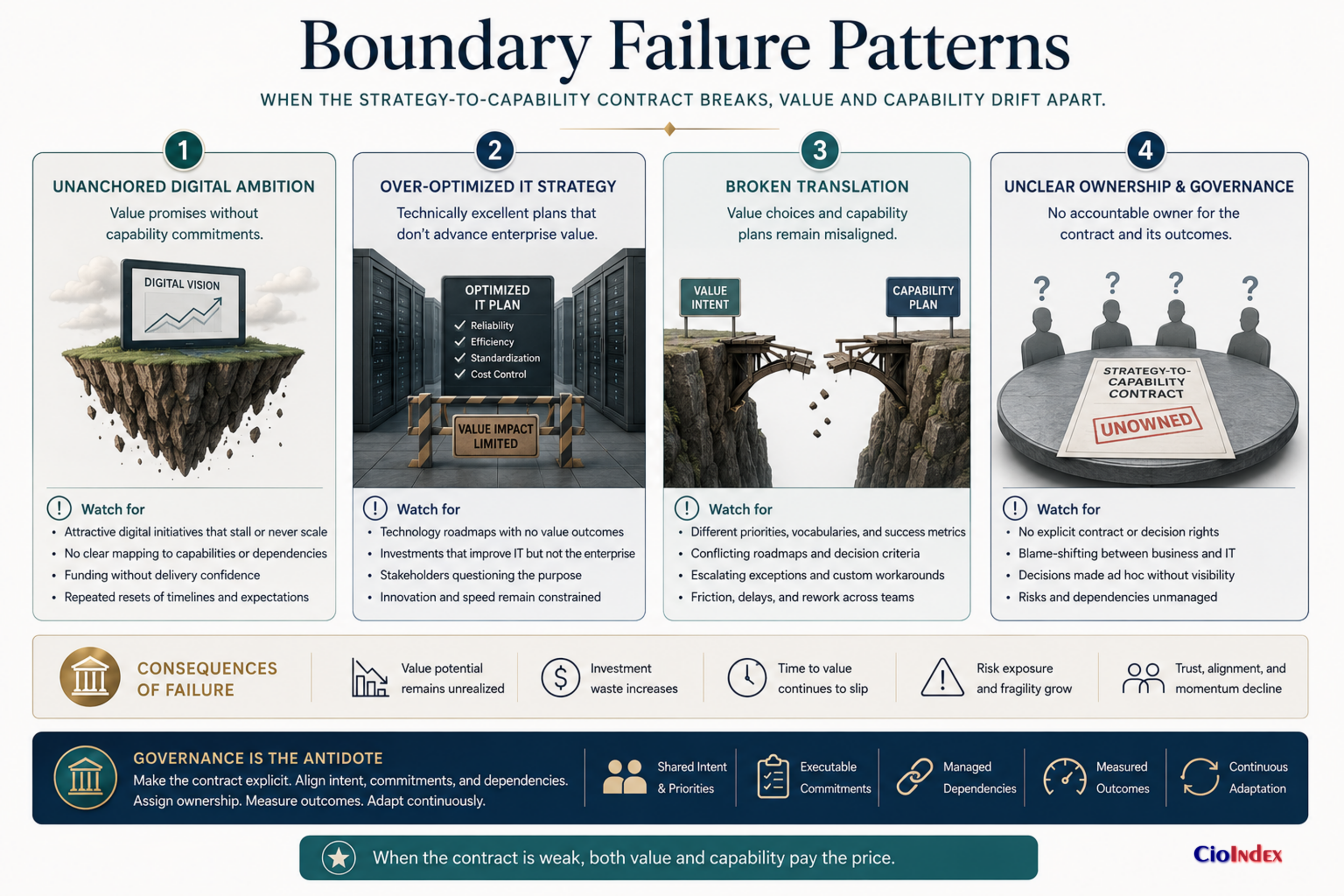
Four Ways the Boundary Fails
The need for a contract becomes clearest when the interface fails. Gartner has warned that multiple IT strategies can create overlaps or gaps in scope.5 The same structural risk appears when digital and IT strategies coexist without explicit decision rights, funding logic, and evidence.
1. Duplicate strategy
Both strategies claim the same decision. The digital strategy specifies cloud, data, platforms, AI, and architecture; the IT strategy specifies the same elements from a technology perspective. Teams then produce parallel roadmaps, competing standards, and duplicate governance forums. The defect is not repeated language. It is unresolved authority. Two groups can discuss the same capability productively if one owns the value requirement and the other owns the enterprise capability commitment. Duplication occurs when both believe they own the final decision.
2. The missing middle
The digital strategy defines customer or operating ambitions, and the IT strategy defines target technologies, but no one owns the transition between them. Process redesign, data stewardship, product management, adoption, policy changes, controls, and workforce capability fall into the gap. Both strategies can appear complete until execution exposes work that neither side recognized as its commitment.
3. The unfunded dependency
A business unit funds the visible digital initiative while shared capabilities are expected to come from the IT budget. The business case captures local benefits but omits enterprise platform, integration, resilience, security, data, and support costs. IT must then absorb the dependency, delay the initiative, or permit a local solution that increases fragmentation. The remedy is not merely chargeback. The portfolio must show who benefits, who pays, and what must be sequenced.
4. Metric conflict
The digital strategy measures adoption, experience, growth, or cycle time. IT strategy measures reliability, security, cost, technical health, and delivery. Each scorecard can improve while the enterprise outcome deteriorates. A digital product can grow while creating an unsustainable service burden. A platform can meet reliability targets while failing to provide the flexibility the business model requires. The interface therefore needs integrated evidence that shows both value realization and capability health.
These patterns explain why more alignment meetings are rarely enough. Meetings cannot compensate for ambiguous authority, hidden dependencies, incompatible funding logic, or scorecards that reward different realities.
How to Govern the Commitments
The Strategy-to-Capability Contract becomes actionable through two supporting mechanisms: enterprise architecture translates and aggregates the implications, and decision rights assign accountability for acting on them.
Enterprise architecture as a translation mechanism
Enterprise architecture can translate value choices into capability, information, application, platform, and technology implications. This is a CIO Index operating-model interpretation rather than a universal claim about how every architecture function should be organized. Architecture does not own the value choice and should not become a third strategy competing with digital and IT strategy. Its role is to reveal relationships that neither strategy can see clearly in isolation.
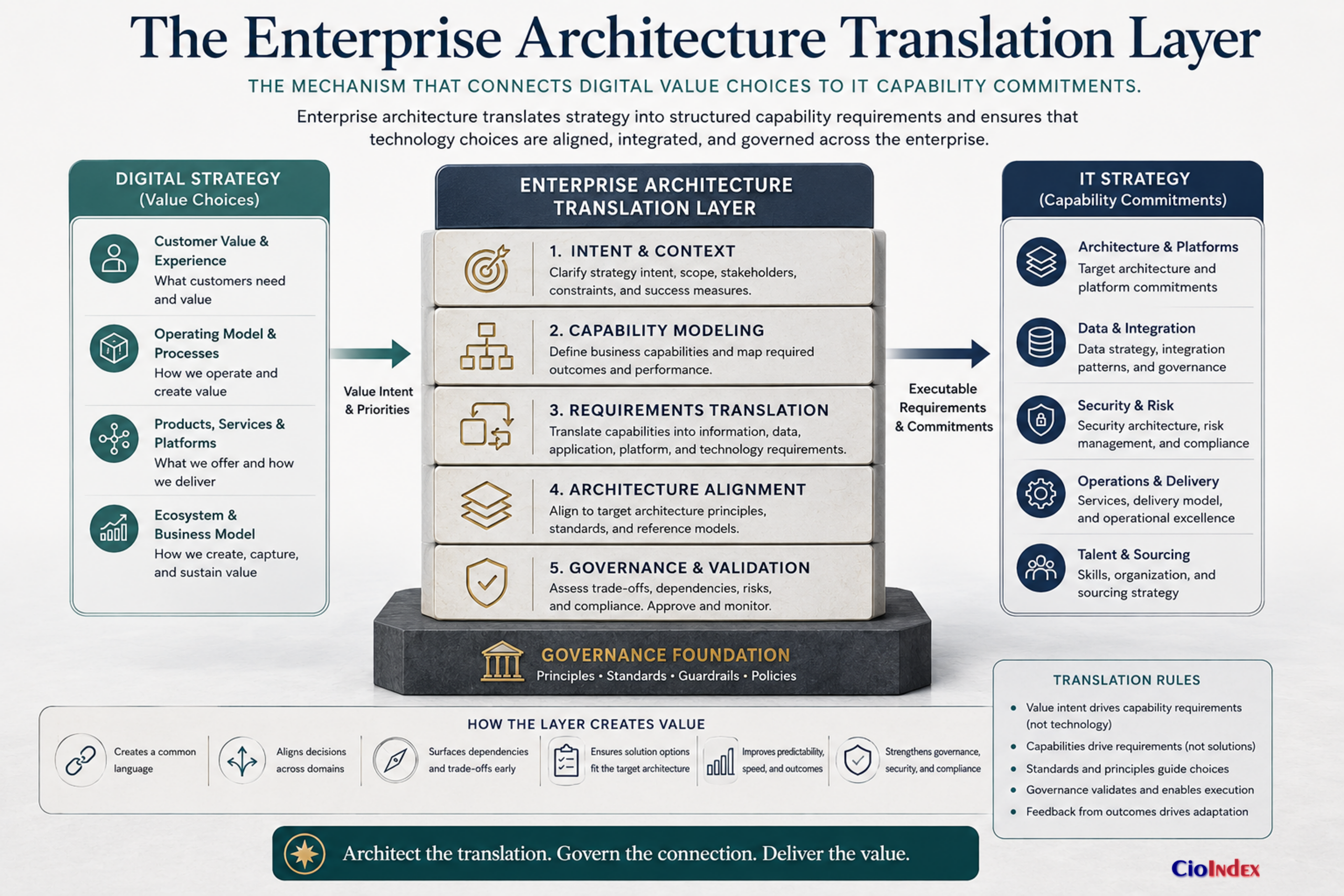
For example, three business units may each propose an AI-enabled customer-service initiative. Viewed separately, each appears to need a model, data access, workflow integration, and channel changes. Architecture analysis may reveal shared dependencies on identity, knowledge, data quality, model governance, monitoring, and integration. Those common commitments belong in the IT strategy and enterprise portfolio; the differentiated customer propositions remain digital strategy choices.
Decision rights for the interface
| Decision | Accountable owner | Required partners | Required output | Escalation trigger |
|---|---|---|---|---|
| Select digital value bet | Business or enterprise strategy owner | CIO, product, finance, risk, operations | Prioritized bet with outcome hypothesis | No credible value owner or conflicting priorities |
| Define required capabilities | Joint business-technology owner | Architecture, data, security, operations, HR | Capability map and readiness gaps | Critical dependency has no owner or funding path |
| Set architecture and platform direction | CIO or delegated technology authority | Product, data, security, business technology leaders | Target-state choices and guardrails | Local speed conflicts with enterprise risk or reuse |
| Fund shared dependencies | Enterprise portfolio authority | CFO, CIO, business sponsors | Sequenced investment commitment | Benefit sits in one unit but cost sits in another |
| Govern outcome evidence | Digital or business outcome owner | CIO, finance, data, risk | Integrated outcome and capability scorecard | Adoption rises while economics, risk, or service health deteriorates |
Titles can vary. Decision rights cannot remain implicit.
Two Operating Cases That Expose The Trade-offs
The boundary becomes clearer when applied to operating choices. The following cases are illustrative composites, not claims about named organizations. Each demonstrates a different failure risk and a different reason for separating value choices from capability commitments.
Case 1: Retail platform expansion—experiment without hiding the cost of scale
A retailer wants to expand from transactional e-commerce into a platform connecting customers with third-party service providers. Digital strategy owns the market hypothesis: which customer problems the platform will solve, what partners will contribute, how trust will be established, and how the retailer will earn value.
Early signals look positive. Registrations and partner listings grow. Yet fulfillment exceptions, identity disputes, partner-data problems, support contacts, and fraud exposure rise with them. Adoption is proving demand, but it is not proving that the platform can scale safely or economically.
IT strategy must therefore commit scalable identity and consent management, partner-onboarding and API standards, transaction monitoring, service observability across partner boundaries, master-data ownership, support tooling, resilience arrangements, and lifecycle rules for third-party integrations.
The governing trade-off is speed versus industrialization. If these commitments are treated as technical details, the platform may grow faster than the enterprise can govern it. If IT demands the full industrial platform before experimentation, the retailer may lose learning speed and partner interest. The contract separates what must be safe during experimentation from what must be industrialized before scale. Evidence gates determine when the initiative moves from local testing to shared platforms and enterprise funding.
Case 2: Predictive uptime services—make only promises the operating system can sustain
An industrial manufacturer wants to move from selling equipment to selling predictive uptime services. Digital strategy changes the business model. It must decide which customers value the service, what performance promise can be made, how risk will be shared, and how pricing will work.
The capability commitments span connected-product telemetry, secure edge and cloud integration, asset identity and configuration data, analytics and model monitoring, field-service workflow integration, customer data rights, product cybersecurity over long asset lifecycles, service-level measurement, and a support model across engineering, IT, operations, and customer service.
A digital-only lens can underestimate installed-base diversity, connectivity constraints, field-service capacity, and lifecycle risk. An IT-only lens can optimize the platform without establishing whether the enterprise can economically sustain the uptime promise. Here the critical question is not speed to market but promise credibility across a federated operating environment.
A coordinated dual model may therefore be more credible than a single undifferentiated strategy. Digital strategy owns the service model and market choices. IT strategy owns the common digital foundation and operational-technology integration principles. Product divisions own variant roadmaps within enterprise guardrails. A cross-enterprise forum governs dependencies, economics, and evidence.
The lesson from both cases is contextual. The objective is not maximum separation or maximum integration. It is to make commitments visible at the level where they can be governed.
Should You Have One Strategy or Two?
Once the interface requirements are visible, the document question becomes easier. The issue is not whether one strategy is theoretically better than two. It is which configuration makes the value choices and capability commitments easiest to govern in this enterprise.
Option 1: One integrated enterprise and technology strategy
Use one integrated strategy when digital choices are inseparable from the core business strategy, the executive team can make value and capability decisions in one planning process, the enterprise is relatively focused or small, separate documents would create ceremony rather than clarity, and technology capacity, risk, and architecture are represented credibly in enterprise decisions.
The risk is abstraction. Even an integrated strategy needs a clear capability roadmap, investment logic, risk posture, and technology operating model.
Option 2: Coordinated digital and IT strategies
Use two coordinated strategies when digital value choices require focused executive attention, the organization has substantial legacy, platform, data, cybersecurity, or modernization commitments, digital and technology planning operate at different cadences, ownership is distributed, or the interface is complex enough to require explicit governance.
The risk is duplication or a missing middle. The Strategy-to-Capability Contract is essential.
Option 3: Federated digital strategies with an enterprise IT strategy
Use a federated model when business units face materially different customers, markets, or regulatory environments; local digital autonomy is strategically valuable; enterprise platforms, cybersecurity controls, data, and architecture still require common direction; and the organization can govern exceptions without forcing uniformity.
The risk is local optimization and fragmented capability demand. Common guardrails, transparent dependency planning, and enterprise capability roadmaps must therefore be stronger than in a centralized model.
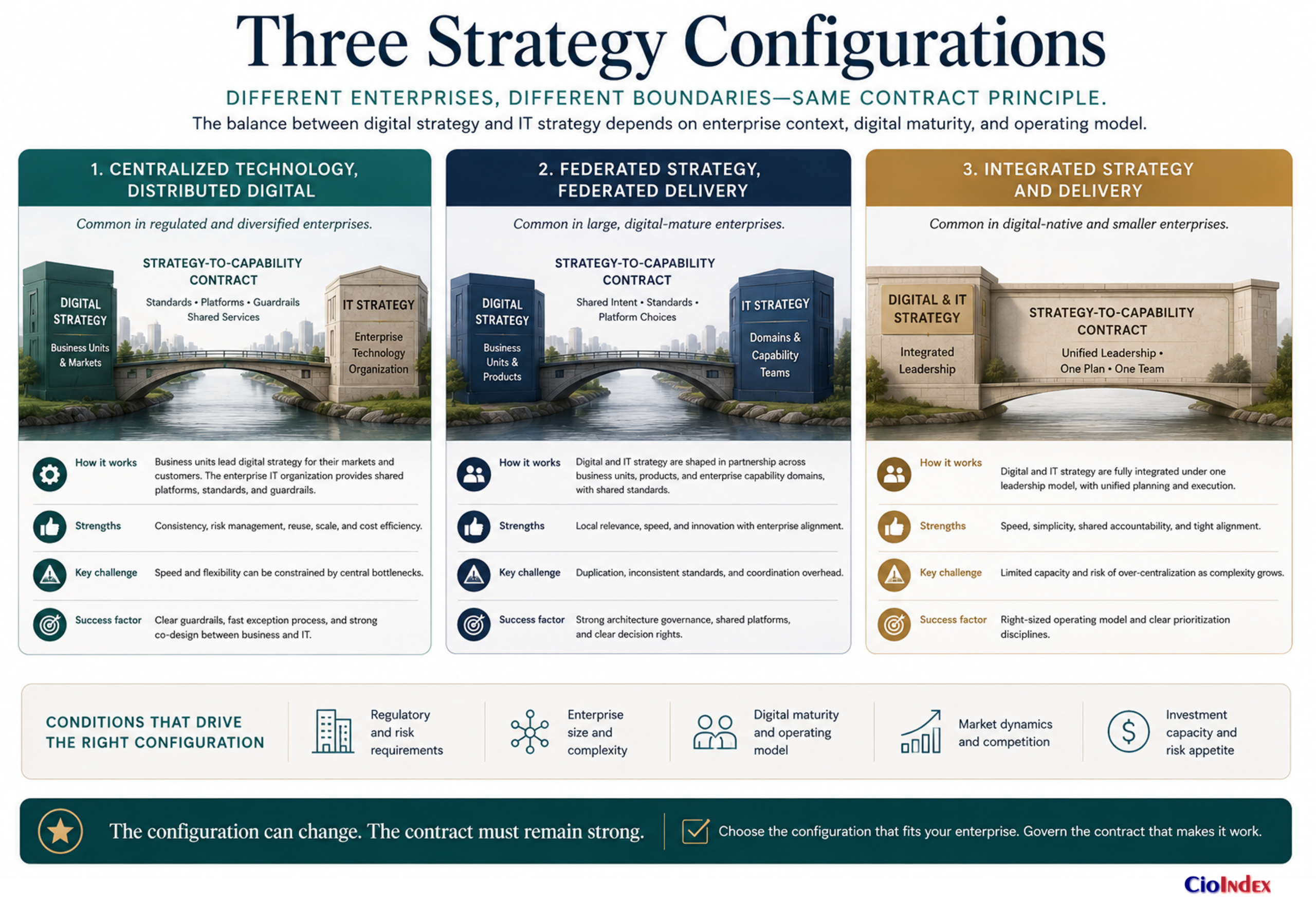
Configuration Decision Table
| Condition | Integrated strategy | Coordinated dual strategies | Federated digital strategies + enterprise IT strategy |
|---|---|---|---|
| Focused enterprise with limited business-model variation | Strong fit | Possible | Weak fit |
| Distinct digital business-model choices | Possible | Strong fit | Strong fit if choices vary by unit |
| Large shared-platform and modernization agenda | Possible with explicit technology commitments | Strong fit | Strong fit |
| High business-unit autonomy | Weak to moderate fit | Moderate fit | Strong fit |
| Planning and funding cadences differ materially | Moderate fit | Strong fit | Strong fit |
| Governance capacity is low | Stronger fit because there are fewer interfaces | Risky | High risk |
| Need for rapid local experimentation | Possible | Strong fit | Strong fit |
The decision should be based on governance effectiveness, not fashion. Two polished documents are worse than one integrated decision system. One concise document is worse than two strategies if it obscures ownership, capability constraints, or evidence.
A CIO Boundary Health Check
CIOs can evaluate whether the boundary can carry real decisions using five tests. Score each from 0 to 2: 0 means absent or unclear; 1 means partially defined or inconsistently applied; 2 means explicit, governed, and evidenced.
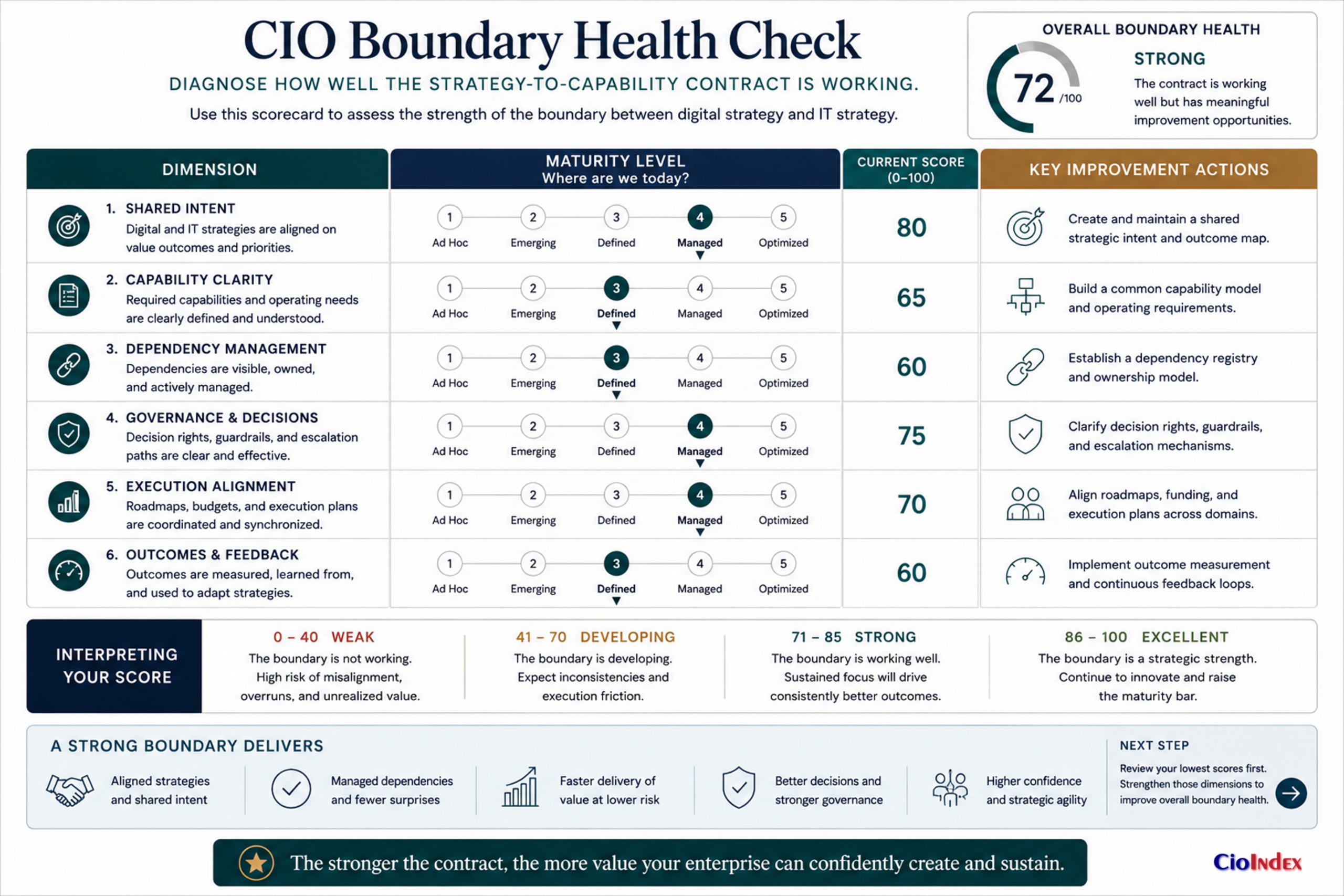
Five Test Diagnostic Table
| Test | Question | Evidence | If weak, act here |
|---|---|---|---|
| Decision clarity | Can leaders state which decisions belong to digital strategy, which belong to IT strategy, and which require joint authority? | Evidence includes a decision-rights matrix, escalation paths, and consistent treatment across major initiatives. | Clarify decision ownership and escalation. |
| Capability commitments | Does every priority digital bet identify the business, data, technology, security, process, and workforce capabilities required? | Evidence includes capability maps, readiness assessments, named owners, and target performance levels. | Map the missing capabilities and assign owners. |
| Dependency visibility | Are shared platforms, data foundations, integration work, controls, technical debt, and organizational changes visible in the portfolio? | Evidence includes cross-initiative dependency maps, sequencing decisions, and architecture traceability. | Aggregate shared demand and sequence dependencies. |
| Funding alignment | Are shared capabilities and risk controls funded in proportion to the enterprise value they enable rather than pushed into an undifferentiated IT budget? | Evidence includes explicit investment ownership, enterprise funding mechanisms, and business cases that include enabling costs. | Redesign investment ownership and portfolio funding. |
| Shared outcome governance | Do governance forums review business outcomes and capability health together? | Evidence includes integrated scorecards, evidence gates, stop-or-scale criteria, and review of operational, security, and technical sustainability. | Integrate value, capability, risk, and sustainability evidence. |
Interpreting the score
- 0–3: Unmanaged boundary. Execution depends on informal negotiation. Immediate governance intervention is required.
- 4–6: Partially managed boundary. Some mechanisms exist, but major initiatives are likely to expose gaps.
- 7–8: Governed boundary. The interface is generally sound, with targeted improvements needed.
- 9–10: Strategy-to-capability system. Value choices and capability commitments are consistently connected and governed.
The score is not a maturity certification. Its purpose is to reveal where strategy language is masking execution risk and to direct intervention toward the weakest part of the interface.
What CIOs should do next
Do not begin by rewriting both strategies. Test the interface on the three to five most consequential digital bets and repair the weakest boundary mechanisms first.
- Name the value choice. Ask the business or digital owner to state what will change in enterprise value, for whom, and through what mechanism.
- Map the capability commitments. Identify the business, data, technology, security, process, operating-model, and workforce capabilities required.
- Assign decision rights. Clarify who decides, who funds, who designs, who operates, who accepts risk, and where conflicts escalate.
- Expose and fund shared dependencies. Aggregate capability demand across initiatives so common platforms, controls, and constraints become visible in the enterprise portfolio.
- Integrate the evidence. Review value realization, capability readiness, operating health, economics, and risk together; define stop, revise, and scale conditions.
- Select the strategy configuration. Choose an integrated, coordinated dual, or federated model based on the complexity of the interface and the organization’s governance capacity.
- Institutionalize cocreation. Move CIO and technology participation upstream into enterprise and digital strategy formation rather than relying on downstream alignment.
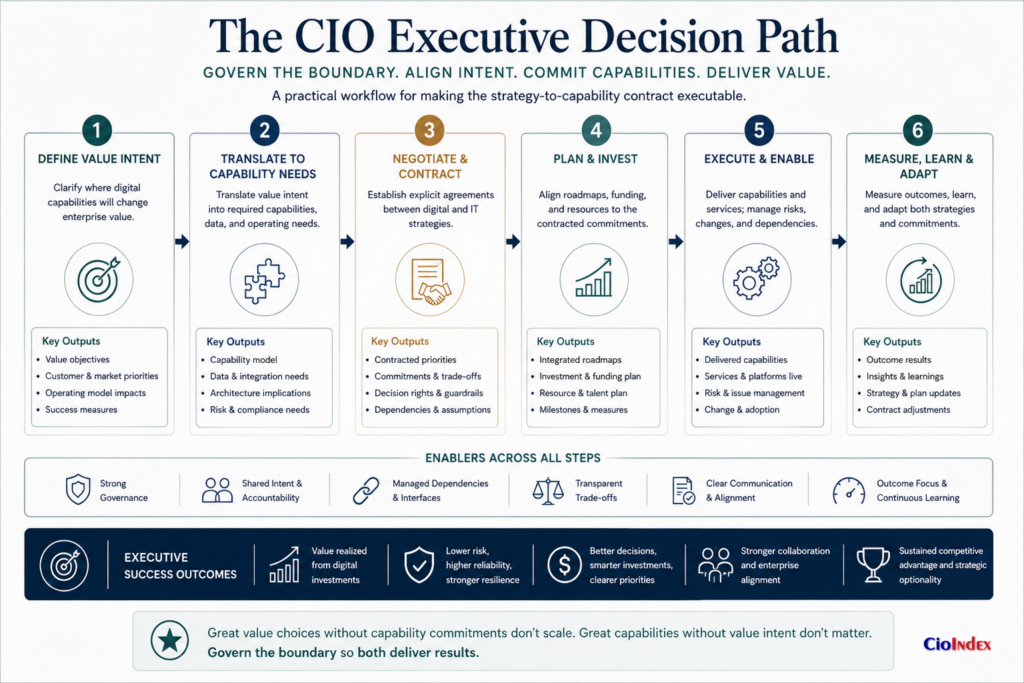
This sequence changes the conversation. Instead of debating whether digital strategy sits above, beside, or inside IT strategy, leaders test whether every value choice has an executable capability commitment and whether every major technology commitment can be traced to enterprise value.
| “No digital choice is complete without a capability commitment. No technology commitment is strategic unless it traces to enterprise value.” |
That is the boundary that matters. When the traceability breaks—when adoption rises while economics, service health, security, or technical sustainability deteriorates—the strategy must be reconsidered rather than celebrated.
Frequently asked questions
Is digital strategy part of business strategy?
Usually, yes. Digital strategy is best understood as business strategy shaped by the possibilities and constraints of digital capabilities. Some organizations document it separately because the choices are complex or because a focused transformation agenda requires dedicated governance. A separate document does not make digital strategy a technology sub-strategy.
Is IT strategy part of digital strategy?
Not necessarily. IT strategy has a broader enterprise capability and stewardship role. It may support digital strategy, but it also addresses resilience, cybersecurity, data, architecture, employee technology, enterprise applications, lifecycle management, service operations, and obligations that extend beyond a particular digital agenda.
Who should own digital strategy: the CIO, CDO, or business?
There is no universal answer. Ownership depends on the enterprise operating model, leadership capabilities, business model, regulatory context, and maturity. The safer principle is to assign accountability for value choices to the appropriate enterprise or business owner while giving the CIO real authority over technology capability, architecture, cybersecurity, resilience, and execution commitments. Where one executive owns both domains, decision rights should still be explicit.
Can an organization have multiple digital strategies?
Yes, particularly in diversified or federated enterprises. Different business units may require different market and customer strategies. The governance challenge is to prevent those strategies from creating incompatible platform, data, security, and architecture demands. An enterprise IT strategy can provide common capability direction while preserving local digital choice.
How often should digital and IT strategies be updated?
The strategies should be reviewed on a cadence appropriate to their assumptions and commitments. Digital bets may require frequent evidence-based adjustment. Platform, architecture, workforce, sourcing, and modernization commitments often operate over longer horizons. The interface should therefore be reviewed continuously even if the formal documents are refreshed at different times.
What role should enterprise architecture play?
Enterprise architecture can translate strategic value choices into capability and portfolio implications, identify shared dependencies, and make trade-offs visible. It should not substitute for business, digital, or IT strategy. Its value lies in connecting the domains and preserving enterprise coherence.
References
- Jeanne W. Ross, Ina M. Sebastian, and Cynthia M. Beath, “How to Create a Great Digital Strategy,” MIT CISR, 2016.
- Gartner, “Build a Better IT Strategic Plan,” current public guidance accessed July 22, 2026.
- Jeanne W. Ross et al., “Designing Digital Organizations,” MIT CISR Working Paper 406, 2016.
- McKinsey & Company, “McKinsey Global Tech Agenda 2026,” 2026. The collaboration finding is treated as an observed research association, not a standalone causal claim.
- Ian Cox and Cassio Dreyfuss, “Determining the Need for Multiple IT Strategies,” Gartner, 2024.