

Organizations often suffer from a lack of digital coherence, which they compensate for with activity. New platforms are launched, systems are modernized, data programs are funded, automation is introduced, and AI pilots begin. But the work often outpaces the enterprise’s ability to connect it to strategy, governance, capability, and measurable value.
The result is expensive motion without reliable progress. Investments become harder to defend, teams optimize locally, data and architecture fragment, and leaders struggle to prove whether digital work is improving customer experience, operating performance, decision quality, resilience, or growth.
The problem is hard to solve because creating a digital strategy sits across business priorities, technology capabilities, operating model choices, funding decisions, governance rights, data quality, risk, and change capacity. No single team can solve it alone, and no technology roadmap can substitute for the executive choices required.
This guide explains how to create a digital strategy that moves from ambition to execution: defining the business problem, identifying required capabilities, making trade-offs, building a roadmap, assigning governance, and measuring value. By the end of this process, the organization should have a strategy document that includes business objectives, value opportunities, required digital capabilities, strategic priorities, a roadmap, governance model, metrics, ownership, risks, assumptions, and a review cycle.
Introduction
Creating a digital strategy begins with a business outcome the organization needs to improve. Cloud platforms, AI pilots, automation programs, customer portals, data initiatives, and system modernization may all become part of the answer, but they are not the strategy. They are the means the strategy may justify.
A strong strategy answers a more fundamental question: how will the organization use digital capabilities to improve performance, serve customers better, make decisions faster, operate with greater resilience, and build advantage over time? The answer must connect business outcomes with technology capabilities, operating model choices, investment priorities, governance, and measurable progress.
The evidence supports this discipline. Deloitte’s research on digital transformation investment value found that digital ambitions tied clearly to enterprise strategy, technology investments aligned to strategy, and digital change connected to strategy are associated with stronger value realization. The practical lesson for CIOs is simple: digital change must be anchored in business strategy, not justified by technology momentum alone. [1]
Most organizations already have digital activity. They use digital channels, enterprise platforms, data, cloud services, automation, analytics, and connected workflows. The problem is not the absence of digital work. The problem is often the absence of coherence. One team improves customer access. Another buys a new platform. IT modernizes infrastructure. Data teams build reports. Business units launch separate initiatives. Each effort may make sense on its own, but together they can create duplication, integration risk, cost growth, and strategic confusion.
Creating a digital strategy is the work of turning scattered activity into disciplined direction. It gives leaders a shared way to decide what matters, what comes first, what must be funded, what must be governed, and what success will look like. The output should not be a glossy transformation story. It should be a practical management tool that helps the enterprise act with focus and confidence.
The simplest mental model is this: digital strategy is the bridge between business intent and digital execution. If the bridge is weak, digital work fragments. If it is strong, technology becomes a coordinated engine for value creation.
That transition is the point of this guide. It uses a brief working definition only to set up the practical work of creating a digital strategy: the decisions, steps, artifacts, governance, and measures leaders need to move from business ambition to executable digital direction.
Before You Create a Digital Strategy, Align on What It Must Do
Before leaders create a digital strategy, they need a working definition that is practical enough to guide decisions. In this article, digital strategy means the management logic that connects business intent to digital execution. It identifies the outcomes digital work must improve, the capabilities required to deliver those outcomes, the priorities leaders will fund first, the roadmap that sequences execution, and the governance and metrics that prove value.
That definition is intentionally action-oriented. It does not treat the strategy as a broad concept to admire or a technology category to describe. It treats it as something leaders must build: a decision system for choosing which digital capabilities matter, what gets sequenced, who owns results, and how progress will be managed.
This transition protects the strategy-building process from the most common failure. If leaders start by asking which platforms, AI tools, automation programs, or cloud projects to launch, the work becomes tool-led. If they start by asking what business outcomes digital capabilities must enable, the strategy can guide investment, operating model choices, governance, metrics, and execution.
Use this working definition only long enough to make the next decision: what must the organization create, fund, sequence, govern, and measure? The rest of the article answers that question step by step.
Distinguish Digital Strategy From Transformation, IT Strategy, and the Technology Roadmap
Before creating a digital strategy, leaders should separate it from adjacent planning terms. These distinctions keep the strategy-building conversation focused on business value, execution logic, and decision rights rather than drifting into a transformation slogan, an IT management plan, or a project schedule.
| Concept | Primary question | Typical output | How it relates to digital strategy |
| Digital strategy | How will digital capabilities create business value? | A strategic plan linking outcomes, capabilities, priorities, roadmap, governance, and metrics. | It is the controlling logic that guides digital investment and execution. |
| Digital transformation | How will the organization change how it operates, serves, decides, and competes? | A broader change agenda involving process, culture, technology, data, skills, and operating model shifts. | It may be the execution journey enabled by the digital strategy. |
| IT strategy | How will IT capabilities, architecture, services, platforms, and operations support enterprise goals? | An IT capability and operating plan covering applications, infrastructure, security, talent, sourcing, and governance. | It supports and enables digital strategy, but it is usually broader in IT management scope. |
| Technology roadmap | What technology work will happen, when, and in what sequence? | A sequenced plan of projects, platforms, migrations, upgrades, and dependencies. | It is one execution artifact inside the strategy, not the strategy itself. |
Why Creating a Digital Strategy Matters
When leaders do not create a digital strategy, organizations tend to accumulate activity without progress. They launch initiatives, buy systems, modernize infrastructure, and experiment with emerging technologies, but the work does not always add up to a coherent change in performance.
This creates several risks. Investment decisions become harder to defend because benefits are unclear. Teams pursue local priorities that conflict with enterprise architecture. Data remains fragmented because no one owns the underlying governance. Customer-facing changes move faster than back-end processes can support. Executives lose confidence because spending rises while business outcomes remain hard to prove.
The strategy creation process prevents that fragmentation. It gives leaders a shared basis for decision-making. It helps the organization distinguish between interesting ideas and important priorities. It also creates a disciplined way to sequence work because transformation fails when everything becomes urgent at the same time.
The value of the strategy shows up in better investment choices, clearer ownership, stronger governance, more consistent execution, and more credible measurement. It also helps the CIO and executive team explain priorities in language the business can understand. Research on digital transformation repeatedly emphasizes that technology alone is not enough. Value depends on organizational capability, business alignment, data, skills, governance, process change, and adoption. [2] [3] [4]
Most importantly, the strategy creates confidence. Leaders can see where the organization is going, why it is going there, how the work will be sequenced, and how progress will be judged.
| Symptom of fragmented digital activity | What it usually signals | Strategic response |
| Multiple teams buying similar tools | Local optimization without enterprise architecture discipline | Create portfolio visibility and common capability standards. |
| Many pilots but few scaled outcomes | Innovation activity without adoption, funding, or operating model support | Define scale criteria, business ownership, and benefits realization. |
| Dashboards that leaders do not trust | Weak data governance and unclear data ownership | Establish data stewardship, quality rules, and decision-grade metrics. |
| Customer-facing upgrades that expose back-end weakness | Front-end digitization without process and integration redesign | Sequence customer experience work with process, data, and platform modernization. |
| Rising digital spend with unclear business value | Activity metrics replacing outcome metrics | Link each initiative to value measures and review benefits regularly. |
Before You Create a Digital Strategy: What You Need to Know
Before leaders create a digital strategy, they need a clear view of the conditions that will shape execution. This readiness step is often skipped because organizations want to move quickly. But speed without diagnosis creates fragile strategy. The plan may sound ambitious while ignoring the constraints that will determine whether it can be delivered.
Begin with business direction. What are the enterprise priorities for the next several years? Which outcomes matter most to the board, CEO, customers, operating leaders, employees, and regulators? The strategy must support those priorities, not compete with them.
Next, understand the current digital state. This includes applications, data, infrastructure, security posture, architecture, integration, vendor landscape, process maturity, skills, funding model, and governance. It also includes softer but critical factors such as leadership alignment, change appetite, decision speed, and business ownership.
The organization must also know its constraints. These may include legacy systems, technical debt, regulatory requirements, budget limits, talent shortages, data quality issues, vendor lock-in, cybersecurity exposure, or low trust between business and technology teams. Constraints do not invalidate strategy. They make strategy more realistic.
Finally, identify the decisions that must be made before action begins. Who owns outcomes? Who approves priorities? Who arbitrates conflicts between enterprise standards and local speed? Who owns data quality? Who will fund cross-functional capabilities? A strategy built without decision rights will struggle once execution starts.
Checklist for Creating a Digital Strategy: Readiness Before You Start
| Readiness area | Question to answer | Evidence needed |
| Business direction | Are enterprise goals clear enough to guide digital choices? | Current strategic plan, executive priorities, board/CEO goals, market pressures. |
| Current digital state | Do leaders understand the systems, data, processes, risks, and dependencies that shape execution? | Application inventory, data quality findings, architecture review, security posture, process pain points. |
| Leadership alignment | Do business and technology leaders agree on the problem and desired outcomes? | Executive interviews, workshop outputs, decision log, shared problem statement. |
| Funding model | Can cross-functional digital capabilities be funded without forcing every initiative into local budgets? | Budget model, portfolio funding rules, investment governance. |
| Decision rights | Is it clear who approves priorities, architecture exceptions, data standards, and trade-offs? | Governance charter, RACI, escalation paths. |
| Change capacity | Can the organization absorb the scale and pace of change implied by the strategy? | Change impact assessment, workforce capacity, adoption history, training needs. |
A Practical Digital Strategy Framework Before You Start
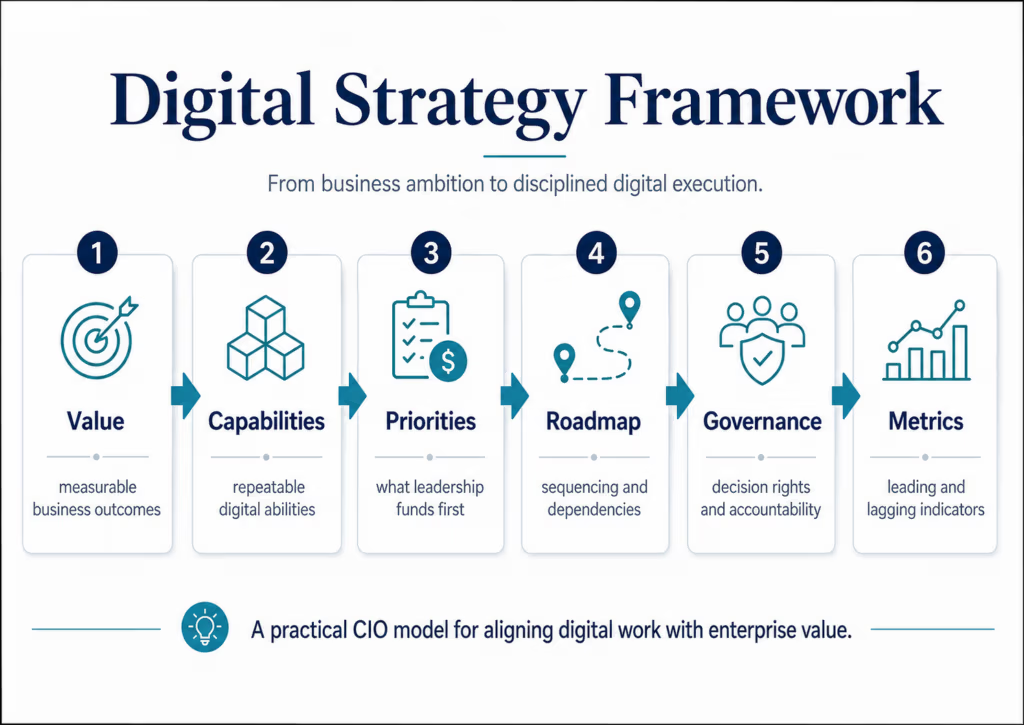
A useful strategy follows a simple framework: value, capabilities, priorities, roadmap, governance, and metrics. These six elements keep the work connected from ambition to execution.
Value defines why the strategy exists. It identifies the business outcomes digital work must improve, such as customer experience, operational efficiency, decision quality, resilience, innovation, growth, or cost performance.
Capabilities define what the organization must be able to do repeatedly. These may include trusted data, integrated customer journeys, scalable platforms, secure cloud operations, automation, product management, digital service design, analytics, AI-enabled workflows, or faster delivery methods.
Priorities define where leadership will focus attention and investment. This is where strategy becomes real because not everything can be first. Priorities must reflect value, urgency, feasibility, dependency, and risk.
The roadmap defines sequence. It shows what must happen now, what must wait, and what conditions must exist before the next stage can succeed. A roadmap is not just a calendar. It is the logic of execution over time.
Governance defines how decisions will be made, how conflicts will be resolved, how architecture and data standards will be protected, and how progress will be reviewed. Metrics define how leaders will know whether digital work is creating value rather than simply completing activity.
This framework matters because it prevents a common failure: jumping from ambition directly to projects. The strategy should move from business value to required capabilities, then to priorities, then to sequenced execution, then to governance and measurement.
| Blueprint element | Strategy question | Output |
| Value | What measurable business outcomes must digital improve? | Value thesis and outcome map. |
| Capabilities | What must the organization be able to do repeatedly? | Capability model linked to outcomes. |
| Priorities | What will leadership fund and sequence first? | Prioritized portfolio and trade-off rationale. |
| Roadmap | What must happen in what order? | Phased roadmap with dependencies, owners, milestones, and decisions. |
| Governance | How will choices be made and conflicts resolved? | Decision rights, forums, escalation paths, standards, and review cadence. |
| Metrics | How will progress and value be proven? | Leading and lagging indicators tied to outcomes. |
How to Create a Digital Strategy Step by Step
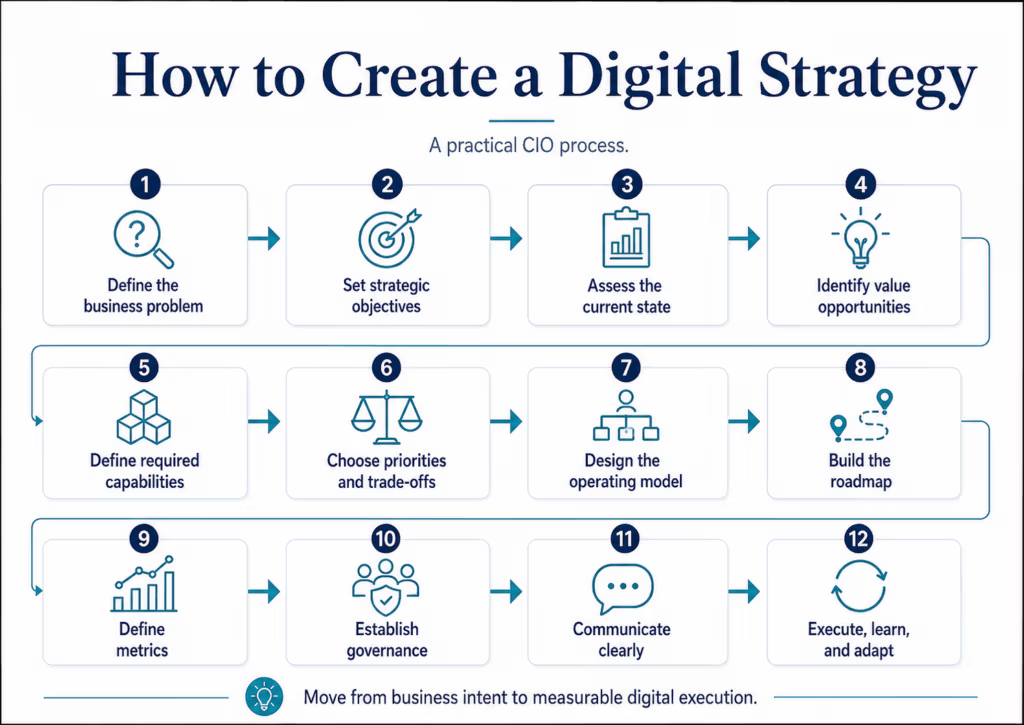
The steps below show how to create a digital strategy without letting the work collapse into a technology roadmap. Treat them as practical steps to create a digital strategy that can be funded, governed, measured, and adjusted. The same logic applies when leaders say they need to build a digital strategy, develop a digital strategy, design a digital strategy, or define a digital strategy planning process: move from business intent to capability choices, execution sequence, governance, and measurable value.
Step 1: Define the Business Problem Digital Must Solve
The first step is to define the business problem clearly. This sounds obvious, but it is where many digital strategies fail. They begin with technology ambition rather than business need. They say the organization must adopt AI, modernize systems, digitize services, become data-driven, or move faster. Those may be useful directions, but they are not yet strategic enough.
A better starting point is to ask what business condition must improve. The answer may be customer friction, slow cycle times, high operating cost, poor decision visibility, fragmented data, outdated systems, weak scalability, low innovation speed, inconsistent service delivery, or competitive pressure.
The more specific the problem, the stronger the strategy will be. ‘We need a digital strategy’ is too vague. ‘We need to reduce customer onboarding time from weeks to days while improving compliance and service quality’ is strategic. It defines the outcome, the operating problem, and the value at stake.
This step should produce a clear problem statement. It should explain what is not working, who is affected, why it matters, and what improvement would look like. The goal is not to solve the problem yet. The goal is to make sure the digital strategy is aimed at something real.
Step 2: Set Strategic Objectives
Once the business problem is clear, define the objectives the digital strategy must support. These objectives should connect directly to enterprise goals such as growth, customer retention, cost efficiency, speed to market, risk reduction, operational resilience, employee productivity, service quality, regulatory responsiveness, or innovation capacity.
The key is to make the objectives specific enough to guide choices. ‘Improve customer experience’ is a reasonable ambition, but it is too broad to direct investment. ‘Create a unified digital customer journey across sales, onboarding, service, and support’ is more useful. ‘Become data-driven’ is also too broad. ‘Use trusted operational data to improve demand forecasting, resource planning, and executive decision-making’ gives the strategy something concrete to build toward.
Digital objectives should also be limited in number. A strategy with twelve priorities is usually a list of aspirations, not a strategy. Leadership must decide what matters most. That does not mean ignoring everything else. It means choosing the outcomes that deserve coordinated executive attention.
A strong set of digital objectives should answer four questions: what value are we trying to create, for whom, by when, and how will we know progress is real?
Step 3: Assess the Current Digital State
Before deciding where to go, the organization must understand where it is. A current-state assessment examines the capabilities, systems, data, processes, skills, governance, risks, and constraints that will shape digital execution. It prevents leaders from designing a strategy that sounds attractive but cannot be delivered.
On the technology side, review the application portfolio, data architecture, infrastructure, integration landscape, cybersecurity posture, cloud maturity, analytics capabilities, automation tools, and technical debt. Identify which systems enable strategy and which ones slow it down.
On the business side, examine process maturity, decision rights, customer pain points, employee experience, organizational silos, funding practices, vendor dependencies, and change readiness. Many digital barriers are not technical. They come from unclear ownership, weak governance, fragmented processes, and competing priorities.
The current-state assessment should not become an endless inventory exercise. Its purpose is to reveal the few conditions that matter most for strategy. What capabilities are strong enough to build on? What gaps must be closed? What risks could derail execution? What constraints must be acknowledged?
Step 4: Identify Where Digital Can Create Value
After diagnosing the current state, identify the areas where digital capability can create meaningful value. The goal is not to digitize everything. The goal is to find the places where digital change will improve business performance in visible, measurable ways.
Digital can improve customer and stakeholder experience by making interactions faster, simpler, more personalized, and more consistent. It can improve operational efficiency by automating work, reducing handoffs, removing duplicate systems, and streamlining processes. It can improve decision-making by creating trusted data, better analytics, and clearer performance visibility. It can improve innovation by enabling new products, services, channels, or business models. It can improve resilience by strengthening cybersecurity, scalability, continuity, and adaptability.
The organization should evaluate each opportunity through a practical lens: value, feasibility, urgency, risk, dependency, and strategic fit. Not every valuable idea should become a priority now. Some opportunities require foundational capabilities first. Others may be attractive but too complex for the current maturity level.
Step 5: Define the Digital Capabilities Required
The strategy must identify the capabilities the organization needs to deliver its objectives. Capabilities are more durable than projects. A project may implement a platform, launch a tool, or automate a process. A capability is the repeatable ability to do something well.
For example, if the strategic objective is faster customer onboarding, the organization may need capabilities in identity management, workflow automation, data integration, digital document handling, customer communication, compliance monitoring, and journey analytics. If the objective is better decision-making, the required capabilities may include data governance, master data management, analytics platforms, reporting standards, and business intelligence skills.
Thinking in capabilities helps leaders avoid tool-driven strategy. It shifts the discussion from ‘what software should we buy?’ to ‘what must we be able to do?’ This step should distinguish between existing capabilities that need improvement and new capabilities that must be built.
Example: Turning Business Outcomes Into Digital Capabilities
| Objective | Required capabilities | Example initiatives | Success measures |
| Reduce customer onboarding time | Identity verification, workflow automation, data integration, document management, compliance monitoring | Automated onboarding workflow, integrated customer profile, digital document intake, compliance exception dashboard | Cycle time, error rate, completion rate, customer satisfaction, compliance exceptions. |
| Improve executive decision quality | Data governance, master data, analytics platform, standardized KPIs, reporting ownership | Enterprise data catalog, executive KPI dashboard, data quality rules, business data owners | Reporting cycle time, data quality score, dashboard adoption, forecast accuracy. |
| Lower operating cost | Process mining, automation, platform rationalization, cloud cost management, service management discipline | Workflow automation, application rationalization, cloud cost optimization, self-service portal | Cost per transaction, automation rate, decommissioned applications, cloud spend variance. |
Step 6: Choose Strategic Priorities and Make Trade-Offs
A strategy is defined as much by what it excludes as by what it includes. Once opportunities and capabilities are clear, leadership must choose priorities. This is where digital strategy becomes real. Every organization has more ideas than capacity. Funding, talent, attention, architecture bandwidth, change appetite, and executive sponsorship are limited.
Prioritization should consider business value, urgency, feasibility, risk, dependency, and readiness. A high-value initiative may need to wait if the data foundation is weak. A modernization effort may need to come before customer-facing innovation. A quick win may be useful if it builds confidence, but dangerous if it distracts from structural work.
The goal is not simply to rank projects. The goal is to create a balanced portfolio. A strong digital strategy usually includes foundational initiatives, value-delivering initiatives, and enabling initiatives. Foundational initiatives build the platforms, data, architecture, and security needed for future work. Value-delivering initiatives create visible business impact. Enabling initiatives improve governance, skills, operating model, or adoption.
Digital Initiative Prioritization Matrix
| Criterion | Question | High score means | Warning sign |
| Business value | Will this materially improve a strategic outcome? | Clear revenue, cost, risk, experience, resilience, or decision benefit. | Benefit is described only as modernization or innovation. |
| Feasibility | Can we deliver this with current or buildable capabilities? | Dependencies are understood and delivery capacity exists. | Success depends on capabilities not yet funded or owned. |
| Urgency | Does timing matter? | Delay creates risk, opportunity loss, customer impact, or compliance exposure. | Urgency is based on executive preference rather than business need. |
| Risk | What could go wrong if we proceed? | Risks are known and manageable. | Security, regulatory, change, vendor, or architecture risks are unclear. |
| Dependency | What must be true first? | Prerequisites are visible and sequenced. | Initiative assumes data, integration, or process maturity that does not exist. |
| Readiness | Is the organization prepared to adopt the change? | Business ownership, funding, skills, and change capacity are in place. | No accountable business owner or adoption plan. |
Step 7: Design the Target Digital Operating Model
The strategy cannot succeed if the organization’s operating model remains unchanged. The operating model defines how work gets done. It includes decision rights, roles, funding, governance, delivery methods, business-IT collaboration, vendor management, architecture control, product ownership, data stewardship, and performance management.
Many digital strategies fail because they assume digital execution can happen inside old structures. Business units expect speed, but funding cycles remain annual and rigid. IT is asked to innovate, but architecture decisions are fragmented. Data is treated as strategic, but no one owns its quality. Agile teams are formed, but governance still rewards project completion rather than product outcomes.
Creating a digital strategy requires deciding how the organization will operate digitally. This may involve product-based delivery, cross-functional teams, stronger enterprise architecture governance, clearer data ownership, new funding models, business capability ownership, or updated portfolio management.
Step 8: Build the Digital Strategy Roadmap
The roadmap translates strategy into sequence. A good digital roadmap does not simply place projects on a timeline. It explains the order of work and why that order matters. It shows dependencies, capability build-up, milestones, decision points, and expected outcomes.
The roadmap should usually be organized in phases. Early phases may focus on alignment, foundational capabilities, urgent pain points, or quick wins that build trust. Middle phases may expand platforms, improve process integration, or scale data and automation. Later phases may focus on advanced analytics, AI-enabled workflows, new digital products, or broader operating model maturity.
The roadmap must balance ambition with absorption capacity. Too much change at once creates fatigue. Too little change loses momentum. The right sequence creates visible progress while building the conditions for deeper transformation. Each roadmap item should have a clear owner, business outcome, dependency, investment estimate, risk, and success measure.
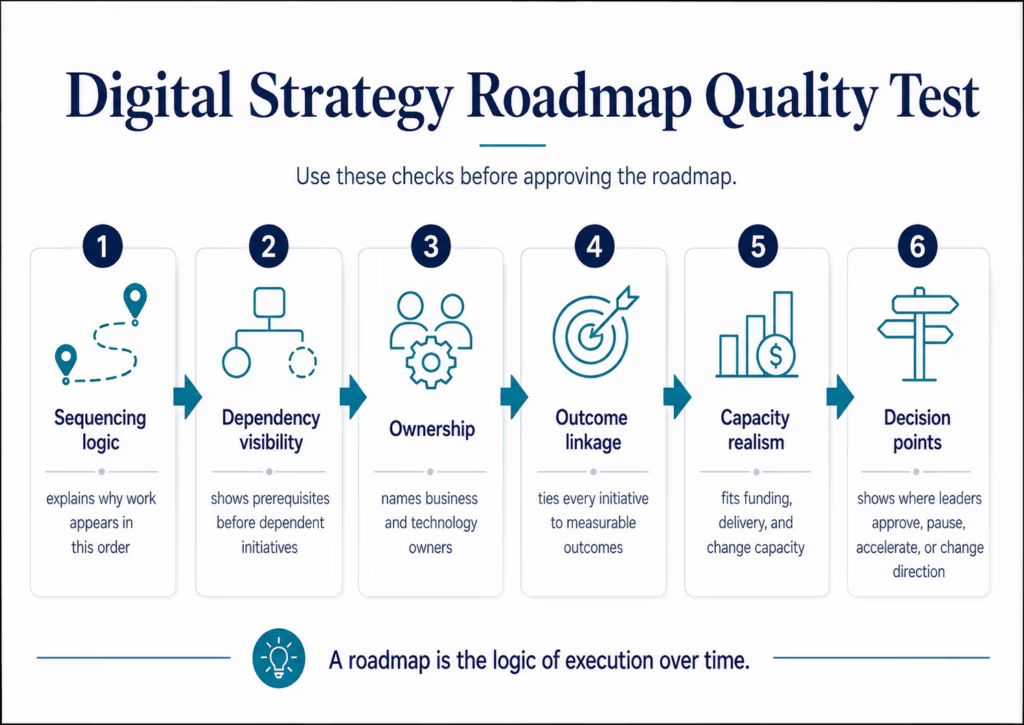
Digital Strategy Roadmap Quality Test
| Roadmap test | Pass condition |
| Sequencing logic | The roadmap explains why work appears in this order, not just when it starts. |
| Dependency visibility | Foundational capabilities, data, architecture, funding, and decisions are shown before dependent initiatives. |
| Ownership | Each major workstream has a named business and technology owner. |
| Outcome linkage | Every initiative connects to a strategic objective and measurable outcome. |
| Capacity realism | The roadmap fits available leadership attention, delivery capacity, change capacity, and funding. |
| Decision points | The roadmap shows where leaders will approve, pause, accelerate, or change direction. |
Step 9: Define Metrics and Success Measures
Digital strategy must be measurable. The right metrics depend on the strategy’s objectives. If the goal is customer experience, measures may include onboarding time, self-service adoption, satisfaction, retention, error rates, and service resolution speed. If the goal is operational efficiency, measures may include cycle time, cost per transaction, automation rate, manual rework, system duplication, and productivity.
The most important principle is to measure outcomes, not just activity. Completing a system implementation is not the same as achieving a digital outcome. Launching an app is not the same as improving customer experience. Migrating workloads to cloud is not the same as improving scalability or cost control.
A strong digital strategy includes leading and lagging indicators. Leading indicators show whether execution is moving in the right direction. Lagging indicators show whether business value is being achieved. Metrics should be reviewed regularly by the leadership team, not buried in project reporting.
Step 10: Establish Governance and Decision Rights
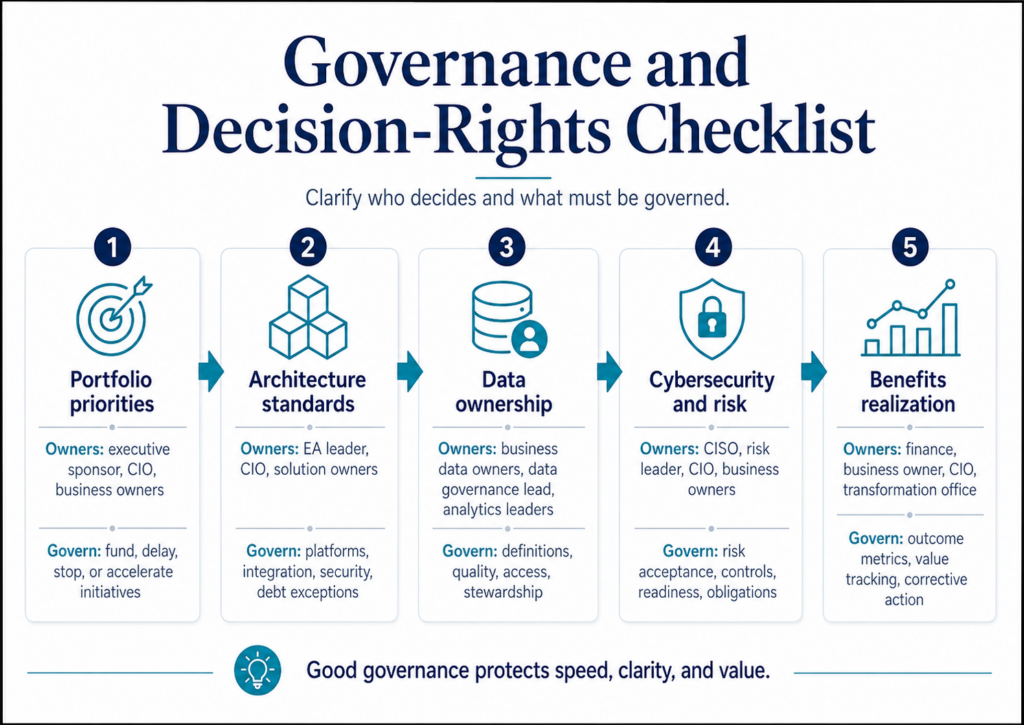
Governance turns digital strategy from intent into disciplined execution. Digital work creates decisions about funding, architecture, data, risk, vendors, priorities, security, customer experience, and business process ownership. If decision rights are unclear, execution slows down or fragments.
The plan should define how decisions will be made and who has authority to make them. This includes portfolio governance, architecture governance, data governance, cybersecurity governance, investment governance, and benefits realization. It also includes escalation paths when priorities conflict.
Governance should not be designed to create bureaucracy. Its purpose is to protect speed, clarity, and value. Good governance helps teams move faster because they know the rules, the decision-makers, and the boundaries.
Governance and Decision-Rights Checklist
| Decision area | Who must be clear? | What must be governed? |
| Portfolio priorities | Executive sponsor, CIO, business owners, portfolio board | Which initiatives are funded, delayed, stopped, or accelerated. |
| Architecture standards | Enterprise architecture leader, CIO, solution owners | Platform choices, integration patterns, security requirements, technical debt exceptions. |
| Data ownership | Business data owners, data governance lead, analytics leaders | Data definitions, quality rules, access rights, stewardship, master data. |
| Cybersecurity and risk | CISO, risk leader, CIO, business owners | Risk acceptance, control requirements, incident readiness, regulatory obligations. |
| Benefits realization | Finance, business owner, CIO, transformation office | Outcome metrics, value tracking, corrective action, benefit ownership. |
Step 11: Communicate the Strategy Clearly
The strategy only works if people understand it. Executives need to understand the investment logic. Business leaders need to understand their role in execution. Employees need to understand what is changing and why. Technology teams need to understand priorities, constraints, and architecture direction. Partners and vendors need to understand expectations.
Communication should be simple, concrete, and repeated. The strategy should explain the case for change, the desired outcomes, the major priorities, the roadmap, the role of different stakeholders, and how progress will be measured. It should avoid vague transformation language. People do not align around slogans. They align around clear direction, credible reasoning, and visible leadership commitment.
A strong communication approach also explains trade-offs. When leaders say yes to certain digital priorities, they are saying no or not yet to others. Making that logic visible reduces confusion and prevents shadow initiatives.
Step 12: Execute, Learn, and Adapt
The final step is execution, but execution is not the end of strategy. It is where the strategy is tested. Digital conditions change. Customer expectations shift. Technology matures. Competitors move. Regulations evolve. Internal capacity expands or contracts. Assumptions that were reasonable at the start may need adjustment.
That is why digital strategy must include learning loops. Leaders should review progress, outcomes, risks, dependencies, adoption, and benefits on a regular rhythm. They should ask what is working, what is stalled, what has changed, and what decisions are needed. They should retire initiatives that no longer make sense and accelerate those that prove value.
The strategy should be stable in direction but adaptive in execution. The destination should remain clear, while the route improves as evidence emerges.
What the Strategy You Create Must Include
A complete strategy document should include a clear business problem and strategic objectives. It should include a current-state assessment that identifies strengths, gaps, risks, and constraints. It should define where digital can create value and which capabilities are required. It should identify strategic priorities and the trade-offs behind them. It should describe the target operating model, governance structure, roadmap, metrics, funding logic, and communication approach.
It should also include assumptions. Every strategy is built on beliefs about customers, markets, technology, capability, cost, risk, and organizational readiness. Making those assumptions visible helps leaders test them over time.
Most importantly, the strategy should be usable. Leaders should be able to use it to make decisions. Teams should be able to use it to align work. The CIO should be able to use it to explain investment choices. The executive team should be able to use it to monitor progress.
If the document cannot guide decisions, it is not yet a strategy. Use the components below as a completeness check while building the strategy, not as a mechanical digital strategy template or a separate template-focused page.
| Digital strategy component | Question it answers | Evidence or artifact |
| Executive summary | What is the strategy in plain language? | One-page summary of problem, objectives, priorities, roadmap, and governance. |
| Business problem | What condition must improve? | Problem statement, baseline measures, stakeholder impact. |
| Strategic objectives | What outcomes will digital support? | Three to five measurable objectives tied to enterprise priorities. |
| Current state | What reality must the strategy account for? | Capability, system, data, process, risk, and maturity assessment. |
| Value opportunities | Where can digital create value? | Value map, use cases, pain points, opportunity assessment. |
| Required capabilities | What must the organization be able to do? | Capability model linked to objectives. |
| Strategic priorities | What comes first and why? | Prioritized portfolio with trade-off rationale. |
| Operating model | How will digital work be run? | Roles, decision rights, funding, ownership, delivery model. |
| Roadmap | How will the work be sequenced? | Phased roadmap with owners, dependencies, milestones, and decisions. |
| Metrics and governance | How will progress be managed? | Outcome metrics, governance forums, review cadence, escalation paths. |
Common Mistakes When Creating a Digital Strategy
The most common mistake is confusing digital strategy with a technology roadmap. A roadmap is important, but it is only one part of the strategy. Without business objectives, capability logic, governance, and metrics, the roadmap becomes a list of work rather than a strategic plan.
Another mistake is trying to do too much at once. Digital ambition often exceeds organizational capacity. A strategy that launches too many initiatives creates competition for attention, funding, talent, and change energy. Sequencing is not a weakness. It is a sign of serious execution thinking.
A third mistake is underestimating operating model change. New tools rarely produce value when old processes, roles, incentives, and decision rights remain untouched. Digital strategy must address how the organization works, not just what it buys.
A fourth mistake is ignoring data. Nearly every digital ambition depends on data quality, availability, governance, and trust. If data ownership is unclear, analytics, automation, and AI efforts will struggle.
A fifth mistake is measuring activity instead of outcomes. Digital teams may complete projects while business value remains unclear. This weakens trust and makes future investment harder to defend.
The final mistake is treating the strategy as fixed. Digital strategy needs discipline, but it also needs review and adjustment. The goal is not to preserve the plan. The goal is to achieve the outcomes.
Digital Strategy Checklist: How to Know the Strategy Is Ready
Before presenting or approving the strategy, leaders should test whether the creation process produced something usable. The questions below check whether the article’s core logic is present: business problem, objectives, current state, capabilities, trade-offs, roadmap, governance, metrics, and adaptation rhythm.
| Quality question | What a strong answer looks like |
| Is the business problem clear? | Leaders can explain the problem without technology jargon and can describe the business impact. |
| Are objectives specific enough to guide investment? | Each objective has a business outcome, owner, time horizon, and success measure. |
| Does the current-state assessment identify real constraints? | The strategy names capability gaps, data issues, architecture dependencies, skills, funding limits, risks, and change capacity. |
| Are capabilities linked to outcomes? | The strategy explains what the organization must be able to do, not merely what tools it will buy. |
| Has leadership made trade-offs? | The strategy identifies what comes first, what waits, and what is intentionally out of scope. |
| Does the roadmap explain sequencing logic? | The roadmap shows dependencies, decision points, and capability build-up, not just dates. |
| Are ownership and governance clear? | Decision rights, escalation paths, business ownership, and governance forums are defined. |
| Do metrics measure outcomes? | Measures focus on value creation, adoption, quality, risk, speed, cost, experience, or resilience, not only delivery activity. |
| Is there an adaptation rhythm? | The strategy includes a review cycle for learning, adjustment, and benefits realization. |
The quality test is simple: could a leadership team use this strategy to make better decisions next month? If not, it needs more work.
CIO Executive Review Questions
Before the strategy is approved, the CIO and executive team should be able to answer these questions without returning to technical jargon or project lists. If the answers are unclear, the strategy is not ready for execution.
| Executive question | What the answer should prove |
| What business outcome will this strategy improve? | The strategy is anchored in enterprise value, not technology activity. |
| Which digital capabilities are required to deliver that outcome? | Leaders understand the repeatable capabilities that must be built or strengthened. |
| What will we fund first, and what will we intentionally defer? | The strategy contains real trade-offs instead of a list of aspirations. |
| Who owns the business result? | Accountability sits with business and technology leaders, not with IT delivery teams alone. |
| What metric will prove that value has been created? | Progress will be judged by outcomes, adoption, risk reduction, speed, cost, experience, or resilience. |
How CIOs Should Lead Digital Strategy Creation
The CIO plays a central role in digital strategy, but the CIO should not create it alone. Digital strategy is an enterprise leadership responsibility. The CIO brings essential knowledge of technology capabilities, architecture, data, risk, platforms, vendors, integration, and delivery constraints. Business leaders bring customer, market, operational, financial, and process knowledge. The executive team brings enterprise priorities and trade-off authority.
The CIO’s role is to connect these perspectives into a coherent strategy. That requires translation. The CIO must translate business goals into digital capabilities and translate technology constraints into business implications. The CIO must help leaders see that digital success depends on architecture, data, governance, security, skills, funding, and adoption. The CIO must also prevent the strategy from becoming either too technical for executives or too vague for delivery teams.
The strongest CIOs act as strategy integrators. They do not merely support digital ambition. They shape it into something the enterprise can actually execute.
Frequently Asked Questions About Creating a Digital Strategy
What is the first step in creating a digital strategy?
The first step is to define the business problem digital must solve. Leaders should clarify the outcome that needs to improve before discussing platforms, tools, AI, automation, or modernization programs.
What should a digital strategy include?
It should include business objectives, current-state assessment, value opportunities, required capabilities, strategic priorities, roadmap, operating model, governance, metrics, risks, assumptions, communication plan, and review cycle.
How is a digital strategy different from a technology roadmap?
It explains how digital capabilities will create business value. A technology roadmap sequences specific technology work. The roadmap is an execution artifact inside the strategy, not a substitute for it.
Who should own the digital strategy?
The executive team should own the strategy, with the CIO playing a central strategy integration role. Business leaders must own outcomes, while technology leaders define the capabilities, architecture, data, security, and delivery conditions required for success.
How often should a digital strategy be reviewed?
The strategy should be reviewed regularly through a governance rhythm, often quarterly for strategic progress and more frequently for execution risks, dependencies, and benefits realization. The direction should be stable, but the roadmap should adapt as evidence changes.
What makes a digital strategy successful?
A successful strategy connects business outcomes to digital capabilities, makes trade-offs explicit, sequences work realistically, assigns ownership, measures outcomes, and includes governance strong enough to manage change over time.
Why do digital strategies fail?
These strategies often fail when they are technology-led, overloaded with too many initiatives, weak on governance, disconnected from business outcomes, dependent on poor data, or measured only by project completion rather than value creation.
Conclusion
Creating a digital strategy is not about producing a document with the word strategy on the cover. It is about building the management logic for digital progress.
The work begins with a business problem, not a technology trend. It moves through objectives, diagnosis, value opportunities, capabilities, priorities, operating model, roadmap, metrics, governance, communication, and adaptation. Each step matters because digital execution is complex. Without structure, digital work fragments. With structure, it becomes a coordinated path to enterprise value.
A strong digital strategy gives leaders clarity. It gives teams direction. It gives investment decisions a rationale. It gives the CIO a way to connect technology capability with business ambition.
Most of all, the process turns digital transformation from a collection of initiatives into a disciplined way of creating value.