

CIOs and IT leaders do not lack IT strategy guidance. The harder problem is deciding which guidance to trust, where to begin, and which resource fits the planning task at hand.
An IT strategy guide may explain the complete strategic planning lifecycle. Another may concentrate on aligning business and technology priorities. A third may help translate an approved strategy into investments, initiatives, and measurable outcomes. Templates, frameworks, handbooks, and planning methodologies are often presented under the same broad label, even though they serve very different purposes.
That makes choosing by title, length, or claims of completeness unreliable. A 250-page planning reference may be invaluable to a team creating its first formal IT strategy, but unnecessarily burdensome to a smaller organization that needs a proportionate plan. An investment-planning handbook may be exactly what a CIO needs after strategic priorities have been agreed, but it cannot replace the strategy that should govern those investments.
The right question is therefore not: Which is the most comprehensive IT strategy guide?
It is: Which guide best addresses the planning decision, organizational situation, and deliverable in front of us?
This article compares 14 IT strategy resources according to the work they help CIOs perform. It explains what each resource appears best suited for, where it fits in the planning lifecycle, and when additional guidance may still be necessary.
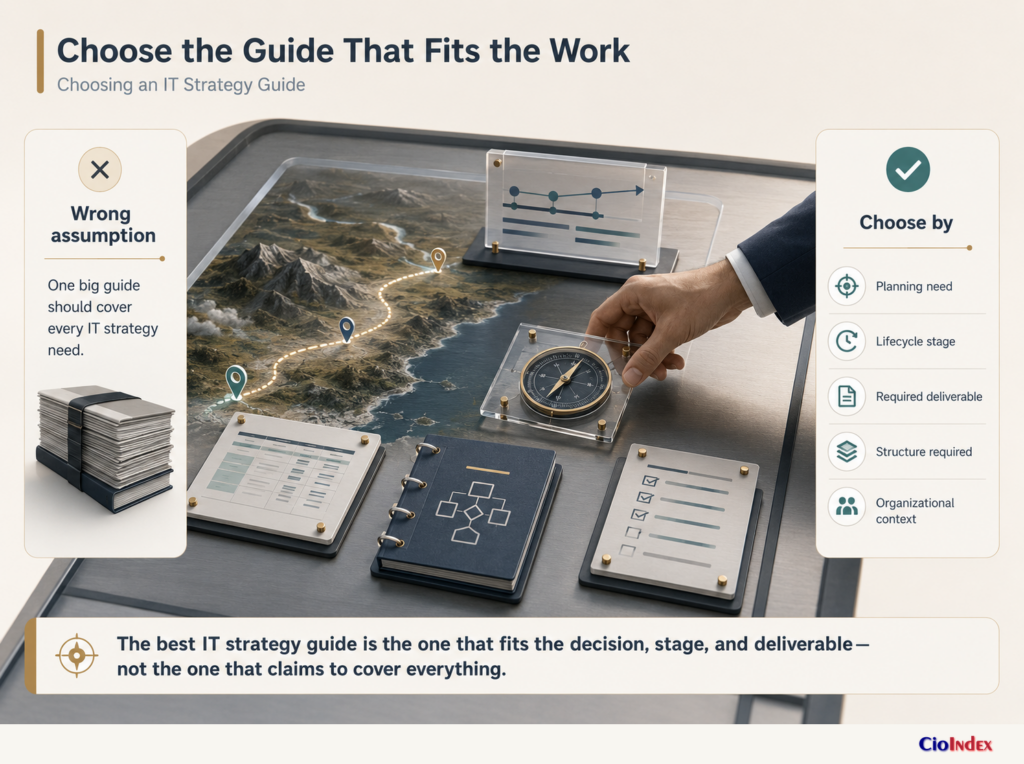
How to Choose an IT Strategy Guide
The usefulness of an IT strategy guide depends less on how much material it contains than on how closely it fits the work the organization must complete.
Before selecting one, answer five questions.
1. What are you trying to accomplish?
Different resources help with different outcomes. You may need to:
- understand IT strategy and strategic planning;
- create a formal IT strategy document;
- align IT priorities with business strategy;
- assess the current state of IT;
- define a future-state technology direction;
- identify and prioritize strategic initiatives;
- develop an IT investment plan;
- create an implementation roadmap;
- establish performance and benefits measures;
- adapt strategic planning for a smaller organization.
A guide designed for one of these purposes should not automatically be expected to address all the others.
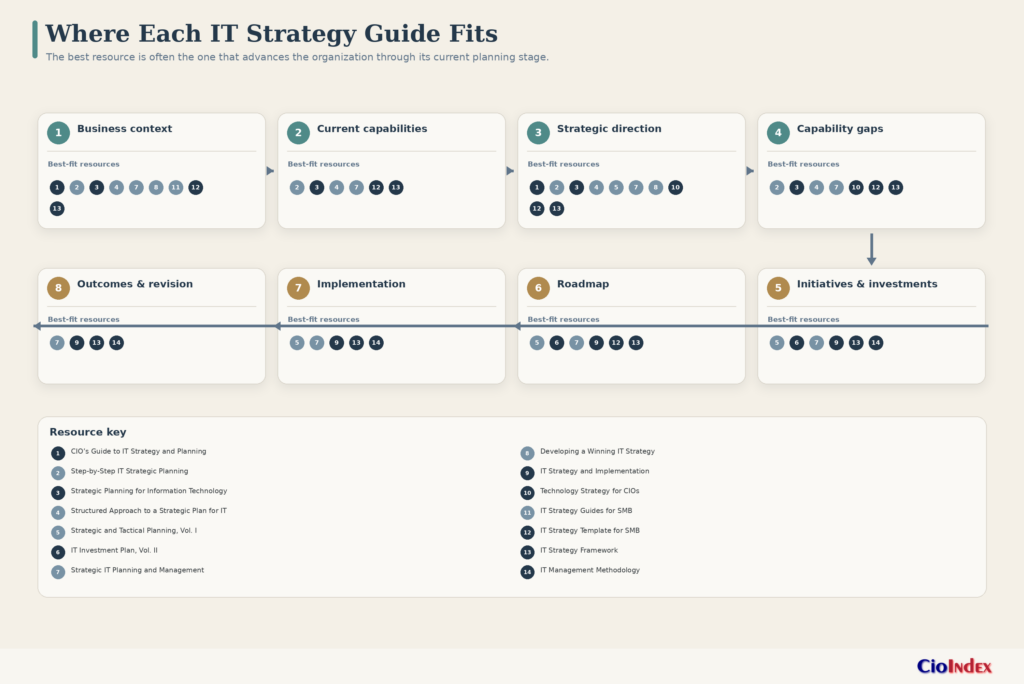
2. Where are you in the planning lifecycle?
A CIO beginning a strategy from scratch needs different guidance from one who already has an approved direction but lacks an executable investment plan.
The major planning stages include:
- understanding the business context;
- assessing current capabilities and constraints;
- defining strategic direction;
- identifying capability gaps;
- selecting initiatives and investments;
- developing the roadmap;
- implementing the strategy;
- measuring outcomes and revising the plan.
The best guide is often the one that helps the organization advance through its current stage—not the one that tries to cover every stage equally.
3. How much structure does the organization need?
Some teams need a detailed methodology with prescribed steps, analytical tools, and formal deliverables. Others need a lighter framework that creates discipline without overwhelming the planning effort.
The appropriate level of structure depends on:
- organizational size;
- planning maturity;
- technology complexity;
- regulatory obligations;
- stakeholder expectations;
- available time and expertise;
- the importance of the decisions being made.
More structure can improve consistency, but excessive structure can turn strategy development into a document-completion exercise.
4. What must the planning effort produce?
A planning resource should be judged partly by the output it helps create.
That output might be:
- a statement of strategic direction;
- a complete IT strategy document;
- a set of strategic principles;
- a future-state capability model;
- an initiative portfolio;
- an IT investment plan;
- a multiyear roadmap;
- a performance framework;
- an implementation and governance system.
A template may help organize one of these outputs. A methodology should explain how to reach the decisions that belong inside it.
5. What organizational context must the guide accommodate?
Guidance developed for a large enterprise, government agency, or highly regulated organization may embed assumptions that do not apply to a small or midsized business.
The underlying principles may remain useful, but CIOs must account for differences in:
- decision rights;
- governance;
- funding;
- scale;
- sourcing;
- compliance;
- planning horizons;
- organizational capacity;
- stakeholder participation.
A guide should support judgment, not replace it.
Quick Comparison of the 14 IT Strategy Resources
| Resource | Best suited for | Primary planning contribution |
|---|---|---|
| CIO’s Guide to IT Strategy and Planning | Broad orientation and end-to-end planning | Connects strategy, planning, alignment, value, and IT leadership |
| A Step-by-Step Guide to IT Strategic Planning | Teams needing a defined planning sequence | Organizes the strategic planning journey |
| Strategic Planning for Information Technology | Creating a formal and comprehensive plan | Explains planning framework, process, and deliverables |
| A Structured Approach to Create a Strategic Plan for IT | Strengthening business–IT alignment | Translates business priorities into IT choices |
| The Definitive Guide to IT Strategic and Tactical Planning, Vol. I | Connecting long-term direction to near-term planning | Integrates strategic and tactical planning |
| The Ultimate Guide to Developing an Effective IT Investment Plan, Vol. II | Converting strategic priorities into investments | Supports investment planning and prioritization |
| Strategic IT Planning and Management Guide | Connecting planning with ongoing management | Bridges strategy development and management |
| Developing a Winning IT Strategy | Exploring strategic differentiation and business models | Connects IT strategy with competitive value |
| IT Strategy and Implementation | Moving from strategy to coordinated action | Emphasizes implementation |
| Technology Strategy: A Guide for CIOs | Making technology-direction choices | Connects technology choices to business value |
| IT Strategy Guides for SMB | Exploring planning guidance for smaller organizations | Curates SMB-oriented strategy resources |
| IT Strategy Template with Guidance for SMB | Producing a proportionate strategy document | Combines a template with simplified guidance |
| IT Strategy Framework | Establishing a reusable development and implementation structure | Provides a strategy framework |
| A Guide to IT Management Methodology | Managing initiatives around intended outcomes | Introduces an outcome-management methodology |
1. CIO’s Guide to IT Strategy and Planning
Best suited for: CIOs who need a broad introduction to the disciplines and decisions involved in IT strategy and planning.
This resource is a logical starting point when the leadership team needs to understand how the major parts of IT strategy fit together. Rather than concentrating on one planning artifact, it appears designed to provide orientation across strategic alignment, planning, business value, management, and the CIO’s leadership responsibilities.
That breadth can help a CIO establish a common vocabulary before assigning detailed analytical or document-development work. It can also help stakeholders understand that an IT strategy is not simply a list of technology projects.
Use it when:
- the organization is establishing a formal IT strategy discipline;
- participants need a shared understanding of the planning process;
- the CIO needs to connect business alignment, value, governance, and technology direction;
- the team is not yet ready to choose a more specialized methodology.
Do not rely on it alone when:
The immediate need is a detailed investment model, implementation roadmap, or specialized planning deliverable. Broad guidance may establish the landscape without providing every tool required to complete each stage.
Contribution: A common understanding of IT strategy and a foundation for selecting more specialized planning resources.
2. A Step-by-Step Guide to IT Strategic Planning
Best suited for: Teams that understand the need for IT strategy but require a clear planning sequence.
The phrase “step by step” matters when an organization’s primary problem is not conceptual understanding but process discipline. Strategy efforts frequently stall because participants do not know what must happen first, which decisions depend on earlier analysis, or how the work should progress toward an approved plan.
A sequential guide can reduce that uncertainty by organizing the planning journey into manageable stages.
Use it when:
- the team needs a defined place to begin;
- planning responsibilities must be coordinated;
- stakeholders need visibility into the process;
- the organization has previously approached strategy in an ad hoc manner.
Do not rely on it alone when:
The steps are followed mechanically without sufficient evidence, debate, or executive judgment. A process can organize strategic thinking, but it cannot guarantee the quality of the choices produced.
Contribution: A repeatable sequence for conducting the IT strategic planning effort.
3. Strategic Planning for Information Technology
Best suited for: CIOs and planning teams developing a formal, detailed IT strategic plan.
At approximately 250 pages, this resource appears intended as a substantial planning reference rather than a quick overview. Its stated coverage of the framework, process, and deliverables of IT strategic planning makes it potentially valuable for organizations that need to construct a complete planning system.
The depth may help teams understand not only what belongs in an IT strategic plan, but how the different analyses and decisions relate to one another.
Use it when:
- the organization is undertaking a major planning exercise;
- the final plan must withstand executive or governance scrutiny;
- the team needs detailed reference material;
- multiple participants require a consistent planning approach.
Do not rely on it alone when:
The organization lacks the capacity to absorb an extensive methodology. A detailed reference should be adapted into a practical work plan rather than treated as a book that every participant must read from beginning to end.
Contribution: A comprehensive planning framework and a structured set of strategy deliverables.
4. A Structured Approach to Create a Strategic Plan for IT
Best suited for: CIOs whose central challenge is aligning technology priorities with business strategy.
This resource appears differentiated by its focus on the relationship between business direction and the choices available to IT. Business priorities create demand, constraints, and value expectations. The CIO must then determine how technology assets, infrastructure, organization, and processes should adapt.
That is a stronger strategic foundation than beginning with a list of desired technologies.
Use it when:
- IT priorities are disconnected from business objectives;
- the organization needs to translate business strategy into technology implications;
- proposed initiatives lack a clear business rationale;
- the CIO must demonstrate why particular technology capabilities or investments matter.
Do not rely on it alone when:
Alignment is treated as the final strategy rather than one of its governing inputs. A complete IT strategy must still address choices, trade-offs, investments, execution, risk, and performance.
Contribution: A structured connection between business priorities and the required evolution of IT.
5. The Definitive Guide to IT Strategic and Tactical Planning, Volume I
Best suited for: Organizations that struggle to connect long-term strategic direction with shorter-term operating plans.
One common failure in IT planning is the separation of strategy from execution. The strategic plan describes an attractive future, while annual budgets, resource plans, and operational priorities continue to follow established patterns.
A resource that deliberately connects strategic and tactical planning can help preserve continuity between long-term direction and near-term action.
Use it when:
- strategy and annual planning operate as separate exercises;
- tactical priorities do not clearly advance strategic objectives;
- the organization needs a repeatable planning rhythm;
- leaders need to distinguish long-term choices from near-term commitments.
Do not rely on it alone when:
Tactical planning is allowed to dilute strategic choices. Connecting the two does not mean turning strategy into a collection of immediate activities.
Contribution: A planning system that connects strategic direction with tactical priorities and management activity.
6. The Ultimate Guide to Developing an Effective IT Investment Plan, Volume II
Best suited for: CIOs who have established strategic priorities and must convert them into a defensible investment plan.
An IT strategy expresses direction and choices. An investment plan determines where money, people, and organizational capacity will be committed to make that direction real.
This resource is therefore best viewed as a downstream companion to strategy formulation. It may help CIOs evaluate proposed investments, organize them into a coherent portfolio, and explain how funding decisions support strategic objectives.
Use it when:
- strategic priorities have already been established;
- investment requests exceed available resources;
- initiatives need to be evaluated consistently;
- the CIO must connect spending decisions with strategic outcomes;
- leadership needs a multiyear view of technology investment.
Do not rely on it alone when:
The organization has not made the strategic choices that should govern investment. Prioritizing projects without an agreed strategy can produce a more orderly portfolio without producing a more strategic one.
Contribution: A structured IT investment plan tied to strategic priorities.
7. Strategic IT Planning and Management Guide
Best suited for: Organizations seeking to connect the creation of an IT plan with its ongoing use in management.
Many plans lose relevance shortly after approval because planning is treated as an episodic documentation exercise. A planning-and-management resource can be useful when the larger need is to make the strategy part of operating decisions, governance, and performance review.
Use it when:
- previous strategies were approved but not actively managed;
- planning and operational governance are disconnected;
- leaders need to understand how a strategic plan should influence recurring decisions;
- the organization needs a more durable planning discipline.
Do not rely on it alone when:
Its planning methodology or deliverables do not provide enough detail for the organization’s situation. The specific contents should be reviewed before treating it as the primary strategy-development resource.
Contribution: A bridge between strategic planning and ongoing IT management.
8. Developing a Winning IT Strategy
Best suited for: CIOs examining how technology can support differentiated business models and competitive value.
Some IT strategies are dominated by internal concerns: cost, infrastructure, applications, service performance, and risk. Those concerns matter, but they do not fully address technology’s potential contribution to market position, customer value, or new business capabilities.
A guide focused on differentiated business models can help expand the strategic conversation beyond operational support.
Use it when:
- business leaders expect technology to contribute to growth or differentiation;
- the organization is reconsidering its business model;
- digital capabilities are changing how value is created or delivered;
- IT strategy has become too internally focused.
Do not rely on it alone when:
High-level differentiation is not translated into capabilities, investments, accountabilities, and execution. Strategic ambition must ultimately become an operating commitment.
Contribution: A business-value and differentiation lens for IT strategy.
9. Driving Organizational Excellence: The Definitive Guide to IT Strategy and Implementation
Best suited for: CIOs who need to move from an approved strategic direction into coordinated implementation.
Organizations rarely fail because they cannot write aspirations. They fail because the strategy does not alter priorities, funding, governance, behavior, or execution.
A resource that addresses both strategy and implementation may help bridge this gap, particularly when the organization already knows where it wants to go but lacks a reliable mechanism for getting there.
Use it when:
- the strategy has been approved but momentum is weak;
- initiatives are not coordinated around a common direction;
- stakeholders interpret the strategy differently;
- implementation ownership is unclear;
- the roadmap needs stronger organizational support.
Do not rely on it alone when:
The strategy itself has not been adequately developed or tested. Implementation discipline cannot repair an incoherent strategic direction.
Contribution: A stronger connection between strategic intent and organizational execution.
10. Technology Strategy: A Guide for CIOs to Create and Deliver Business Value
Best suited for: CIOs making major technology-direction choices that must be justified in terms of business value.
Technology strategy addresses decisions about the technologies, platforms, architectures, and capabilities the organization will adopt, develop, modernize, retain, or retire. These decisions should be governed by the broader IT and business strategy rather than made in isolation.
This resource may be particularly useful when technology choices have become strategically consequential.
Use it when:
- the organization must make major platform or architecture decisions;
- technology choices are affecting business capability and competitiveness;
- leaders need to connect modernization with measurable value;
- the technology portfolio lacks a coherent direction.
Do not rely on it alone when:
Technology strategy is treated as synonymous with the complete enterprise IT strategy. The wider strategy may also need to address governance, organization, sourcing, service delivery, talent, investment, risk, and execution.
Contribution: A value-oriented direction for major technology decisions.
11. IT Strategy Guides for SMB
Best suited for: Leaders in small and midsized organizations exploring planning resources appropriate to their scale.
An SMB often needs the same strategic clarity as a large enterprise but cannot support the same planning overhead. A curated digest can help leaders identify resources that emphasize proportionate analysis, simpler governance, and practical execution.
Because this resource is a collection rather than one standalone methodology, its usefulness lies partly in helping readers identify suitable next resources.
Use it when:
- enterprise planning methods appear too complex;
- the organization has limited specialist planning capacity;
- the IT leader performs several roles;
- the strategy must be practical, concise, and affordable.
Do not rely on it alone when:
The organization’s complexity, regulation, or transformation agenda requires deeper analysis than a simplified approach provides.
Contribution: A starting point for finding appropriately scaled IT strategy guidance.
12. IT Strategy Template with Guidance for SMB
Best suited for: Small and midsized organizations that need a practical structure for producing an IT strategy document.
A template can reduce the effort required to organize a plan and help prevent material sections from being overlooked. The accompanying guidance makes this resource more useful than a blank document structure.
Its strongest value is likely proportionality: enough structure to support disciplined planning without imposing an enterprise-scale methodology.
Use it when:
- the organization needs to create its first formal IT strategy;
- the planning team is small;
- a concise and usable document is more valuable than an elaborate planning system;
- the CIO needs a practical starting structure.
Do not rely on it alone when:
The team expects the template to supply the strategic answers. Completing sections does not ensure that assumptions were tested, alternatives considered, or difficult trade-offs made.
Contribution: A proportionate structure for creating an SMB IT strategy document.
13. IT Strategy Framework: A Guide for CIOs to Develop and Implement IT Strategies That Deliver Results
Best suited for: CIOs seeking a reusable structure that connects strategy development with implementation.
A framework can make a complex discipline easier to understand by showing the major components and their relationships. It can also create consistency across planning cycles without prescribing every activity in detail.
This resource may suit organizations that need a governing structure but want flexibility in the specific tools and techniques used within it.
Use it when:
- the organization needs a repeatable strategy framework;
- planning terminology and activities are inconsistent;
- development and implementation are treated as disconnected stages;
- the CIO wants a structure that can be adapted over time.
Do not rely on it alone when:
The framework remains conceptual. Each component must eventually be translated into decisions, responsibilities, evidence, deliverables, and management practices.
Contribution: A reusable structure for developing and implementing IT strategy.
14. A Guide to IT Management Methodology
Best suited for: CIOs interested in managing technology initiatives around outcomes rather than activity completion alone.
This resource introduces Outcome Management, an IT planning and management methodology associated with the Canadian government. Its emphasis on outcomes is valuable because organizations often confuse delivering a project with realizing the intended business result.
The public-sector origin may also provide useful rigor around governance, accountability, and benefits. At the same time, its assumptions and terminology may require adaptation in other environments.
Use it when:
- projects are completed without clear evidence of realized value;
- expected outcomes are not defined precisely;
- responsibility for benefits is unclear;
- the organization needs a stronger connection between planning, delivery, and results.
Do not rely on it alone when:
The organization needs a complete enterprise IT strategy methodology. Outcome management can strengthen planning and execution, but it addresses a particular management problem.
Contribution: A disciplined way to define, manage, and evaluate the outcomes expected from IT initiatives.
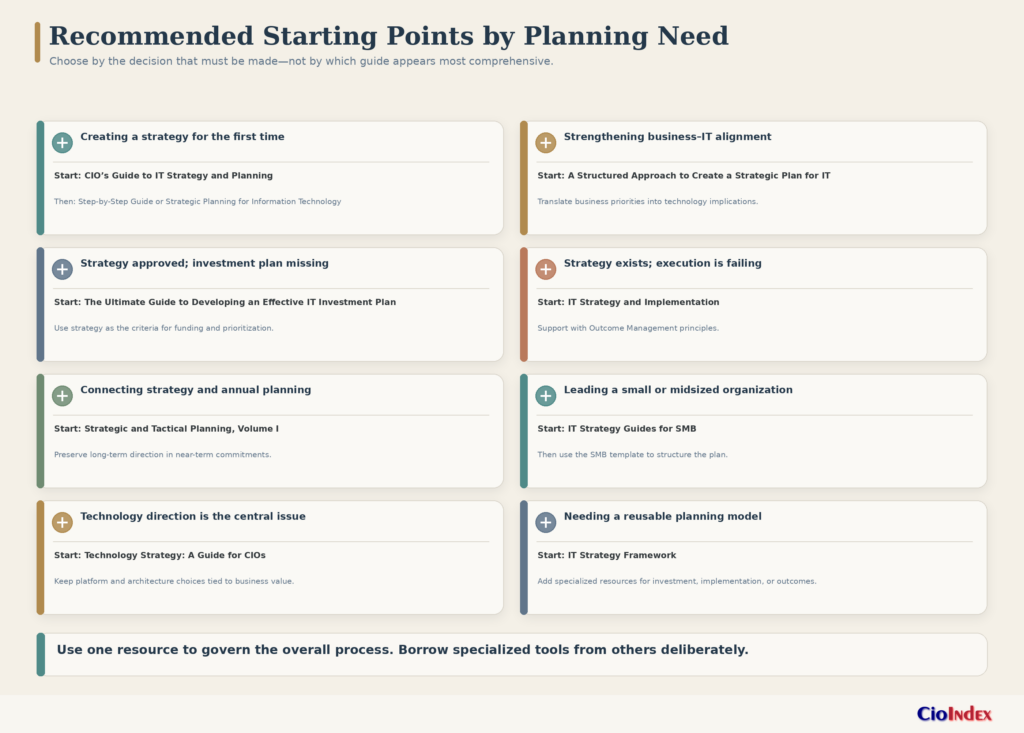
Recommended Starting Points by Planning Need
No single resource is the right starting point for every organization. The following pathways provide a more practical way to choose.
You are creating an IT strategy for the first time
Begin with a broad orientation resource such as the CIO’s Guide to IT Strategy and Planning. Then select a structured planning resource, such as A Step-by-Step Guide to IT Strategic Planning or Strategic Planning for Information Technology.
Use the broad resource to understand the discipline and the structured resource to organize the work.
You need to strengthen business–IT alignment
Start with A Structured Approach to Create a Strategic Plan for IT.
Its apparent focus on connecting business priorities with changes to IT assets, infrastructure, organization, and processes makes it the most directly aligned with this problem.
You already have a strategy but need an investment plan
Use The Ultimate Guide to Developing an Effective IT Investment Plan.
The governing strategy should already be sufficiently clear to provide criteria for evaluating and prioritizing investments.
You have a strategy but execution is failing
Consider Driving Organizational Excellence: The Definitive Guide to IT Strategy and Implementation, supported by the outcome-management principles in A Guide to IT Management Methodology.
One resource can help connect direction to coordinated action; the other can strengthen accountability for results.
You need to connect strategic and annual planning
Use The Definitive Guide to IT Strategic and Tactical Planning, Volume I.
The central task is to preserve strategic direction as the organization makes shorter-term commitments.
You lead a small or midsized organization
Begin with IT Strategy Guides for SMB to identify appropriate resources. Then use the IT Strategy Template with Guidance for SMB to structure the plan.
The objective should not be to reproduce an enterprise planning bureaucracy on a smaller scale. It should be to create enough analysis and structure to support sound choices.
Technology direction is the central strategic issue
Use Technology Strategy: A Guide for CIOs to Create and Deliver Business Value, while ensuring the resulting technology choices remain connected to the broader enterprise IT strategy.
You need a reusable planning model
Consider the IT Strategy Framework as the governing structure, supplemented by specialized resources for investment, implementation, or outcome management.
Three Ways to Use These Resources
Selecting a guide is only the beginning. CIOs must also decide how it will be used.
Path 1: Build a Complete Strategy from Scratch
A practical sequence is:
- establish a shared understanding of IT strategy;
- choose one governing planning methodology;
- assess the business and current IT environment;
- define strategic direction and future capabilities;
- identify gaps and strategic initiatives;
- translate priorities into an investment plan;
- build the roadmap;
- establish implementation governance;
- define outcomes and performance measures.
Different resources can support different steps, but one methodology should govern the overall process.
Path 2: Repair an Existing Strategy
Do not begin by rewriting the document. First determine why the existing strategy is not working.
Typical causes include:
- weak connection to business priorities;
- too many initiatives and too few choices;
- unclear outcomes;
- unrealistic funding or capacity assumptions;
- lack of ownership;
- failure to connect strategy with annual planning;
- inadequate implementation governance;
- no mechanism for reviewing assumptions.
Select resources that address the actual failure. A new template will not solve an alignment problem, and a new roadmap will not solve an incoherent strategy.
Path 3: Create a Proportionate SMB Strategy
Smaller organizations should concentrate on the decisions with the greatest business consequence.
A proportionate strategy may focus on:
- the business capabilities technology must support;
- the most significant risks and constraints;
- the target technology direction;
- a limited set of strategic priorities;
- an affordable roadmap;
- clear ownership;
- a small number of meaningful measures;
- a regular review cycle.
The strategy can be concise without being superficial.
Common Mistakes When Selecting an IT Strategy Guide
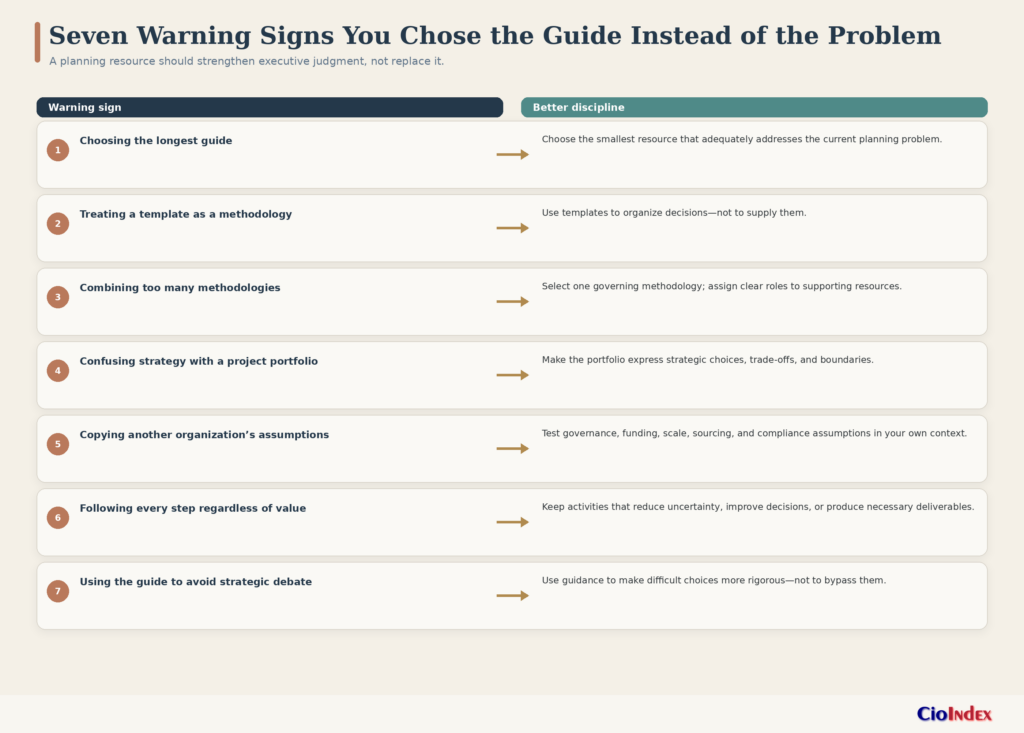
Choosing the Longest Guide
Length may indicate depth, but it does not prove relevance. An extensive guide can introduce unnecessary analysis and slow the planning effort.
Choose the smallest resource that adequately addresses the current planning problem while connecting its output to the next stage of work.
Treating a Template as a Methodology
A template tells the team where information belongs. It does not explain how to obtain reliable information, resolve competing priorities, evaluate alternatives, or make strategic choices.
Templates are useful containers. They are not substitutes for reasoning.
Combining Too Many Methodologies
Using several resources can add value, but only when they are assigned clear roles.
Problems arise when teams combine:
- different planning sequences;
- inconsistent terminology;
- competing definitions of strategy;
- overlapping deliverables;
- incompatible evaluation methods.
Choose one governing methodology. Borrow specialized tools from other resources deliberately.
Confusing Strategy with a Project Portfolio
A list of approved or proposed initiatives is not an IT strategy.
The strategy should explain:
- what the organization is trying to accomplish;
- which capabilities matter;
- what choices have been made;
- what will not be pursued;
- how investments create value;
- which risks and constraints govern execution.
The portfolio should express those choices.
Copying Another Organization’s Assumptions
A guide may contain assumptions shaped by its original environment. Those assumptions may concern governance, funding, regulation, organization, sourcing, risk, or planning maturity.
Adopt useful principles, but test every prescribed practice against the organization’s own context.
Following Every Step Regardless of Value
A structured process is valuable because it prevents omissions and creates discipline. It becomes counterproductive when teams perform activities simply because the guide contains them.
Every major activity should contribute to a decision, reduce uncertainty, build agreement, or produce a necessary deliverable.
Using the Guide to Avoid Strategic Debate
No guide can remove the need to make difficult choices.
The leadership team may still need to decide:
- which capabilities matter most;
- which systems should be modernized or retired;
- where standardization is required;
- how much risk is acceptable;
- which investments should not proceed;
- what the organization can realistically deliver;
- what trade-offs must be made.
A guide should make those debates more rigorous, not allow the organization to bypass them.
How to Make the Final Choice
Before selecting a guide, ask:
- What decision or deliverable must this planning effort produce?
- Which stage of the planning lifecycle are we in?
- What is currently preventing progress?
- How much structure can the organization realistically absorb?
- Which assumptions in the guide must be adapted?
- What additional guidance will be needed after this stage?
- Who will own the resulting decisions and actions?
Then choose the resource that best fits those answers.
The most impressive guide is not necessarily the most useful one. The right guide provides enough structure to improve the organization’s thinking without replacing judgment, obscuring the real decisions, or making the planning effort unnecessarily complex.
Browse the Complete IT Strategy Guides Library
These 14 resources represent different starting points for IT strategy development, planning, investment, implementation, and outcome management. They are an editorial selection—not the complete CIO Index inventory.
For additional guidebooks, handbooks, manuals, frameworks, and strategic planning resources, browse the complete IT Strategy Guides Library.