

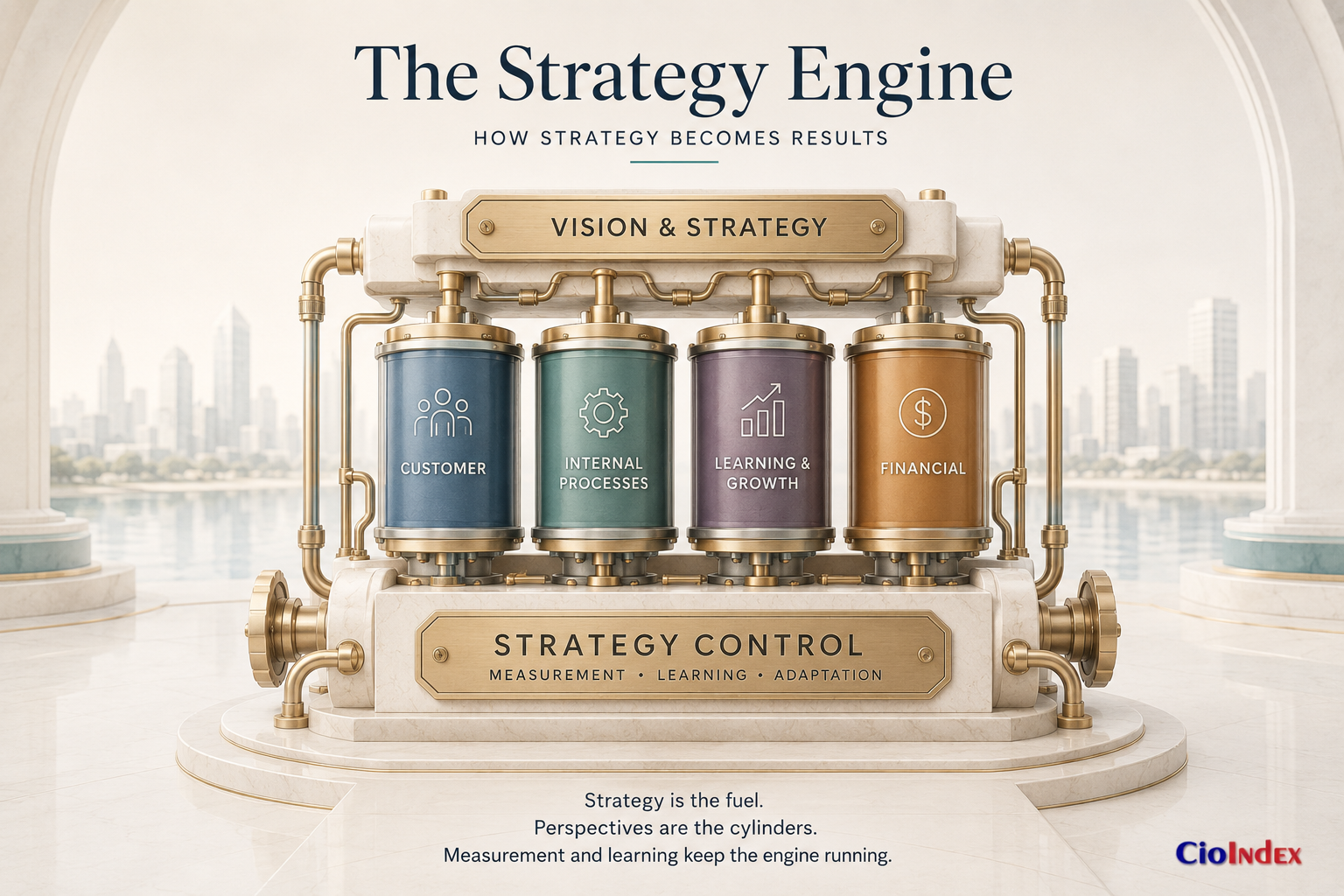
A Balanced Scorecard is a strategy-management system that translates a strategic direction into connected objectives, measures, targets, initiatives, ownership, and management decisions. It combines financial and nonfinancial perspectives so leaders can see not only the outcomes an organization wants, but also the customer, process, and capability conditions expected to produce them.
That definition explains the method. It does not answer the harder leadership question:
Is the organization managing strategy—or maintaining a dashboard that merely looks strategic?
A scorecard can be balanced across four perspectives, populated with precise measures, automated in polished software, and reviewed every month while still measuring the wrong strategy. It can create the appearance of alignment without resolving strategic disagreement. It can imply cause and effect without proving it. It can reward local performance while the wider enterprise result deteriorates.
The Balanced Scorecard creates value when it becomes a disciplined way to state, test, govern, and revise a strategy. It creates bureaucracy when it becomes a classification system for metrics.
For CIOs, this distinction is consequential. Technology organizations already generate abundant operational data. The problem is rarely the absence of measures. The problem is deciding which technology capabilities, operating changes, investments, and risks matter to enterprise strategy—and what leadership will do when the evidence challenges the plan.
This article explains the Balanced Scorecard broadly—its purpose, perspectives, mechanics, benefits, limitations, implementation, and relationship to other management tools. It also applies the CIO Index Balanced Scorecard Validity Test, a five-condition decision lens for determining whether a scorecard can genuinely improve strategic control or will merely organize reporting.
The distinction governing the article is simple: measurement balance is not strategic validity. A scorecard becomes strategically useful only when the strategy is clear, its causal assumptions are credible, its measures validly represent the objectives, its findings change decisions, and the organization can govern the system over time.
What Is a Balanced Scorecard?
Robert S. Kaplan and David P. Norton introduced the Balanced Scorecard in 1992 as a way to supplement financial measures with indicators concerning customers, internal processes, and organizational learning and growth. The concept subsequently developed from a performance-measurement framework into a broader strategy-management system. Harvard Business School material describes the later framework as a way to put strategy at the center of management processes and to represent strategic hypotheses through linked objectives in a strategy map.[1][2]
The classic four perspectives are:
- Financial: What economic or stewardship outcomes must the organization produce?
- Customer: What value must it create for customers or stakeholders?
- Internal process: Which processes must perform differently to create that value?
- Learning and growth: Which people, information, technology, culture, and organizational capabilities must improve to support those processes?
The labels can be adapted. Public agencies may place mission or stakeholder outcomes above financial stewardship. A technology organization may use business contribution, stakeholder value, operational excellence, and future readiness. The important feature is not the labels themselves. It is the logic that connects desired outcomes to the capabilities and actions expected to produce them.
A practical CIO definition is:
A Balanced Scorecard is a strategy-control system that makes leadership’s strategic assumptions visible, measurable, actionable, and reviewable.
That definition separates the Balanced Scorecard from three common substitutes:
- A KPI dashboard reports selected performance signals.
- A project portfolio shows where money and effort are allocated.
- An operating report shows whether services, projects, risks, and finances remain within expected limits.
All three may support a Balanced Scorecard. None becomes one merely by arranging measures under four headings.
This distinction establishes what a Balanced Scorecard is, but not whether a particular scorecard is strategically sound. To make that judgment, leadership must look beyond its four perspectives and examine the problem the framework is supposed to solve: the recurring separation between strategic intention, operating activity, evidence, and executive decision.
Why the Balanced Scorecard Exists
Financial results matter, but they are generally lagging outcomes. They often show what happened after the capabilities, customer choices, process performance, and investment decisions that produced the result. Kaplan and Norton’s original intervention was to broaden management attention beyond financial reporting and connect present operating drivers to future results.
The deeper problem remains current. Organizations often manage strategy in bursts: leaders formulate a plan, approve investments, and then return to operational fire-fighting. Harvard Business School’s discussion of strategy execution describes the Balanced Scorecard as part of a continual management system linking strategy and operations rather than allowing strategic intent to fade behind daily demands.[3]
For CIOs, the gap appears in familiar forms:
- The enterprise says digital experience is strategic, but technology funding remains organized by systems rather than customer journeys.
- The board calls resilience a priority, but scorecards emphasize availability while ignoring concentration risk, recovery capability, and unresolved technical debt.
- Leadership announces an AI strategy, but measures count pilots, users, or models rather than decision quality, process change, economic value, and control effectiveness.
- The CIO reports project delivery, budget variance, and uptime while the business still cannot tell whether technology is improving the enterprise’s strategic position.
The Balanced Scorecard is meant to make those disconnects visible. Its purpose is not to create more measures. Its purpose is to force an explicit argument about how the strategy is supposed to work.
The Four Perspectives—and What They Do Not Prove
| Perspective | Core strategic question | CIO interpretation | Illustrative measures |
|---|---|---|---|
| Financial or stewardship | What economic, fiduciary, or mission value must result? | Are technology investments improving growth, cost, risk, resilience, or mission performance? | Benefits realized, unit cost, cost-to-serve, avoided loss, value delivered |
| Customer or stakeholder | What outcomes must customers and stakeholders experience? | Are employees, customers, partners, regulators, and business units receiving better digital outcomes? | Digital completion, customer effort, service trust, adoption, stakeholder confidence |
| Internal process | Which operating capabilities must perform differently? | Which delivery, architecture, security, data, service, and vendor processes must improve? | Lead time, restoration quality, defect escape, data reliability, control performance |
| Learning and growth or organizational capacity | What enables sustained improvement? | Do talent, platforms, information, culture, governance, and leadership support the strategy? | Critical skill coverage, platform reuse, decision latency, data fitness, leadership capacity |
The four perspectives help prevent one-dimensional management. A CIO who reports only cost may underinvest in resilience, data, skills, and trust. A CIO who reports only delivery velocity may accelerate work that creates little enterprise value. A security function that reports only control completion may overlook whether the controls materially reduce exposure.
But balance does not establish validity.
A scorecard can distribute measures elegantly across the four perspectives and still be wrong in at least five ways:
- The strategy itself may be unclear or internally contradictory.
- The selected objectives may not represent the strategy.
- The measures may not validly represent the objectives.
- The assumed causal relationships may be untested or false.
- The review process may not change decisions.
This is the Balanced Scorecard equivalent of a critical measurement principle:
Measurement balance is not strategic validity.
A well-maintained scorecard can institutionalize the wrong strategy just as efficiently as it can support the right one.
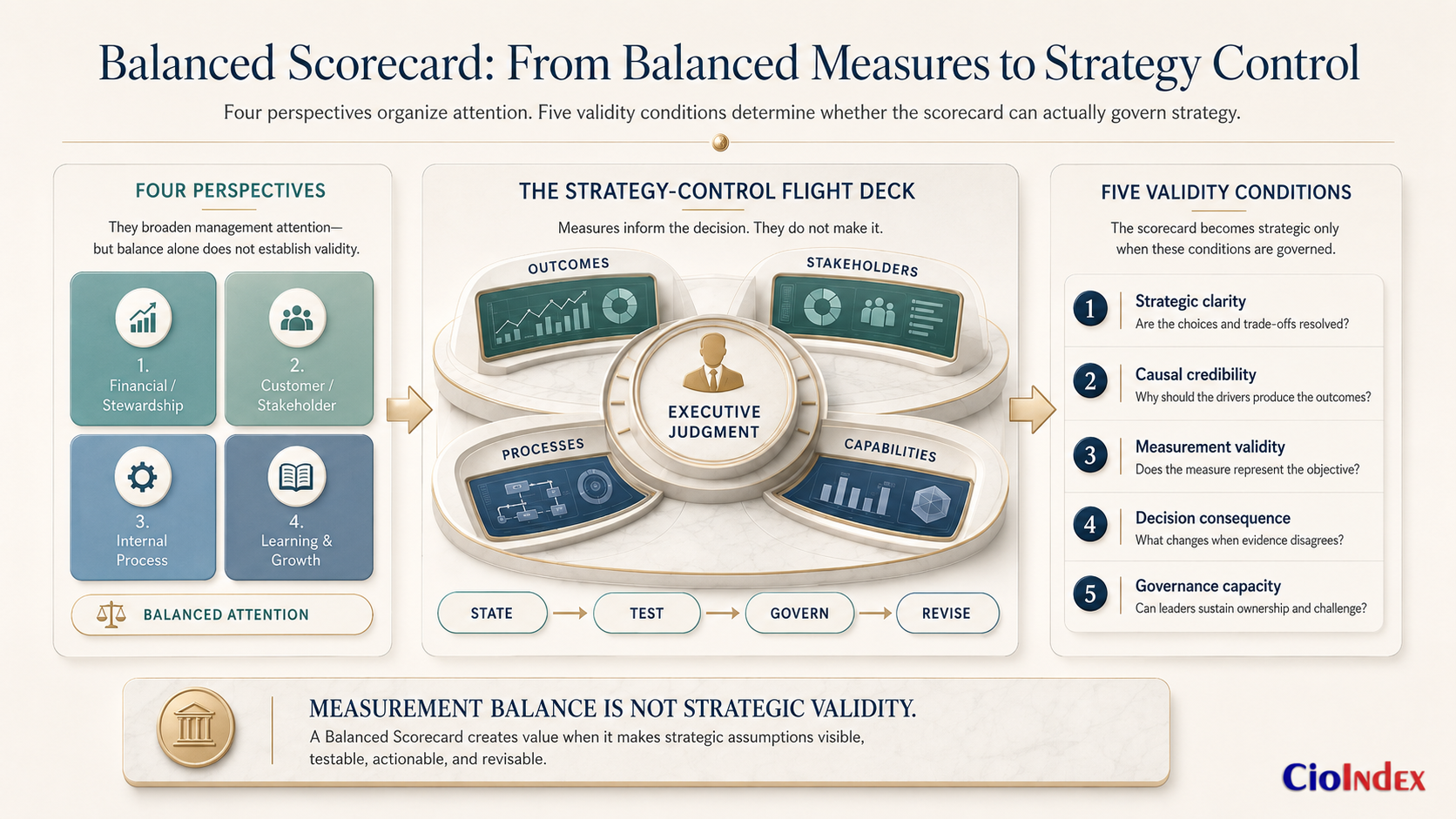
That is the limitation conventional Balanced Scorecard explanations often leave unresolved. The four perspectives can widen management attention, but they cannot establish that the strategy is coherent, that the measures represent it, or that the organization will act intelligently on the evidence.
The relevant question is therefore no longer merely, “Are all four perspectives represented?” It is, “What chain of choices, assumptions, evidence, ownership, and decisions makes this scorecard strategically valid?”
How a Balanced Scorecard Works
A Balanced Scorecard works only when it connects two different structures. The first is the object structure: outcomes, objectives, measures, targets, initiatives, owners, and review rules. The second is the decision structure: what leadership believes, what evidence would support or challenge that belief, who must respond, and what action follows.
Many weak scorecards build the first structure and omit the second.
A useful Balanced Scorecard creates an explicit chain from strategic intent to management action.
| Element | Decision it must clarify | Weak version | Stronger version |
|---|---|---|---|
| Strategic outcome | What must materially change? | “Improve digital” | “Reduce customer abandonment in the three highest-volume service journeys” |
| Objective | What condition must be achieved? | “Modernize platforms” | “Enable customers to complete eligible transactions without assisted support” |
| Measure | What evidence represents the objective? | “Projects completed” | “Share of eligible transactions completed successfully without assisted intervention” |
| Target | What result is sufficient, by when? | “Improve year over year” | “Increase successful digital completion from 54% to 72% by Q4 while maintaining fraud loss within tolerance” |
| Initiative | What intervention will move the objective? | “Transformation program” | “Identity redesign, journey simplification, API reliability work, and adoption support” |
| Owner | Who is accountable for interpreting and acting? | “IT and business” | “Chief Customer Officer owns the outcome; CIO and COO jointly own enabling interventions” |
| Review rule | What decision follows from the evidence? | “Discuss monthly” | “Reallocate funding, revise the journey, or challenge the causal hypothesis when leading measures move without outcome improvement” |
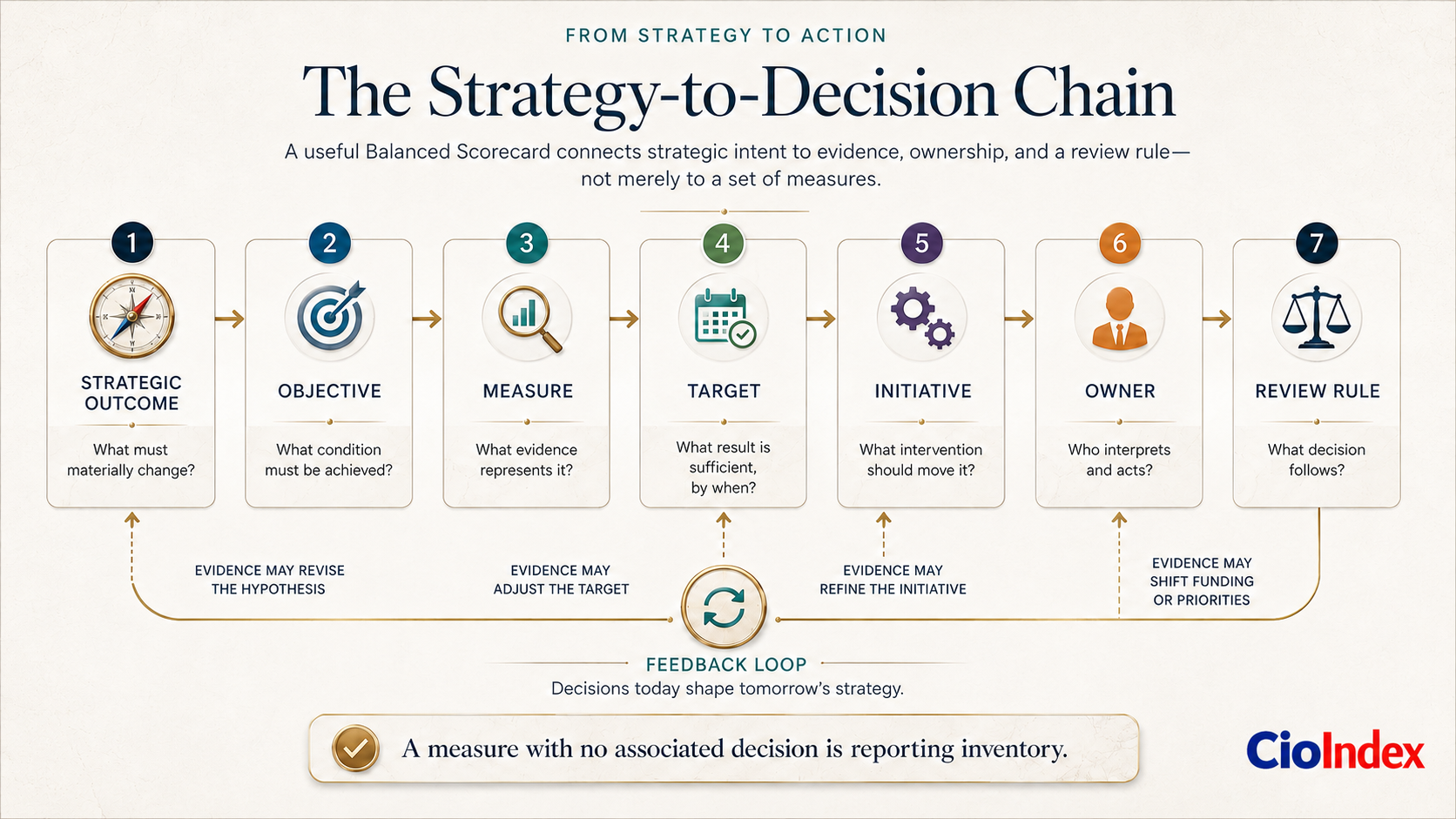
This chain matters because a scorecard is not merely a collection of observations. It is a set of managerial commitments:
- This is the outcome we value.
- These are the conditions we believe will produce it.
- These measures represent those conditions.
- These initiatives should move the measures.
- These people own the result.
- These are the decisions we will make when the evidence disagrees.
If any of those commitments remains implicit, the scorecard can report performance without governing strategy.
Strategy Maps: Useful Hypotheses, Not Proven Causality
A strategy map visually connects objectives across the perspectives. Kaplan describes financial and customer objectives as desired outcomes, while internal-process and learning-and-growth objectives describe how the organization intends to achieve them.[2]
The word intends is important.
A strategy map is best understood as a map of strategic hypotheses. It expresses leadership’s belief that improving one capability or process will contribute to another outcome. For example:
Better product-management capability → clearer prioritization → faster delivery of high-value features → higher adoption → improved economic value.
The sequence is plausible. It is not automatically true.
Several things may break the chain:
- Product-management capability improves, but decision rights remain fragmented.
- Delivery speed increases, but the features address the wrong customer problem.
- Adoption rises because use is mandated, not because value improved.
- Customer satisfaction improves while operating cost or risk becomes unacceptable.
- Financial performance changes because of pricing, market conditions, or another initiative.
Research and reviews of Balanced Scorecard implementation have repeatedly questioned the assumption that causal relationships between perspectives are sufficiently demonstrated. Recent systematic review work continues to distinguish logical or managerial causality from statistically tested causality and finds room for stronger empirical treatment.[4] Other research has examined how motivated reasoning can affect managers’ interpretation of scorecard evidence, particularly when they were involved in selecting the initiatives being evaluated.[5]
The practical conclusion is not that strategy maps are useless. It is that they should be governed as hypotheses.
A responsible strategy map should identify:
- the proposed relationship;
- the mechanism expected to produce the effect;
- the time lag;
- competing explanations;
- external conditions;
- evidence that would strengthen or weaken the hypothesis;
- the decision that follows if the relationship does not appear.
The scorecard should help leadership learn whether the strategy works. It should not convert an executive belief into an unquestioned causal fact.
Causal credibility is only one requirement. A scorecard can contain plausible strategic relationships and still fail because the strategy is unresolved, the measures are invalid, the evidence has no decision consequence, or the organization lacks the capacity to challenge and revise the system.
The CIO Index Balanced Scorecard Validity Test brings those requirements together. It is not another scorecard format. It is a decision lens for determining whether a proposed scorecard has the conditions required to operate as a strategy-control system.
The CIO Index Balanced Scorecard Validity Test
The CIO Index Balanced Scorecard Validity Test examines whether a proposed scorecard is capable of functioning as a strategy-control system rather than a reporting artifact.
It has five conditions:
- Strategic clarity
- Causal credibility
- Measurement validity
- Decision consequence
- Governance capacity
This is a CIO Index analytical framework, not an official Kaplan-Norton model or a validated scientific assessment.
1. Strategic clarity
Executive question: Is the strategy resolved enough to translate into a coherent set of choices and objectives?
Examine:
- explicit strategic choices and tradeoffs;
- target customers, stakeholders, or missions;
- value proposition;
- investment priorities;
- risks the organization accepts or rejects;
- capabilities that differentiate the strategy;
- objectives leadership is willing to stop funding.
A scorecard cannot resolve an absent strategy. When leaders disagree on the value proposition, operating model, risk posture, or investment priorities, the first task is strategy formation—not metric selection.
2. Causal credibility
Executive question: Is there a credible explanation for why the selected capabilities, processes, and initiatives should produce the desired outcomes?
Examine:
- stated mechanisms;
- sequence and time lag;
- dependencies;
- competing explanations;
- external drivers;
- evidence from pilots, prior periods, research, or analogous operations;
- conditions under which the relationship may fail.
A plausible arrow on a strategy map is a starting hypothesis, not proof.
3. Measurement validity
Executive question: Do the measures represent the strategic objective—or merely something easy to count?
Examine:
- operational definitions;
- data lineage;
- comparability;
- gaming risk;
- leading versus lagging behavior;
- customer and system-level consequences;
- whether the measure can improve while the objective worsens.
Consider technical debt. Counting applications retired may look like progress. But retirement can increase integration complexity, operational risk, or vendor concentration if the target architecture is poor. The number is precise; the strategic inference may be invalid.
4. Decision consequence
Executive question: What will leadership do differently when the measure moves, fails to move, or moves without the expected outcome?
Examine:
- funding decisions;
- policy changes;
- initiative continuation or termination;
- risk acceptance;
- ownership escalation;
- hypothesis revision;
- target revision;
- removal of obsolete measures.
A measure with no associated decision is usually reporting inventory.
5. Governance capacity
Executive question: Can the organization sustain the ownership, review, challenge, and adaptation needed to keep the scorecard valid?
Examine:
- named objective owners;
- measure owners and data stewards;
- review cadence;
- authority to intervene;
- cross-functional participation;
- conflict resolution;
- independent challenge;
- refresh rules;
- retirement rules.
A scorecard is not self-executing. Software can refresh the numbers, but it cannot resolve strategic disagreement, challenge a convenient measure, or withdraw an initiative whose sponsors remain committed to it.
Fit decisions
The Validity Test should result in one of six decisions:
- Use: The strategy and governance conditions are sufficiently mature.
- Redesign: The intent is sound, but objectives, measures, causal logic, or ownership need repair.
- Narrow: Apply the scorecard to a bounded strategic domain rather than the whole enterprise.
- Combine: Use it with complementary methods for experimentation, risk, portfolio choice, architecture, or operational control.
- Defer: Resolve strategy, measurement, ownership, or data prerequisites first.
- Avoid: Do not impose a scorecard where the work is exploratory, the strategy is unresolved, or the reporting burden exceeds the decision value.
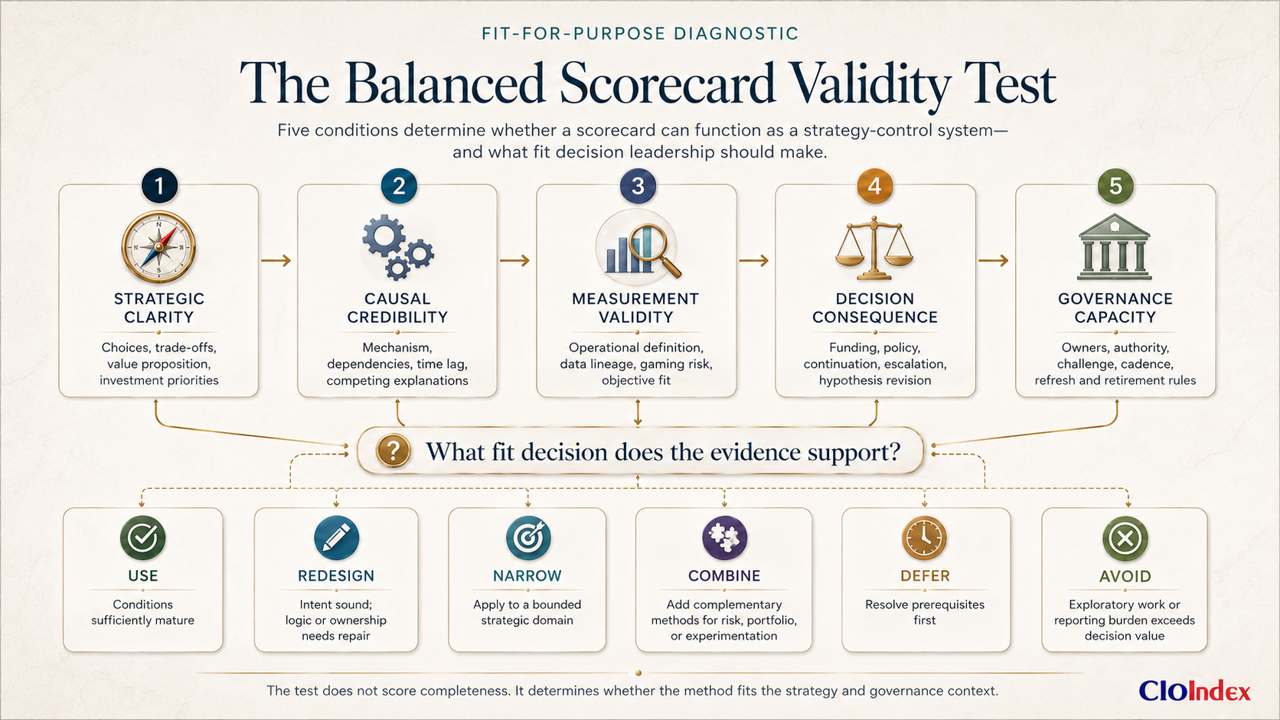
These are not merely implementation outcomes. They provide the decision logic for the remainder of the article. The fit and non-fit sections apply the five validity conditions to context. The benefits section explains what becomes possible when those conditions hold. The failure modes show what happens when they do not. The operating model then translates the same conditions into design and governance practice.
When a Balanced Scorecard Fits
A Balanced Scorecard is a stronger fit when:
- leadership has made real strategic choices;
- the strategy can be expressed as a manageable set of objectives;
- outcomes and drivers can be represented with credible evidence;
- cross-functional ownership is available;
- leaders are willing to change investments and priorities in response to the evidence;
- the organization needs to connect long-term capability building with near-term performance;
- strategy execution requires alignment across units, partners, or operating layers.
For CIOs, appropriate uses may include:
- enterprise digital strategy;
- technology operating-model transformation;
- cyber-resilience strategy;
- data and analytics strategy;
- cloud and platform strategy;
- technology investment and benefits realization;
- enterprise architecture outcomes;
- IT-business alignment;
- service transformation;
- workforce and capability development.
ISACA’s discussion of COBIT goals cascades illustrates a compatible logic: stakeholder needs are translated into enterprise goals, alignment goals, and governance and management priorities. ISACA has explicitly connected COBIT’s goals cascade with Balanced Scorecard perspectives and has described the IT Balanced Scorecard as a way to translate strategy into measurable components.[6][7]
Compatibility does not mean identity. COBIT provides a governance and management framework with goals, objectives, components, and practices. A Balanced Scorecard provides a strategy description and review system. They can reinforce each other, but neither should be reduced to the other.
When a Balanced Scorecard Does Not Fit
A Balanced Scorecard is a weaker fit when:
- the strategy is still being discovered;
- leaders have not made the tradeoffs the scorecard would supposedly represent;
- the environment changes faster than objectives and causal assumptions can be reviewed;
- the organization wants a prettier executive dashboard rather than a management system;
- measures are selected primarily because data are available;
- local units cannot be meaningfully aligned through one causal model;
- leadership will not stop initiatives or reallocate resources when evidence changes;
- reporting and cascading effort exceeds the value of the decisions produced.
It is especially weak as the primary method for:
- product discovery;
- emerging-technology exploration;
- unprecedented crisis response;
- architecture option analysis;
- adversarial security investigation;
- one-time strategic choices;
- innovation work where uncertainty and variation are still sources of learning.
The scorecard may later govern the repeatable capabilities surrounding those activities. It should not force premature certainty onto the exploratory work itself.
Benefits of a Balanced Scorecard
When the fit is sound, a Balanced Scorecard can create several forms of value.
None of these benefits comes from adopting the label or completing the artifact. Each depends on a mechanism. Strategy becomes more discussable because assumptions are made explicit. Investments become more aligned because they are connected to objectives and evidence. Management focus improves because leadership limits attention to strategically consequential measures. Learning occurs only when findings can challenge initiatives, targets, measures, and the strategy itself.
It makes strategy discussable
A strategy map and scorecard force leaders to express the strategy in a form that can be challenged. Objectives, dependencies, measures, and initiatives become visible rather than remaining inside presentations or executive intuition.
It connects capabilities to outcomes
The framework gives intangible assets—skills, information, culture, technology, and organizational capacity—a place in the strategic argument. HBS material describes strategy maps as linking those enabling conditions to process, customer, and financial outcomes.[2]
It aligns investments and operations
A scorecard can connect enterprise outcomes to investment portfolios, operating priorities, and accountability. This is particularly useful for CIOs because technology spending is often easier to classify by system or project than by strategic contribution.
It improves management focus
A well-designed scorecard reduces attention to a small number of strategic objectives rather than expanding into a universal metric catalog. It gives review meetings a shared structure and makes exceptions more visible.
It creates a learning loop
When treated as a hypothesis system, the scorecard helps leaders compare expected and observed relationships. It can reveal that an initiative improved a driver without improving the outcome—or that an outcome changed for reasons outside the strategy.
These benefits are conditional. A scorecard does not create strategic clarity merely because it is complete. It amplifies the quality of the choices, measures, and governance that produced it.
Common Failure Modes
1. Dashboard substitution
The organization arranges existing KPIs across four perspectives and calls the result a Balanced Scorecard.
Why it fails: The measures were not derived from a strategic thesis, and no causal or decision logic connects them.
2. Strategy decoration
The scorecard is created after major initiatives are already approved, giving existing commitments a strategic narrative.
Why it fails: Measurement is being used to legitimize decisions rather than test them.
3. Causal theater
A strategy map connects objectives with arrows, but no mechanism, time lag, competing explanation, or falsification condition is defined.
Why it fails: The map converts aspiration into apparent causality.
4. Metric validity failure
The measure is reliable and precise but does not represent the objective.
Example: A cybersecurity scorecard reports patch-compliance percentage while ignoring asset criticality, exposure, exploitability, compensating controls, and attack paths. The metric improves while material risk remains unchanged.
5. KPI proliferation
Every stakeholder adds measures until the scorecard becomes an enterprise reporting encyclopedia.
Why it fails: Strategic priorities disappear inside completeness.
6. Mechanical cascading
Enterprise objectives are copied into business-unit, function, team, and individual scorecards without preserving the original strategic logic.
Why it fails: Local measures become proxies for alignment, and units optimize their own targets.
7. Ownership ambiguity
Objectives are assigned to committees or “IT and the business.”
Why it fails: No one has the authority and obligation to interpret the evidence and change the operating system.
8. Incentive contamination
Measures become compensation targets before their validity and gaming risks are understood.
Why it fails: People optimize the reported number, sometimes at the expense of the underlying objective.
9. Review without intervention
Leaders discuss red and amber indicators but do not alter funding, initiatives, policy, ownership, or assumptions.
Why it fails: The scorecard becomes a ritualized explanation of variance.
10. Frozen strategy
The scorecard is treated as stable because changing it would disrupt trend lines and reporting processes.
Why it fails: The management system preserves obsolete strategic assumptions.
These failures appear different, but they share one underlying defect: the scorecard becomes detached from a genuine learning-and-control process. It may contain objectives, metrics, owners, meetings, and software, yet still lack a credible relationship between strategy, evidence, and intervention.
The practical test is whether the scorecard can cause leadership to question an assumption, revise an initiative, reallocate resources, accept or reduce risk, or abandon a strategic hypothesis. If it cannot, the organization has built a reporting system, not a strategy-control system.
A CIO Example: Cyber Resilience
Suppose the enterprise declares cyber resilience a strategic priority.
A weak IT scorecard might include:
- patch compliance;
- number of vulnerabilities;
- training completion;
- incident count;
- recovery-test completion;
- security-project status.
The measures are relevant, but they do not yet describe a strategy.
A stronger strategic argument might be:
- Financial/stewardship outcome: reduce the expected business loss and operational disruption from material cyber events.
- Stakeholder outcome: maintain confidence that critical services and regulated obligations can be sustained or restored.
- Process objectives: identify critical assets, reduce exploitable paths, contain incidents, restore priority services, and learn from exercises and events.
- Capability objectives: improve asset intelligence, recovery architecture, crisis decision rights, supplier resilience, and specialist capacity.
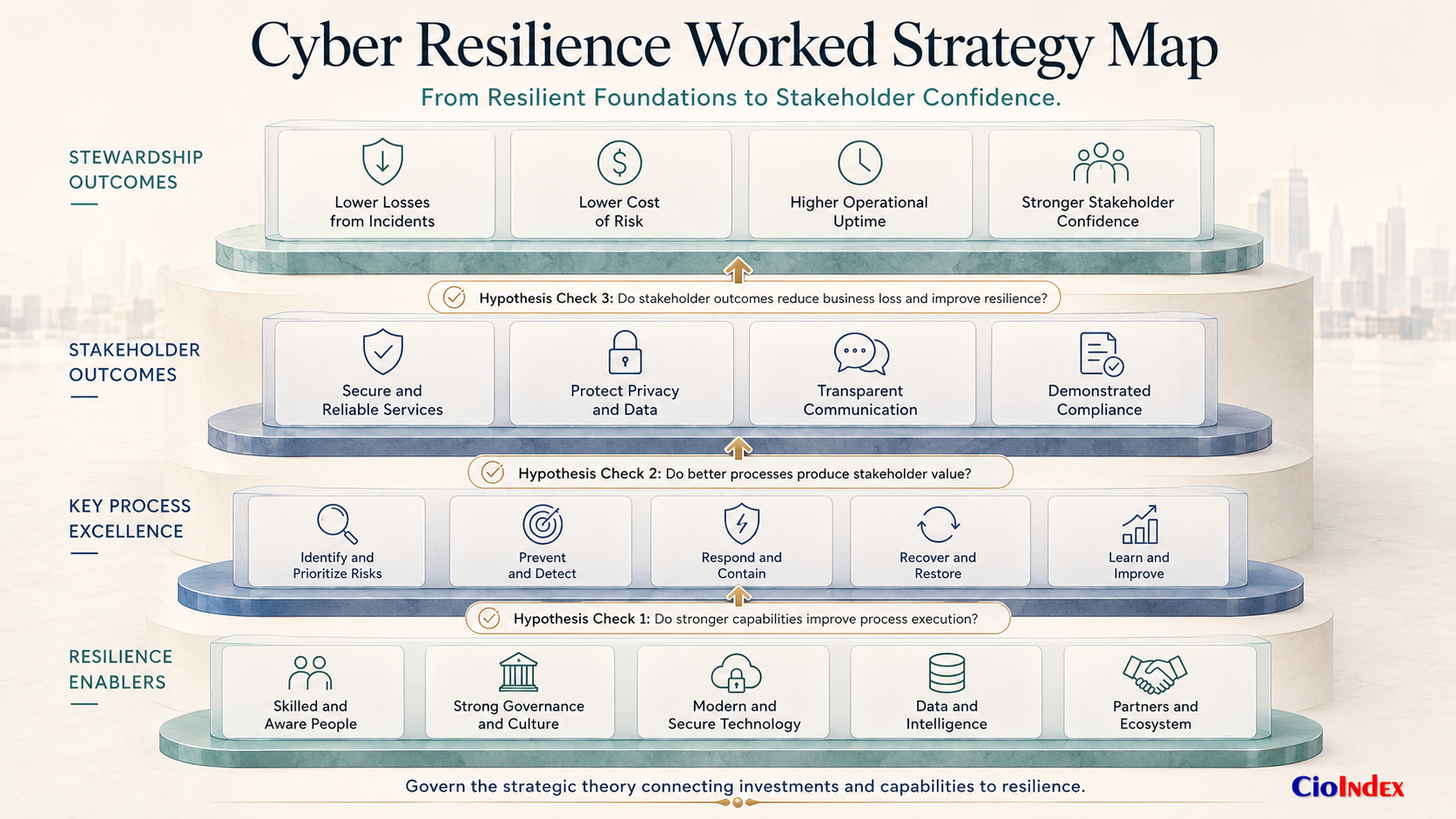
The strategy map would then make hypotheses visible:
- Better asset and dependency intelligence should improve remediation prioritization.
- Better recovery architecture and rehearsed decision rights should reduce restoration uncertainty.
- Better supplier resilience should reduce concentration and recovery dependencies.
The scorecard should not assume those relationships are true merely because they are reasonable. Leadership should ask:
- Did improved asset intelligence change remediation choices?
- Did those choices reduce material exposure rather than raw vulnerability counts?
- Did recovery exercises improve business-service restoration, or only technical procedure completion?
- Did supplier controls reduce concentration risk, or merely increase contractual documentation?
The point is not to create more cyber metrics. It is to govern the strategic theory connecting investments and capabilities to resilience.
Building a valid scorecard therefore requires an operating sequence that begins with strategic choices and ends with the continuing authority to challenge, refresh, and retire what no longer holds.
A CIO Operating Model for Building a Balanced Scorecard
Step 1: Resolve the strategic choices
Document the outcomes, target stakeholders, value proposition, risks, tradeoffs, and capabilities that define the strategy. Do not begin with the four perspectives.
Step 2: Build the strategy map as a hypothesis map
Connect outcomes to the processes and capabilities expected to produce them. State the mechanism and the important assumptions behind every material relationship.
Step 3: Select evidence, not merely metrics
For each objective, identify the evidence needed to judge whether the objective is improving. Combine leading and lagging measures. Test whether the measure can improve while the objective worsens.
Step 4: Set targets with context
Targets should reflect strategic ambition, baseline performance, external constraints, risk tolerance, and the likely time lag. Avoid targets selected only because they are easy to communicate.
Step 5: Link initiatives to objectives
Every strategic initiative should identify which objective it supports, how it is expected to move the evidence, and what would cause funding or design to change.
Step 6: Assign decision ownership
Separate:
- objective owner;
- measure owner;
- data steward;
- initiative owner;
- review authority.
One person may hold several roles, but the roles should not remain implicit.
Step 7: Design the review conversation
For every objective, define:
- what constitutes a meaningful deviation;
- what competing explanations should be considered;
- who must participate;
- what decisions are available;
- what evidence triggers escalation, redesign, or withdrawal.
Step 8: Refresh and retire
Set review triggers for:
- strategic change;
- market or regulatory change;
- new evidence concerning causal relationships;
- persistent measure gaming;
- objective completion;
- measure obsolescence;
- initiative termination.
A living scorecard is not one whose data refresh automatically. It is one whose strategic assumptions remain open to challenge.
Balanced Scorecard vs. Related Management Tools
| Tool | Primary job | Relationship to Balanced Scorecard | Main confusion risk |
|---|---|---|---|
| KPI dashboard | Monitor operational or performance signals | Can supply measures | Mistaking visibility for strategy management |
| OKRs | Focus teams on objectives and measurable results, often over shorter cycles | Can operationalize selected strategic objectives | Local ambition without enterprise causal coherence |
| Strategy map | Visualize linked strategic objectives | Core design companion | Treating arrows as proven causality |
| Portfolio management | Select, fund, and govern initiatives | Executes investment choices connected to objectives | Funding work without validating strategic contribution |
| COBIT goals cascade | Translate stakeholder needs into enterprise, alignment, and governance priorities | Compatible governance architecture | Treating framework mappings as organization-specific strategy |
| Risk dashboard | Monitor exposure, controls, and response | Provides risk evidence | Measuring control activity instead of strategic risk outcomes |
| Benefits-realization management | Validate whether initiatives create intended value | Tests initiative-to-outcome claims | Counting forecast benefits as realized value |
The tools solve different problems. A mature operating system combines them deliberately rather than forcing every management need into one framework.
The decision is therefore not whether the Balanced Scorecard is better than these tools. It is whether strategy control is the management problem that needs to be solved—and, if so, which complementary tools are needed for execution, operational monitoring, risk, investment governance, experimentation, and benefits validation. Framework selection should follow the decision problem, not management fashion.
Is the Balanced Scorecard Still Relevant?
Yes—but selectively.
The Balanced Scorecard remains relevant because organizations still struggle to connect strategy with operations, capabilities, investment, measurement, and accountability. Current institutional and professional material continues to use the framework and related goals-cascade logic in strategy and technology governance.[6][7]
Its continued relevance does not mean every organization should implement a comprehensive scorecard. Nor does it establish that the framework itself improves performance in every setting. Implementation research describes Balanced Scorecard adoption as a complex management innovation requiring experimentation and customization.[8] Reviews continue to identify challenges involving causality, implementation burden, decentralization, cultural fit, and potential rigidity.[4][9]
Digital dashboards, analytics, process mining, and AI can improve data collection, explanation, and monitoring. They can also make an invalid scorecard refresh faster and look more authoritative.
Technology changes the speed of measurement. It does not answer:
- whether the strategy is coherent;
- whether the measure represents the objective;
- whether a relationship is causal;
- whether leadership should intervene;
- whether the scorecard itself should change.
The mature organization is not the one with the most complete scorecard. It is the one that uses the least burdensome management system capable of improving strategic decisions.
The Real Test
The broad explanation of the Balanced Scorecard tells us what the framework contains and how it is intended to work. The evidence, limitations, fit conditions, failure modes, and implementation requirements point to a more consequential standard: the Balanced Scorecard should not be judged by whether it includes four perspectives, uses strategy-map software, or produces a polished executive report.
It should be judged by whether it helps leadership:
- express the strategy clearly;
- expose the assumptions linking capabilities to outcomes;
- choose valid evidence;
- assign accountable ownership;
- make different decisions when the evidence changes;
- revise or abandon a strategic hypothesis that no longer holds.
The final executive question is not:
Should we adopt a Balanced Scorecard?
It is:
Is our strategy sufficiently clear, testable, measurable, actionable, and governable for a Balanced Scorecard to improve the decisions we make?
If the answer is yes, the framework can become a powerful strategy-control system. Leadership can use the five conditions—strategic clarity, causal credibility, measurement validity, decision consequence, and governance capacity—as the standing agenda for designing, reviewing, and periodically challenging the scorecard.
If the answer is no, building the scorecard may only make uncertainty look organized.
Frequently Asked Questions
What is a Balanced Scorecard in simple terms?
A Balanced Scorecard is a system for translating strategy into linked objectives, measures, targets, initiatives, ownership, and management decisions across financial, customer, process, and organizational-capacity perspectives.
What are the four Balanced Scorecard perspectives?
The classic perspectives are financial, customer, internal process, and learning and growth. Organizations may adapt the labels, but the framework is intended to connect desired outcomes with the processes and capabilities expected to produce them.
Is a Balanced Scorecard the same as a dashboard?
No. A dashboard displays measures. A Balanced Scorecard should describe and govern a strategy. It connects measures to strategic objectives, causal hypotheses, targets, initiatives, owners, and decisions.
What is a strategy map?
A strategy map is a visual representation of linked strategic objectives. It shows how leadership believes capabilities and processes will contribute to customer, stakeholder, financial, or mission outcomes. Its arrows should be treated as strategic hypotheses rather than automatically proven causal relationships.
When should a CIO use a Balanced Scorecard?
A CIO should consider it when enterprise or technology strategy is sufficiently clear, outcomes and drivers can be measured credibly, cross-functional ownership exists, and leadership will change investments or priorities in response to evidence.
When should a Balanced Scorecard not be used?
It is a weak fit when strategy is unresolved, work is highly exploratory, measures are selected because data are convenient, causal assumptions cannot be examined, or leadership wants reporting without decision accountability.
What is the biggest Balanced Scorecard mistake?
The most common mistake is converting an existing KPI inventory into four categories and treating the result as a strategy-management system.
Does a Balanced Scorecard prove that strategy is working?
No. It structures evidence and strategic hypotheses. Leadership must still examine measurement validity, competing explanations, external conditions, time lags, and whether observed changes can reasonably be attributed to the strategy.
How many measures should a Balanced Scorecard contain?
There is no universal correct number. The scorecard should contain the smallest set of measures sufficient to evaluate the strategic objectives and support management decisions. Excess measures dilute attention and increase reporting burden.
Is the Balanced Scorecard obsolete?
No. The underlying problem—connecting strategy to execution and learning—remains current. Its use should be selective, adapted to context, and combined with other methods where they solve different decision problems.
References
- Robert S. Kaplan and David P. Norton, “The Balanced Scorecard—Measures That Drive Performance,” Harvard Business Review, 1992.
- Harvard Business School Working Knowledge, “Mapping Your Corporate Strategy,” featuring Robert S. Kaplan, 2004.
- Harvard Business School Working Knowledge, “Strategy Execution and the Balanced Scorecard,” featuring Robert S. Kaplan, 2008.
- “At the Core of the Balanced Scorecard: Understanding Cause-and-Effect Relationships in Health and Social Care,” systematic literature review, 2025.
- William B. Tayler, “The Balanced Scorecard as a Strategy-Evaluation Tool: The Effects of Implementation Involvement and a Causal-Chain Focus,” The Accounting Review research version.
- ISACA, “Drive Transparent and Measurable Value With COBIT 5 Process Metrics,” 2017.
- ISACA Journal, “Lost in the Woods: COBIT 2019 and the IT Balanced Scorecard,” 2021.
- Geert Braam and Ed Nijssen, “Exploring Antecedents of Experimentation and Implementation of the Balanced Scorecard,” Journal of Management & Organization, 2015.
- “Balanced Scorecard: History, Implementation, and Impact,” Encyclopedia, 2025.
Author
Sourabh Hajela is the Founder, Executive Editor, and CEO of CIO Index, Inc., with more than three decades of experience in technology strategy, planning, governance, and enterprise IT capability. His work focuses on helping CIOs translate management frameworks into sound operating decisions, accountable execution, and measurable business outcomes. That perspective informs this article’s treatment of the Balanced Scorecard not as a four-box reporting template, but as a strategy-control system whose value depends on strategic clarity, causal credibility, measurement validity, decision consequence, and governance capacity.
Research and Editorial Method
This article is a CIO Index synthesis based on primary and institutional material from the framework’s originators, current professional governance guidance, peer-reviewed and academic research, and published criticism. Established descriptions, empirical findings, CIO Index interpretations, and illustrative examples are distinguished. Strategy maps are treated as representations of strategic hypotheses, not as proof of causality. The CIO Index Balanced Scorecard Validity Test is an original analytical framework and is not an official Balanced Scorecard standard.