

Artificial intelligence is the capability of a machine-based system to infer from inputs and generate outputs – such as predictions, content, recommendations, decisions, or actions – that influence physical or digital environments. In enterprise use, an AI system includes the model, data, applications, workflow, people, permissions, controls, and monitoring that determine how the output is used. Its business value depends on whether that complete system produces a measurable, governed outcome. This definition is consistent with current OECD and NIST framing while making the enterprise boundary explicit.[1][2]
Consider an illustrative customer-service team that introduces an AI assistant. Agents accept 92% of its drafts with little editing, yet customer satisfaction is unchanged, repeat contacts increase, and experienced agents quietly correct answers before sending them. The model may be performing well against its chosen metric. The enterprise outcome is still uncertain.
AI is often discussed as though value appears when a capable model is deployed. In practice, purpose, data, inference, output, workflow integration, outcomes, and control determine whether an AI system improves a real decision or process. The CIO Index AI System-to-Value Chain later brings those links together.
AI capability is not enterprise value. A model produces an output; the enterprise must convert that output into a governed outcome.
This article explains what AI is, how it works, its main types, its relationship to machine learning and generative AI, and what enterprises must judge before expanding AI authority.
What Is Artificial Intelligence?
Artificial intelligence, or AI, is the broad field concerned with building machine-based systems that perform functions associated with perception, pattern recognition, prediction, language, reasoning, recommendation, content generation, or action.
The word intelligence can be misleading because it encourages people to judge a system by how human its output appears. A fluent answer, realistic image, or accurate forecast can look intelligent. But an AI system does not need to think or experience the world as a person does. It needs a method for transforming inputs into outputs that help accomplish a defined objective.
The OECD definition emphasizes that an AI system infers from inputs how to generate outputs such as predictions, content, recommendations, or decisions, and that systems vary in autonomy and adaptiveness after deployment.[1] NIST similarly defines AI in terms of machine-based systems that can make predictions, recommendations, or decisions for human-defined objectives.[2]
Three parts matter for enterprise leaders:
- Objective: the system is built or configured to do something.
- Inference: it applies rules, learned parameters, or both to new inputs.
- Effect: its output influences a person, workflow, software process, device, or decision.
The practical question is not whether a system seems intelligent. It is whether the system performs a useful function reliably enough, in the relevant context, with evidence and controls proportionate to the consequences of error.
AI model versus AI system
An AI model is the computational component that represents patterns or relationships and generates an inference. NIST describes it as a component of an information system that uses computational or statistical techniques to generate outputs from inputs.[3]
An AI system is broader. It may include models; training, reference, and operational data; prompts, retrieval sources, rules, and business logic; applications and interfaces; human reviewers; downstream workflow steps; permissions; and monitoring, escalation, and rollback mechanisms.
This distinction changes accountability. A model team may own model quality, but it cannot alone guarantee that the full system improves customer service, reduces fraud, accelerates engineering, or protects patients.
The 92% acceptance rate in the illustrative service case could indicate useful drafts. It could also hide off-record corrections, easy-case bias, poor review design, or more repeat contacts. The metric is precise. The inference it supports is not.
The model generates an answer. The service system decides when to show it, what evidence to retrieve, who verifies it, which cases to exclude, when to escalate, and how to detect harm. For a CIO, the unit of management is therefore the AI-enabled decision or workflow.
How Does Artificial Intelligence Work?
AI works by converting a purpose and a set of inputs into an inference, an output, and – when integrated into an operating process – an effect. Most AI systems can be understood through five stages.
1. Define the objective and operating environment
Every AI system begins with a task: classify an email, predict machine failure, recommend an offer, summarize a document, generate code, detect an anomaly, or execute a bounded sequence of actions.
The objective determines what data matters, what output is useful, what error means, and how performance should be evaluated. A poorly framed objective cannot be repaired by a more powerful model. A system trained to predict historical approvals, for example, may reproduce past decisions without establishing whether those decisions were fair, lawful, or economically sound.
Context changes the burden of proof. The same output may be harmless in brainstorming and consequential in a clinical, financial, employment, security, or public-sector decision. Leaders must define success, consequential error, and accountability before choosing the model.
2. Represent inputs in a form the system can use
AI operates on representations: numbers, categories, tokens, pixels, audio features, sensor readings, graph structures, or other encoded data. Inputs may come from transactions, documents, databases, media, prompts, telemetry, external knowledge, or feedback.
The input is never a neutral copy of reality. Data reflects what was collected, labeled, omitted, and recorded by the source process. A model trained on support tickets sees the ticketing record, not every customer problem or workaround outside it. Representation therefore defines what the system can see – and what remains invisible.
3. Build or configure the model
Some AI systems use explicit rules. Many use machine learning, in which an algorithm adjusts model parameters to improve performance on examples, feedback, or an objective.
- Supervised learning uses labeled examples.
- Unsupervised learning finds structure without predefined labels.
- Self-supervised learning derives learning signals from the data itself.
- Reinforcement learning learns from rewards or penalties associated with actions.
Deep learning uses multiple processing layers to learn representations at several levels of abstraction.[5] Modern generative systems often use transformer architectures, introduced in the 2017 paper Attention Is All You Need.[6]
Training creates a computational capability, not a production-ready enterprise system. The learning objective, evaluation data, operating conditions, and failure controls must still fit the real use case.
4. Perform inference and generate an output
Once trained or configured, the model performs inference by applying what it has learned to a new input. The output may be a score, category, forecast, alert, ranked list, generated content, recommendation, decision, plan, or tool call.
Inference is not the same as explanation or truth. A language model generates a probable continuation; a forecast estimates a future value; a classifier assigns a label. Whether the output is valid for a particular decision requires separate judgment.
5. Integrate the output, observe the result, and adapt
An output becomes operational only when it enters a workflow. A recommendation may be shown to a person, a prediction may change inventory, generated code may be reviewed and merged, or an agent may update a record or initiate a transaction.
The enterprise must then observe whether users follow the output, cycle time changes, errors fall or move elsewhere, workarounds appear, customers behave differently, data shifts, or new risks emerge. Feedback may trigger retraining, rule changes, workflow redesign, narrower permissions, or retirement.
These five stages explain why model performance and enterprise value are different claims. The model creates an inference. Integration changes work. Only observed outcomes and credible evidence establish whether the change created value.
How AI, Machine Learning, Deep Learning, and Generative AI Fit Together
AI terminology becomes confusing because different words describe different levels or properties of the technology stack.
| Concept | What it describes | Enterprise question |
| Artificial intelligence | The broad field of machine-based systems that infer from inputs and generate outputs | What decision, workflow, or environment will the system influence? |
| Machine learning | A family of AI methods that learns patterns or relationships from data or feedback | What is being learned, from which data, against what objective? |
| Deep learning | Machine learning using layered neural networks to learn representations | What scale, complexity, data, and evaluation burden does the model introduce? |
| Generative AI | AI designed to generate derived synthetic content such as text, images, audio, video, or code | How will generated content be grounded, verified, protected, and used? |
| Large language model | A language-focused model, often transformer-based, trained at scale to process and generate text or related sequences | What knowledge, reasoning, retrieval, security, and reliability limits apply? |
| Agentic AI | A system designed to pursue goals through planning, tool use, feedback, and action | What is it allowed to do, and how will actions be constrained and reversed? |
| Artificial general intelligence | A contested concept for broadly capable intelligence across many domains | What claim is actually being made, and what evidence would justify it? |
AI is the broadest category. Machine learning is one family within AI. Deep learning is a subset of machine learning. Generative AI is a capability class that often uses deep-learning models, but the terms are not interchangeable.[4][5]
NIST defines generative AI as models that emulate the structure and characteristics of input data to generate derived synthetic content.[4] That content can include text, images, audio, video, and other digital forms. A fraud-detection model, optimization engine, or vision classifier may use AI without generating content.
What Are the Main Types of Artificial Intelligence?
There is no single authoritative list of AI types because each taxonomy answers a different question. A capability taxonomy asks how broad the system is. A learning taxonomy asks how it learns. An enterprise taxonomy asks what role it performs in work.
The classification question determines the list. A system can simultaneously be narrow AI, use self-supervised learning, generate content, and act through tools because the categories describe different properties.
Types of AI by capability scope
Narrow or task-bounded AI
Most deployed AI is narrow or task-bounded: it is designed for a specific class of objectives, even when the underlying model can support many tasks. Examples include image detection, demand forecasting, translation, recommendations, code generation, security anomaly detection, and service routing.
A general-purpose model can still be part of a narrow enterprise system. A large language model may support many capabilities, but a claims-processing application built around it has a bounded purpose, workflow, permission set, and accountability structure.
Artificial general intelligence and superintelligence
Artificial general intelligence, or AGI, refers to a hypothetical or contested form of broad capability across many cognitive domains. Stanford HAI notes that there is no universally accepted definition or test for AGI.[8] Artificial superintelligence refers to a theoretical system exceeding human performance across most or all relevant cognitive domains.
Neither is an ordinary production category. Enterprises should govern demonstrated capabilities and actual permissions rather than speculative labels.
Types of AI by learning method
- Supervised learning uses labeled examples to learn a mapping from inputs to outputs. Its central risk is that a label may be a weak proxy for the real outcome.
- Unsupervised learning identifies patterns, clusters, or latent structure without a predefined target. A mathematical grouping is not automatically a meaningful business segment or risk category.
- Self-supervised learning derives training signals from the data itself. It enables learning at scale but also absorbs inconsistencies, bias, and uncertain provenance from source data.
- Reinforcement learning learns from rewards or penalties associated with actions. A poorly designed reward can encourage behavior that improves the metric while undermining the real objective.
Types of AI by enterprise role
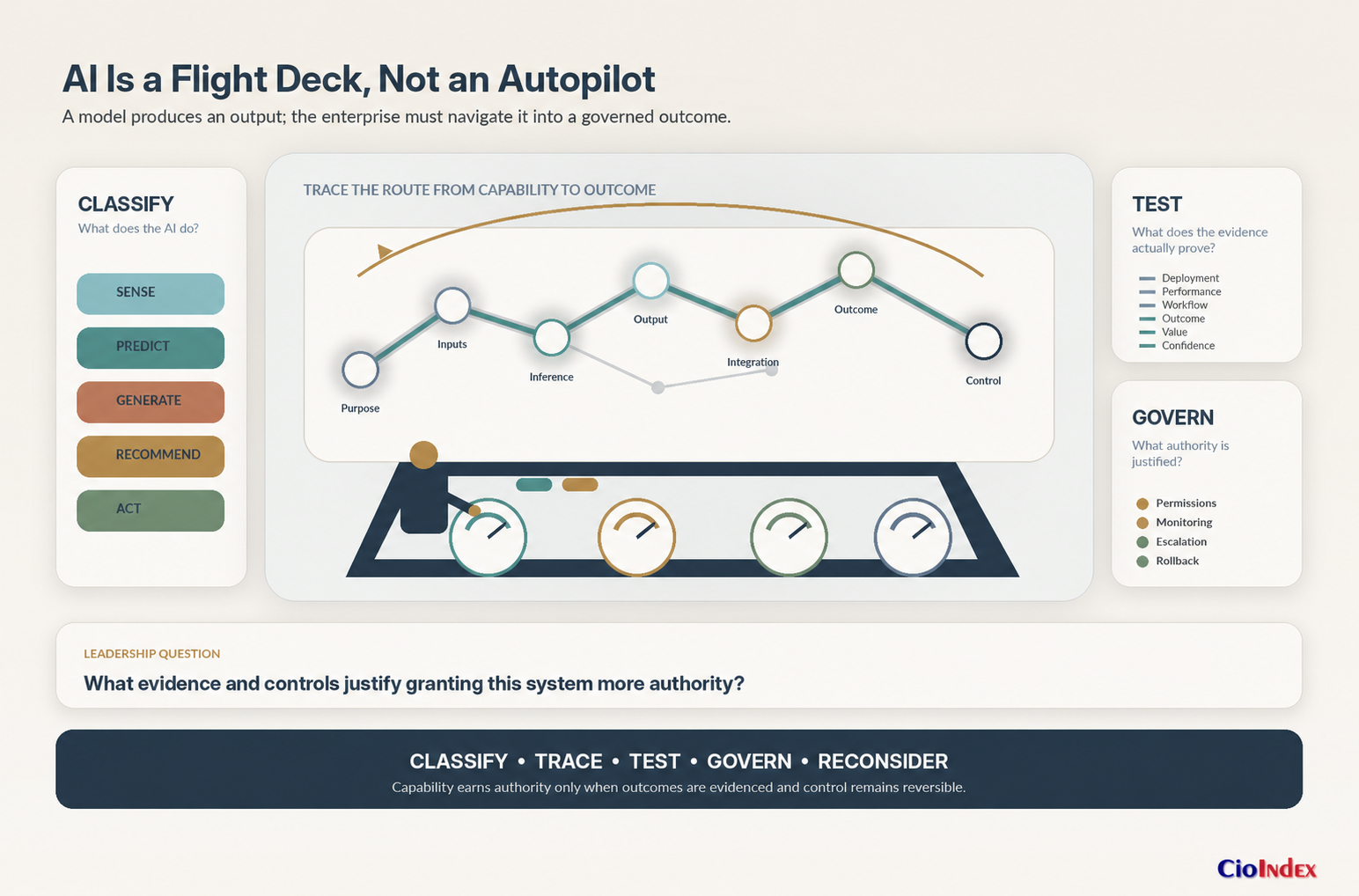
For enterprise planning, the CIO Index Enterprise AI Capability Taxonomy classifies what AI does in the flow of work:
- Sense – detect, recognize, extract, or interpret conditions.
- Predict – estimate a probability, future state, demand level, or risk.
- Generate – create text, code, images, designs, simulations, or other content.
- Recommend – rank options, propose actions, or support a decision.
- Act – execute a bounded action in a digital or physical environment.
An invoice-processing agent might sense document fields, predict coding risk, generate an explanation, recommend treatment, and act by updating an enterprise system.
The taxonomy classifies capability; it does not establish value or safety. As a system moves from sensing and generating toward recommending and acting, leaders must examine who retains authority, how errors are contained, and whether changes can be reversed.
Autonomy changes the risk from what a model says to what a system is allowed to do.
What Does Artificial Intelligence Mean for Enterprises?
AI means that organizations can redesign how information is interpreted, decisions are supported, content is produced, and actions are executed. It does not mean that every task should be automated or that access to a powerful model creates an advantage by itself.
The 2026 Stanford AI Index reported that 88% of surveyed organizations used AI in 2025 and 70% used generative AI in at least one business function. The same evidence showed AI-agent deployment remained in the single digits across nearly all business functions.[10] These figures describe surveyed adoption, not every organization in the economy, but they illustrate an important pattern: access and experimentation are widespread, while operational autonomy remains much less mature.
For enterprises, the strategic shift has three parts.
AI changes the economics of some cognitive work
AI can reduce the time and marginal effort required to classify information, produce a first draft, search large bodies of content, identify patterns, or generate alternatives. This can increase capacity, compress cycle time, and make previously uneconomic work possible.
But lower production cost can also increase review volume, create more low-quality output, or move work to another part of the process. The relevant question is not whether the model produces more. It is whether the complete workflow improves after review, correction, exception handling, and control are included.
AI changes decision architecture
Traditional software follows explicitly programmed logic. Learning systems can infer patterns that are difficult to specify as rules. Generative and agentic systems can also handle less structured tasks.
This creates new decision questions:
- Which judgments remain human?
- Which outputs require verification?
- What confidence is sufficient for each action?
- When must the system escalate?
- Which decisions may be automated, recommended, or only informed?
- Who owns the outcome when several teams own different components?
AI therefore changes not only how a decision is produced but also how authority, evidence, and accountability must be designed around it.
AI changes the control surface
An AI system can fail through inaccurate output, invalid assumptions, poor data, insecure integration, excessive permissions, adversarial manipulation, privacy leakage, biased outcomes, weak human review, or drift after deployment.
The control surface expands with system reach. A model used to brainstorm internal options has a different exposure from an agent that can change prices, send customer communications, approve access, or execute financial transactions.
Enterprise AI management must therefore connect technology risk with process ownership, business controls, information security, legal obligations, architecture, procurement, workforce design, and performance management.
How AI Creates Enterprise Value – and Why It Sometimes Does Not
AI does not contain business value as an intrinsic property. It creates value through a mechanism that removes a real constraint or enables a useful capability.
Common mechanisms include:
- Speed: reducing the time required to interpret, draft, forecast, or decide.
- Scale: applying analysis or service to more cases than people could handle manually.
- Consistency: applying a defined method across cases, while recognizing that consistent error is still error.
- Detection: finding patterns or anomalies difficult for people or conventional rules to identify.
- Personalization: adapting content, recommendations, or experiences to context.
- Exploration: producing alternatives, simulations, or designs more rapidly.
- Automation: executing bounded actions without manual intervention.
Each benefit of AI is conditional.
AI improves speed when information processing is the actual bottleneck and review does not consume the time saved. It reduces cost when the total system – including data preparation, integration, oversight, infrastructure, security, and correction – costs less than the alternative. It improves quality when the output is valid for the real objective, not merely better on a convenient benchmark. It supports innovation when the organization can adopt and govern the new operating method.
A useful value claim therefore specifies:
- the current constraint or baseline;
- the AI capability expected to change it;
- the workflow or decision that will change;
- the operational measure expected to move;
- the business consequence of that movement;
- the new cost, risk, or dependency introduced;
- the evidence required to continue, scale, redesign, or stop.
The AI Outcome Evidence Ladder
Enterprise discussions often collapse several different claims into one. The CIO Index AI Outcome Evidence Ladder keeps them separate:
| Evidence level | What it establishes | What it does not establish |
| Deployment | The system is available or in use | That people use it well or that outcomes improve |
| Model performance | The model met defined evaluation measures | That the measure represents the real objective |
| Workflow behavior | People or systems changed how work is performed | That the change produced a beneficial result |
| Operational outcome | A relevant process measure improved | That AI caused the improvement or that value exceeds cost |
| Business value | A financial, customer, risk, mission, or strategic result improved | That the effect will persist under changing conditions |
| Durable or causal confidence | Evidence supports persistence or attribution | That the system will remain valid without monitoring and adaptation |
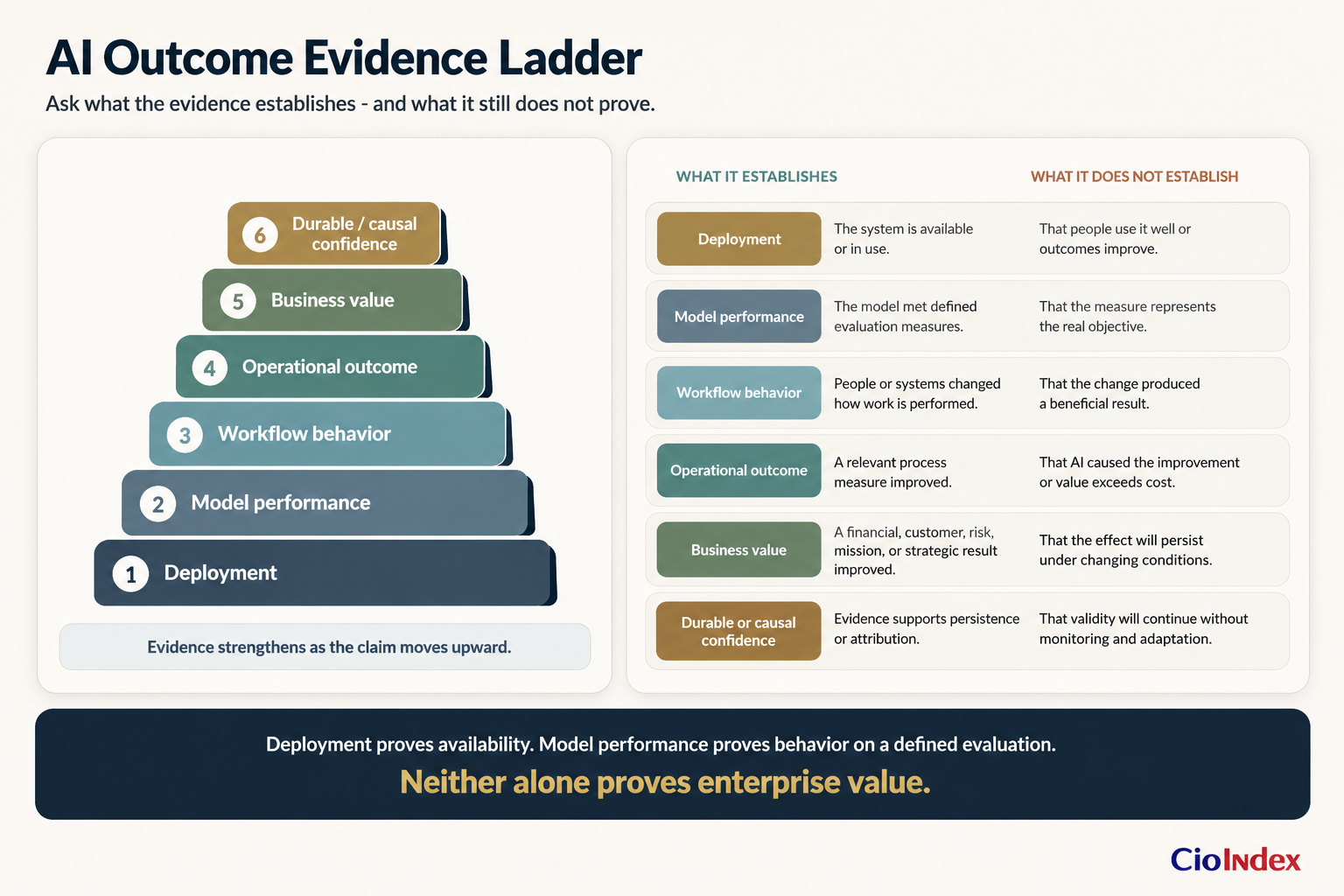
Deployment proves availability. Model performance proves behavior on a defined evaluation. Neither alone proves enterprise value.
The ladder is especially useful when a pilot produces an impressive number. Before presenting it as value, leaders should ask which rung the evidence actually supports.
The article’s decision assets now connect in one lifecycle.
- The Enterprise AI Capability Taxonomy classifies what the system does.
- The System-to-Value Chain traces how that capability is expected to create an outcome.
- The Outcome Evidence Ladder tests what the observed evidence actually proves.
- The Seven-Question Use-Case Test determines whether the use case is ready to scale.
- The Outcome Evidence Register carries the decision, measures, assumptions, ownership, and reconsideration triggers into ongoing governance.
What Are the Main Limitations and Risks of AI?
The main limitations of AI arise when the objective, data, inference, workflow, human behavior, permissions, or dependencies fail to support the decision the enterprise intends to improve.
Wrong objectives and incomplete representations
AI can be accurate against the wrong target. Fraud labels may reflect only detected fraud. Employee-performance data may reflect biased evaluations. Churn labels may arrive too late to guide intervention.
Precision is not validity. The enterprise must test whether the target, label, benchmark, and success metric correspond to the decision that matters. The same applies to inputs: missing groups, weak proxies, outdated records, or unlawful collection can make a representation unsuitable even when statistical performance appears strong.
Evaluation limits and unsupported outputs
Performance may deteriorate when inputs, users, processes, adversaries, or external conditions change. A model tested on one population, language, market, or workflow may not generalize to another.
Generative models can also produce coherent material that is incorrect, incomplete, fabricated, or inappropriate. Monitoring should cover data change, output quality, user behavior, exceptions, and downstream effects – not only uptime. Telling users that a system “may make mistakes” is not a control; verification must be feasible and proportionate to consequence.
Bias, human reliance, and accountability gaps
Models can reproduce historical disparities, encode weak proxies, or affect groups differently. Bias management requires attention to affected people, lawful purpose, data provenance, alternative explanations, appeal paths, and the consequences of false positives and false negatives.
People may over-rely on confident outputs, while nominal human review can become ceremonial if reviewers lack time, evidence, authority, or a practical way to challenge the system. “Human in the loop” is not a control design. The enterprise must define what the human reviews and what happens when the reviewer disagrees.
Security, privacy, and dependency exposure
AI systems create attack surfaces including data poisoning, model theft, adversarial inputs, prompt injection, sensitive-data leakage, insecure tool use, and supply-chain dependencies. A secure model connected to an overprivileged application can still create severe exposure.
Dependence on external models, cloud platforms, data providers, open-source components, chips, or proprietary interfaces can also affect resilience, cost, portability, privacy, and negotiating power. A multivendor architecture does not remove concentration when services share the same infrastructure, model family, or data source.
These risks are not a separate appendix to value. Each represents a weak or broken link in the system expected to create the outcome.
The CIO Index AI System-to-Value Chain™
The CIO Index AI System-to-Value Chain™ is an original decision framework for tracing an AI use case from intent to evidence. It is not an external standard or predictive scoring model. Its purpose is to expose missing links that a technology demonstration can conceal.
| Element | Executive question | Common failure |
| Purpose | Which decision, workflow, or outcome should change? | The project begins with a model or vendor rather than a defined problem. |
| Inputs | What data, context, rights, and quality does the system require? | Available data is treated as a valid representation of reality. |
| Inference | How does the system produce the output, and how is performance evaluated? | Benchmark performance is accepted without testing context or failure modes. |
| Output | What prediction, content, recommendation, decision, or action is produced? | A plausible output is treated as correct or complete. |
| Integration | How will people and systems use, verify, escalate, or override the output? | The model is deployed without redesigning the workflow. |
| Outcome | Which operational and business measures should improve against what baseline? | Adoption or model metrics are reported as value. |
| Control | Who owns the system, which risks are monitored, and what triggers intervention? | Accountability is fragmented and no one can pause, reverse, or retire the use case. |
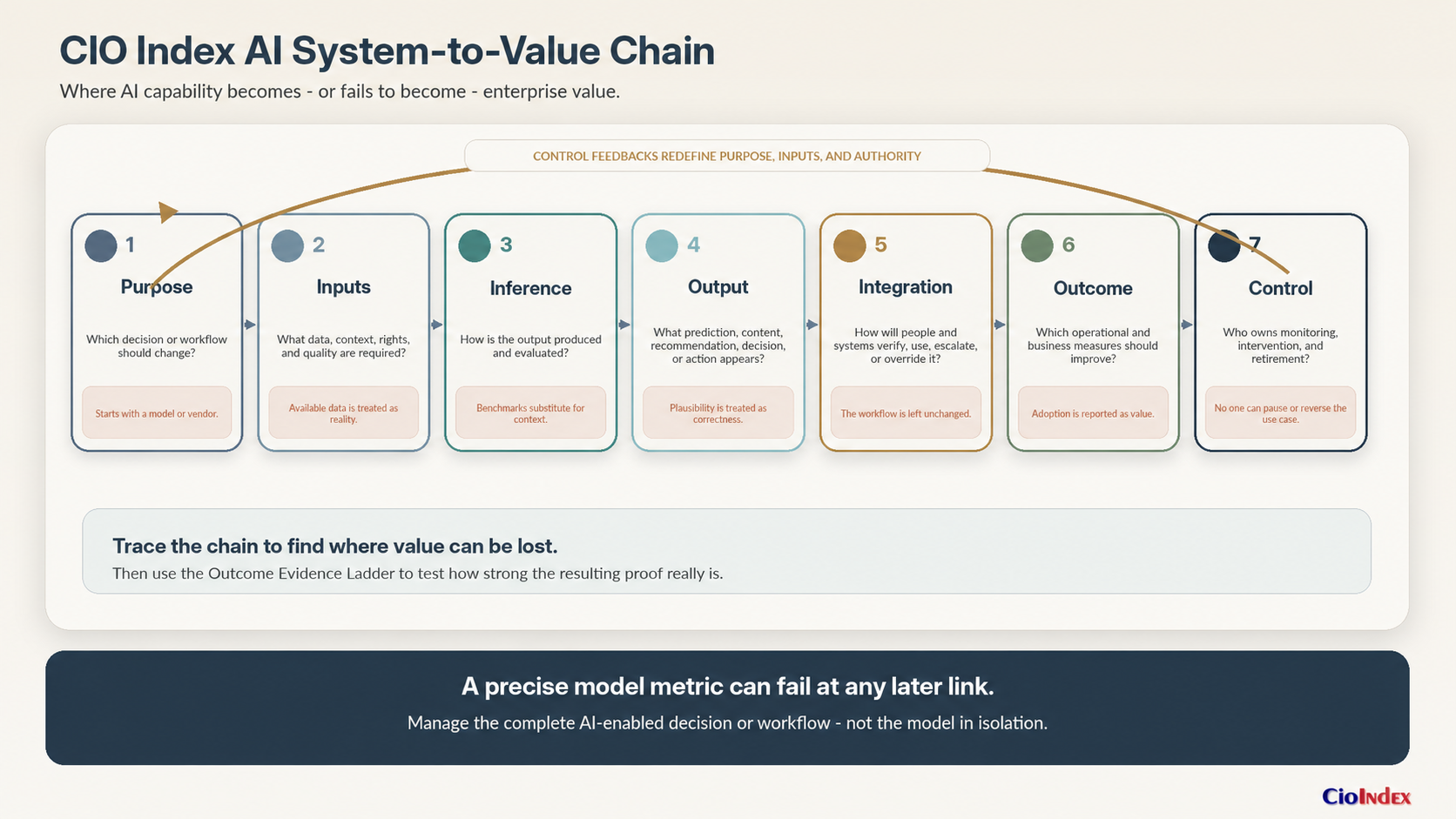
The chain is only as strong as its weakest consequential link.
Return to the service-assistant example. The team can now trace the full system:
- Purpose: reduce resolution time without reducing service quality.
- Inputs: customer history, product information, policies, and the current request.
- Inference: retrieve relevant evidence and generate a draft.
- Output: a proposed response with sources and confidence indicators.
- Integration: an agent reviews, edits, sends, or escalates it.
- Outcome: resolution time, repeat contacts, customer satisfaction, quality, and risk.
- Control: ownership, exception rules, audit logs, monitoring, and rollback.
The 92% acceptance rate belongs mainly to integration. It does not establish the outcome. The value claim becomes credible only when the team connects that behavior to operational and business evidence while preserving the ability to intervene.
The chain explains where value can be lost. The Evidence Ladder explains how strong the resulting proof is. Together they prevent a precise model or adoption metric from carrying a claim it cannot support.
A Seven-Question Enterprise AI Use-Case Test
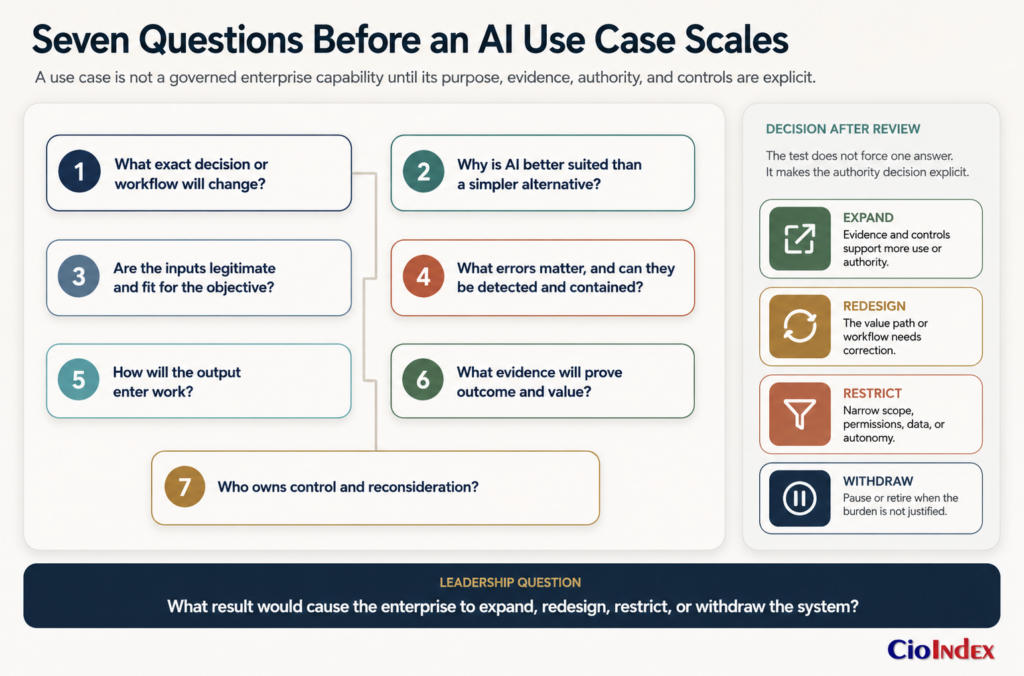
Before scaling an AI use case, leaders should be able to answer seven questions.
- What exact decision or workflow will change? Name the actor, action, and current constraint. “Improve productivity” is not specific enough. “Reduce the time analysts spend locating evidence for quarterly risk reviews” is testable.
- Why is AI better suited than a simpler alternative? Compare AI with process redesign, search, rules, analytics, conventional automation, better data, additional training, or no intervention. AI should earn its place through fit, not novelty.
- Are the inputs legitimate and fit for the objective? Evaluate quality, coverage, timeliness, provenance, rights, privacy, representativeness, security, and the relationship between the data and the real-world decision.
- What errors matter, and can they be detected and contained? Measure not only average performance but consequential failure. Define exclusions, thresholds, verification, escalation, and recovery. A tolerable drafting error may be unacceptable in a payment, access, safety, or legal action.
- How will the output enter work? Specify who receives it, what they do, which systems it touches, how uncertainty is represented, and how the workflow changes. Do not assume users will adopt the intended method.
- What evidence will prove outcome and value? Record the baseline, model measures, workflow measures, operational outcomes, business outcomes, costs, and review period. State what the evidence would not prove.
- Who owns control and reconsideration? Assign accountable owners for the business outcome, model, data, process, security, legal obligations, monitoring, exceptions, and retirement. Define triggers for narrowing, retraining, redesigning, pausing, or withdrawing the system.
A use case that cannot answer these questions is not necessarily forbidden. It is not ready to be represented as a governed enterprise capability.
Turn the Test into an AI Outcome Evidence Register
The use-case test should produce an operating record rather than end as a one-time approval discussion. For each material use case, maintain a compact register containing:
- use-case and decision owner;
- intended workflow change;
- baseline;
- model-performance measure;
- workflow-behavior measure;
- operational-outcome measure;
- business-value measure;
- major assumptions and exclusions;
- control owner and escalation route;
- next review date and reconsideration trigger.
The register keeps the original value hypothesis, evidence burden, and authority decision visible after deployment. It also gives governance a concrete basis for expanding, redesigning, restricting, or withdrawing the system.
How Should Enterprises Govern AI?
Governance is the control link of the System-to-Value Chain. It defines who may authorize an AI use case, what evidence is sufficient, how risk is monitored, and what conditions require intervention.
AI governance is the accountability system for how artificial intelligence is selected, developed, deployed, monitored, and used. It should not become a remote committee that reviews documents after technical and business decisions are already fixed.
Govern the Use Case, Not only the Model
A model inventory is necessary but incomplete. Governance should identify the full use case, affected stakeholders, owner, purpose, data, integrations, permissions, consequences, vendors, and controls. The same foundation model may support both a low-risk drafting assistant and a high-risk decision system; context determines the control burden.
Match Control Intensity to Consequence and Uncertainty
Controls should strengthen as potential harm, autonomy, uncertainty, scale, and irreversibility increase. A low-risk internal assistant may need approved sources, access controls, guidance, sampling, and logs. A consequential decision system may require independent validation, thresholds, human authority, appeal, continuous monitoring, change control, incident response, and rollback.
NIST identifies trustworthy AI characteristics including validity and reliability, safety, security and resilience, accountability and transparency, explainability and interpretability, privacy enhancement, and managed harmful bias.[11] No single metric establishes trustworthiness.
Use a Lifecycle Risk-Management Structure
NIST AI RMF 1.0 organizes AI risk management around Govern, Map, Measure, and Manage.[12] As of July 2026, NIST states that the framework is being revised, so organizations should verify the current version before formal adoption.[14]
ISO/IEC 42001:2023 provides requirements for establishing and improving an AI management system.[13] It can support discipline, but it does not replace use-case judgment, legal analysis, or technical validation.
Make Accountability and Change Authority Explicit
Material AI systems need clear ownership for business outcomes, product operation, model configuration, data rights, architecture, security, privacy, legal obligations, human review, monitoring, incidents, and retirement.
AI systems can change because models, data, prompts, retrieval sources, user behavior, external services, or the environment change. Owners must have authority to require testing, narrow permissions, redesign the workflow, pause deployment, or retire the use case. Governance is effective when it can change the system, not merely document it.
How Does Agentic AI Change the Enterprise Control Problem?
Agentic AI is an emerging term for systems designed to pursue tasks through goal interpretation, planning, tool use, feedback, and adaptive action within constraints.[9] Because the term covers many architectures and autonomy levels, leaders should ask what a specific system can actually do.
The control problem changes when the system can act. A content generator may produce a problematic draft; an agent with tool access can send it, modify a database, create an account, or initiate a payment. Risk now includes permissions, sequencing, state change, and recovery.
Consider an illustrative invoice agent that reads an invoice, matches a purchase order, recommends an accounting code, and can release payment below a threshold. A broad permission to “process invoices” is difficult to govern. A stronger design segments authority: extract without changing records; recommend coding but require approval; update low-risk fields under validation rules; release only low-value, high-confidence, fully matched invoices; escalate exceptions and changed bank details; and log actions with a reversible state where possible.
Autonomy should be earned by evidence. Three principles follow:
- Least privilege: grant the narrowest permissions required.
- Pre-action verification: verify before irreversible consequences.
- Designed escalation and rollback: treat recovery as a product capability.
Agentic AI intensifies the existing doctrine: classify the capability, trace the outcome path, test the evidence, govern the authority, and contract that authority when conditions change. Detailed agent architecture belongs in a dedicated article.
Frequently Asked Questions
What is artificial intelligence in simple terms?
Artificial intelligence is the ability of a machine-based system to use inputs to generate a prediction, answer, recommendation, decision, or action. In an enterprise, AI also includes the workflow and controls that determine how the output is used.
How does artificial intelligence work?
AI defines an objective, represents inputs as data, applies rules or learned parameters, and generates an inference. The output enters a workflow, where the enterprise observes whether it improves the intended outcome.
Is artificial intelligence the same as machine learning?
No. AI is the broad field of machine-based inference systems. Machine learning is one family of AI methods in which models learn patterns from data or feedback. Many applications combine machine learning with rules, retrieval, software logic, and human review.
What are the main types of artificial intelligence?
AI can be classified by capability scope, learning method, or enterprise role. Enterprise roles include sensing, predicting, generating, recommending, and acting. These classifications overlap because they answer different questions.
How is generative AI different from artificial intelligence?
Artificial intelligence is the broad category. Generative AI is a type of AI focused on producing derived synthetic content such as text, images, audio, video, or code.[4] Fraud detection, forecasting, and optimization can use AI without generating content.
What is agentic AI?
Agentic AI refers to systems designed to pursue goals through planning, tool use, feedback, and action. Enterprises should define the agent’s objective, permissions, verification, escalation, monitoring, and rollback capability.
What does artificial intelligence mean for enterprises?
AI can change how work senses conditions, predicts outcomes, generates content, recommends choices, or takes bounded action. The opportunity is to redesign decisions and workflows so outputs create measurable outcomes with clear ownership, acceptable risk, and effective controls.
What are the main risks of enterprise AI?
Risks include invalid objectives, poor or unlawful data, unreliable outputs, bias, privacy leakage, security attacks, excessive permissions, weak human oversight, vendor dependency, and performance drift. The required controls depend on the use context and consequence of error.
How should an organization decide where to use AI?
Start with a defined decision or workflow, not a model. Test whether AI fits better than simpler alternatives, whether inputs are legitimate, whether errors can be contained, how the output enters work, what evidence will establish outcomes, and who owns monitoring and reconsideration.
The Enterprise Question That Matters
Enterprises will encounter models that are more fluent, capable, multimodal, and autonomous. The temptation will be to equate capability with readiness, adoption with progress, and precision with proof. Those shortcuts create fragile systems and inflated value claims.
A stronger approach follows one management lifecycle:
Classify what the AI does. Trace how the system creates an outcome. Test what the evidence proves. Govern the authority granted to it. Reconsider when conditions change.
That lifecycle leads to the executive question:
Which decisions and workflows should AI influence, under what evidence and controls, and what result would cause the enterprise to expand, redesign, restrict, or withdraw it?
The answer turns artificial intelligence from a technology acquisition into an enterprise management discipline.
References
- AI, “OECD AI system definition explainer,” revised definition, March 6, 2024. https://oecd.ai/en/wonk/definition
- National Institute of Standards and Technology, “Artificial intelligence,” CSRC Glossary. https://csrc.nist.gov/glossary/term/artificial_intelligence
- National Institute of Standards and Technology, “Artificial intelligence model,” CSRC Glossary. https://csrc.nist.gov/glossary/term/artificial_intelligence_model
- National Institute of Standards and Technology, “Generative artificial intelligence,” CSRC Glossary. https://csrc.nist.gov/glossary/term/generative_artificial_intelligence
- Yann LeCun, Yoshua Bengio, and Geoffrey Hinton, “Deep learning,” Nature 521, 436-444, May 27, 2015. https://www.nature.com/articles/nature14539
- Ashish Vaswani et al., “Attention Is All You Need,” NeurIPS 2017. https://research.google/pubs/attention-is-all-you-need/
- NASA, “What Is Artificial Intelligence?” last updated May 13, 2024. https://www.nasa.gov/what-is-artificial-intelligence/
- Stanford Institute for Human-Centered AI, “What Is AGI (Artificial General Intelligence)?” https://hai.stanford.edu/ai-definitions/what-is-agi-artificial-general-intelligence
- Stanford Institute for Human-Centered AI, “What Is Agentic AI?” https://hai.stanford.edu/ai-definitions/what-is-agentic-ai
- Stanford Institute for Human-Centered AI, “The 2026 AI Index Report: Economy,” 2026. https://hai.stanford.edu/ai-index/2026-ai-index-report/economy
- National Institute of Standards and Technology, “AI Risks and Trustworthiness,” NIST AI Resource Center. https://airc.nist.gov/airmf-resources/airmf/3-sec-characteristics/
- National Institute of Standards and Technology, “NIST AI Risk Management Framework Core,” AI RMF 1.0. https://airc.nist.gov/airmf-resources/airmf/0-ai-rmf-1-0/
- International Organization for Standardization, “ISO/IEC 42001:2023 – AI management systems.” https://www.iso.org/standard/42001
- National Institute of Standards and Technology, “AI Risk Management Framework current status,” April 7, 2026. https://www.nist.gov/itl/ai-risk-management-framework