

Cloud computing is a model for obtaining configurable computing resources—such as servers, storage, networks, platforms, and software—as on-demand services that can be provisioned and released rapidly. The U.S. National Institute of Standards and Technology defines the model through five essential characteristics, three service models, and four deployment models.[1]
That definition tells us what cloud computing is. It does not answer the more consequential executive question:
Is the organization changing how technology capacity, economics, control, and accountability work—or merely moving the same systems into someone else’s data center?
A workload can run on a major cloud platform and still behave like traditional infrastructure. It may be manually provisioned, permanently oversized, tightly coupled to one environment, weakly instrumented, expensive to change, and governed through slow ticket queues. The hosting location changed; the operating model did not.
The reverse is also possible. A private or hybrid environment can exhibit important cloud characteristics when teams can obtain standardized services on demand, capacity is pooled and elastic, usage is measured, controls are automated, and responsibility is clear.
For CIOs, this distinction matters because the strategic value of cloud computing does not come from remote ownership of servers alone. It comes from changing the unit of management—from machines and projects to services, policies, products, consumption, and continuously governed choices.
The central CIO Index view is:
Cloud computing is a programmable operating model for making technology capacity and managed capabilities available as services. Its value depends on whether the organization can convert that programmability into faster decisions, credible unit economics, resilient design, clear responsibility, and reversible choices.
Cloud can increase speed while increasing waste. It can improve infrastructure resilience while making one provider, identity plane, region, or software dependency more consequential. It can reduce hardware management while increasing architecture, security, financial, and vendor-management demands. It can make capacity elastic without making the application scalable. It can make costs variable without making them lower.
The mature question is therefore not, “Should we use cloud?” It is:
Which capabilities should be consumed as cloud services, what operating changes are required to create value, which responsibilities remain ours, and what evidence would cause us to redesign, relocate, or exit?
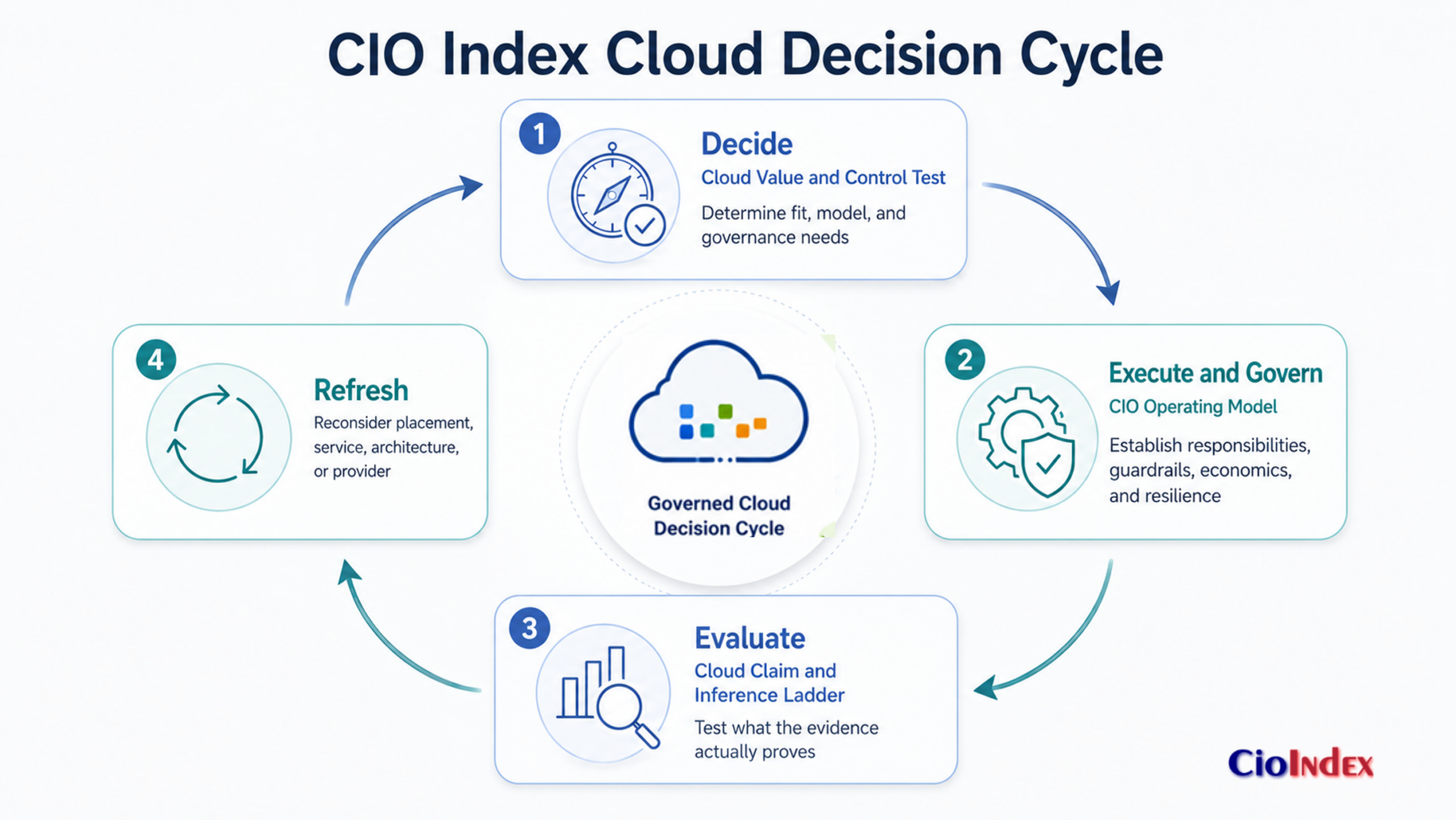
The article uses three complementary CIO Index tools to answer that question.
- The CIO Index Cloud Value and Control Test™ helps leaders decide whether and how a capability should use cloud services.
- The CIO Operating Model translates that decision into responsibilities, guardrails, economics, resilience, and lifecycle governance.
- The Cloud Claim and Inference Ladder™ then tests what the resulting evidence actually proves.
Together, the tools form a continuing decision cycle: decide where cloud fits, execute and govern the choice, evaluate whether the expected value occurred, and revisit the decision when the evidence or operating context changes.
What Is Cloud Computing?
NIST defines cloud computing as a model that enables convenient, on-demand network access to a shared pool of configurable computing resources that can be rapidly provisioned and released with minimal management effort or provider interaction.[1] NIST later published an evaluation method to determine whether a computing capability genuinely aligns with that definition and how it should be categorized. [2]
The five essential characteristics are:
- On-demand self-service: Consumers can obtain computing capabilities without requiring human interaction with the provider for every request.
- Broad network access: Capabilities are available over networks through standard mechanisms.
- Resource pooling: Provider resources serve multiple consumers through pooled physical and virtual capacity.
- Rapid elasticity: Capacity can expand and contract quickly, sometimes appearing effectively unlimited to the consumer.
- Measured service: Usage is monitored, controlled, and reported, enabling transparency and consumption-based management.
These characteristics are more useful than the vague test, “Is it hosted off-site?” A remotely hosted server acquired through a long procurement cycle, statically allocated for years, manually administered, and billed as a fixed asset may be outsourced infrastructure, but it expresses little of the cloud operating model.
A practical CIO definition is:
Cloud computing is the standardized, network-accessible delivery of technology capabilities as measured services whose capacity, configuration, and lifecycle can be controlled programmatically.
The word programmatically is critical. The cloud’s distinctive managerial potential comes from turning infrastructure and platform decisions into software-addressable actions:
- provisioning through APIs and infrastructure as code;
- policy enforcement through automated controls;
- scaling through rules and telemetry;
- deployment through repeatable pipelines;
- cost allocation through usage data;
- recovery through tested patterns;
- lifecycle management through standard service catalogs;
- configuration evidence through machine-readable state.
The organization does not receive this value automatically. It must design for it.
Cloud Computing Is Not One Thing
The term cloud is routinely used to describe several different objects:
- a commercial provider;
- a data-center location;
- a service-delivery model;
- a procurement arrangement;
- an application architecture;
- an operating model;
- a financial model;
- a modernization strategy.
Those objects overlap, but they are not interchangeable.
A company can purchase software as a service without having a coherent enterprise cloud strategy. It can move virtual machines to infrastructure as a service without modernizing the applications. It can adopt containers without improving deployment safety. It can operate across three providers without possessing a true multicloud architecture. It can create a cloud center of excellence while leaving product teams dependent on slow centralized approvals.
This leads to the first insight in the article’s reasoning chain:
Cloud location is not cloud capability. Running in a cloud environment establishes where and from whom capacity is obtained. It does not establish that the workload is elastic, resilient, automated, economically efficient, portable, or well governed.
How Cloud Computing Works
Cloud providers aggregate physical infrastructure—compute, storage, networking, facilities, power, cooling, and operational capability—and expose increasingly abstract services to consumers.
At a simplified level, the model has four layers:
| Layer | Provider contribution | Consumer decision |
|---|---|---|
| Physical capacity | Data centers, hardware, physical networks, power, cooling | Which locations, regions, and provider footprints are acceptable? |
| Abstraction and control | Virtualization, orchestration, APIs, identity integration, policy mechanisms | How will resources be configured, secured, observed, and governed? |
| Managed services | Databases, analytics, integration, AI, security, developer platforms | Which operational responsibilities should be transferred, retained, or shared? |
| Business workloads | Applications, data, processes, customer experiences, decisions | What business outcome justifies the service and who owns it? |
The provider creates a standardized service boundary. The customer selects services, configures them, integrates them, governs consumption, and remains accountable for the business system.
The boundary changes by service model. Moving from infrastructure as a service toward platform or software services generally transfers more technical operation to the provider. It does not transfer ownership of the business outcome, data obligations, identity decisions, legal duties, or the consequences of poor configuration.
This produces the second insight:
Operational work can transfer; enterprise accountability does not. Cloud changes who performs controls and how responsibilities are divided. It does not eliminate the customer’s obligation to understand, govern, and verify the resulting system.
AWS describes security and compliance as shared responsibilities, with AWS securing the underlying cloud infrastructure while customers remain responsible for the components they control; the exact division varies with the services selected.[10] Microsoft similarly states that customers retain responsibility for data and identities across cloud models, while responsibility for other layers changes across IaaS, PaaS, and SaaS.[11] Google argues that the traditional shared-responsibility formulation can be difficult for customers to operationalize and promotes a “shared fate” approach that adds provider guidance and partnership, while still recognizing customer duties.[12]
The models differ in language, but the executive implication is consistent: responsibility must be assigned service by service, not assumed from the word cloud.
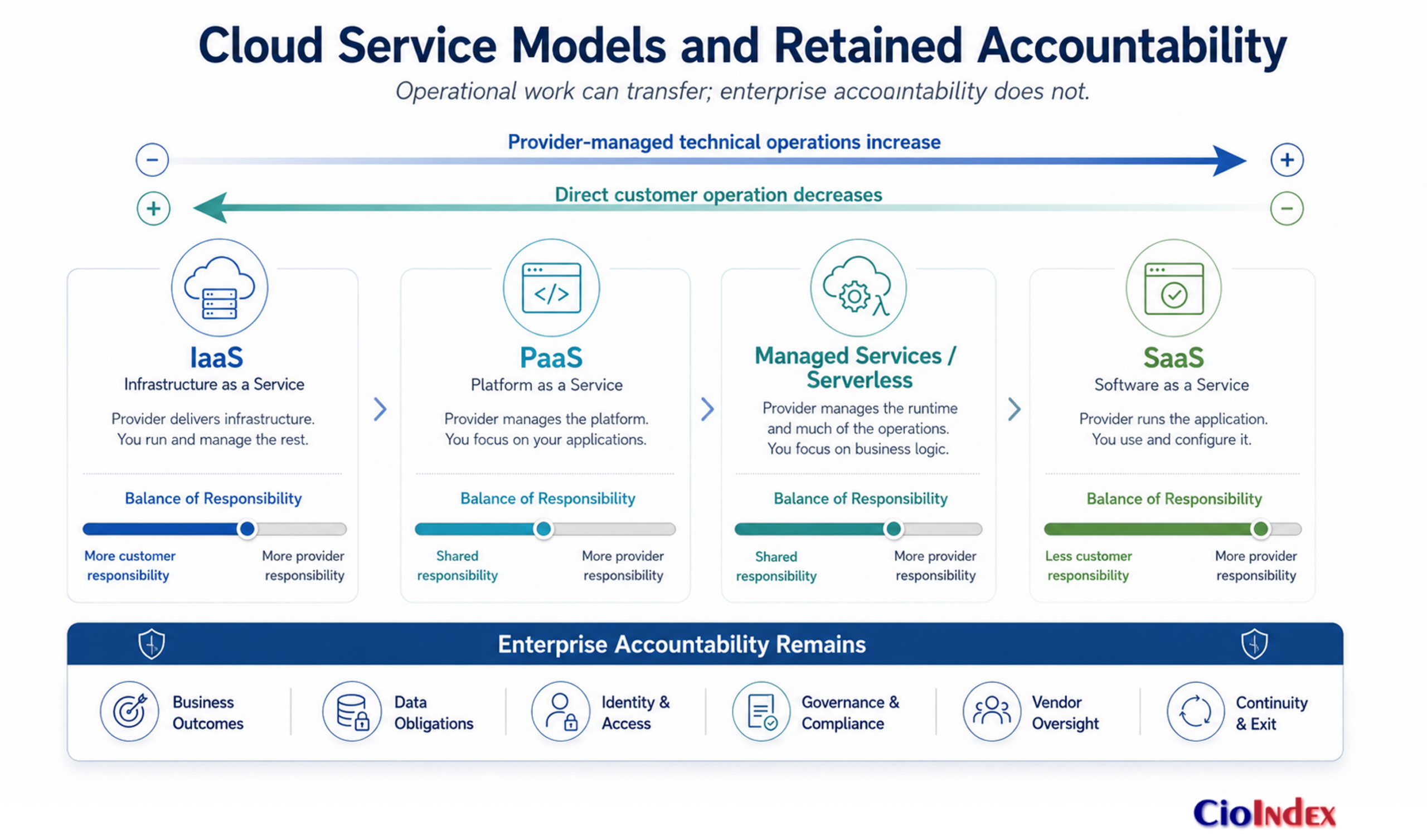
The Main Cloud Service Models
Infrastructure as a Service
Infrastructure as a service, or IaaS, provides fundamental compute, storage, and network resources. The provider operates the physical infrastructure and virtualization layer. The customer generally controls operating systems, applications, configurations, identities, data, and much of the workload’s security and reliability design.
IaaS offers flexibility and familiar administrative control. It can also preserve traditional operating habits. A virtual machine provisioned in minutes is still expensive and fragile if it remains permanently oversized, manually configured, weakly patched, and dependent on one administrator.
Platform as a Service
Platform as a service, or PaaS, provides managed application, database, integration, analytics, or runtime capabilities. The customer focuses more on application logic, data, and configuration while the provider manages more of the underlying platform.
PaaS can reduce undifferentiated operational work and accelerate delivery. It may also increase dependence on provider-specific interfaces, data services, operating constraints, and pricing structures. The decision is not simply “more managed is better.” It is whether the transferred work is non-differentiating and whether the resulting dependency is acceptable.
Software as a Service
Software as a service, or SaaS, delivers a complete application. The provider manages most of the technical stack, while the customer remains responsible for use, access, information governance, configuration, integration, data quality, vendor oversight, continuity planning, and business outcomes.
SaaS can compress implementation time dramatically. It can also create fragmented data, overlapping contracts, weak exit rights, uncontrolled identity relationships, and business-process dependence on vendor roadmaps.
Serverless and Function Services
Serverless services allow teams to execute code or workflows without directly provisioning servers. The provider manages capacity and much of the runtime lifecycle. This can align cost with execution and reduce operational burden for suitable workloads.
“Serverless” does not mean that servers disappear. It means the consumer manages a more abstract service boundary. That boundary can improve speed while introducing execution limits, event complexity, observability challenges, and stronger provider coupling.
Public, Private, Hybrid, and Multicloud
NIST’s deployment models include public, private, community, and hybrid cloud.[1]
- Public cloud uses services available from an external provider’s shared infrastructure.
- Private cloud provides cloud capabilities for the exclusive use of one organization.
- Community cloud serves organizations with shared requirements or concerns.
- Hybrid cloud combines distinct cloud environments that remain separate but are connected through technology that supports data and application portability.
Multicloud is widely used to describe consumption from more than one cloud provider. That description can conceal an important difference.
An organization may have contracts with several providers because business units bought services independently. That is a multiple-cloud estate. A deliberate multicloud architecture requires defined workload-placement logic, identity and network patterns, operational integration, security controls, data governance, skills, cost management, and recovery expectations across providers.
A 2026 U.S. Government Accountability Office report warned that ad hoc use of multiple providers should not be mistaken for a true multicloud architecture. GAO noted potential advantages such as concentration-risk management and outage mitigation, but also higher workforce and operational costs.[7]
The third insight follows:
Provider diversity is not architectural resilience. Multiple contracts may diversify vendors while multiplying failure modes, skills requirements, data movements, control planes, and operational inconsistency.
Cloud Hosted Versus Cloud Native
A cloud-hosted application runs in a cloud environment. A cloud-native application is designed to exploit dynamic infrastructure, automation, service abstraction, and distributed operating patterns.
The Cloud Native Computing Foundation describes cloud-native technologies as enabling scalable applications in modern public, private, and hybrid environments. Its definition emphasizes loosely coupled systems that are resilient, manageable, and observable, combined with automation that enables frequent and predictable change.[13]
Cloud-native design can include:
- containers;
- managed platforms;
- declarative infrastructure;
- automated deployment;
- horizontal scaling;
- immutable release patterns;
- service-oriented or event-driven architecture;
- strong observability;
- failure-aware design.
These are means, not ends. A microservice architecture can increase deployment independence, but it also creates distributed-system complexity. Containers can improve portability, but stateful dependencies, managed data services, identity systems, and operational tooling may still create deep coupling.
The relevant question is not, “Are we cloud native?” It is:
Which architectural characteristics improve the required business outcome enough to justify their added complexity?
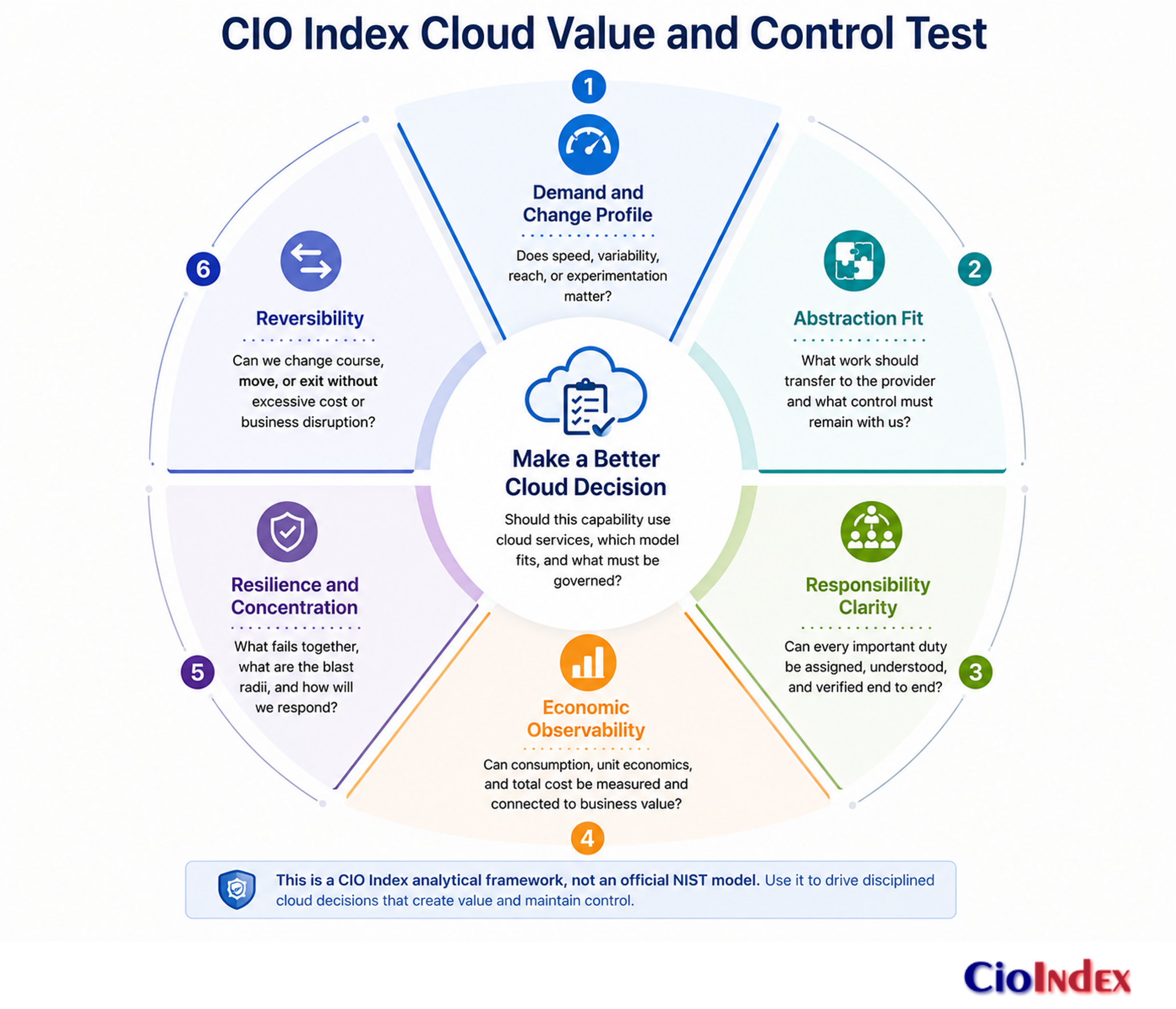
The CIO Index Cloud Value and Control Test™: : Decide Where Cloud Fits
The CIO Index Cloud Value and Control Test™ determines whether a workload or capability should use cloud services, which model fits, and what must be governed.
It has six dimensions:
- Demand and change profile
- Abstraction fit
- Responsibility clarity
- Economic observability
- Resilience and concentration
- Reversibility
This is a CIO Index analytical framework, not an official NIST model or a validated scientific assessment.
1. Demand and Change Profile
Executive question: Does the workload benefit from rapid provisioning, variable capacity, global reach, experimentation, or frequent change?
Examine:
- demand volatility;
- release frequency;
- time-to-environment;
- geographic needs;
- temporary versus persistent capacity;
- data-growth pattern;
- lifecycle uncertainty;
- consequences of waiting for infrastructure.
A stable workload with predictable demand and a long useful life may not derive large value from elasticity. A new digital product, analytics experiment, or seasonal service may derive significant value from rapid, reversible access to capacity.
2. Abstraction Fit
Executive question: At what service level should the organization consume the capability?
Examine:
- need for infrastructure control;
- differentiation of platform operations;
- portability requirements;
- regulatory constraints;
- performance needs;
- managed-service maturity;
- internal operating capability;
- architecture coupling.
IaaS preserves control but retains more operational work. PaaS and SaaS transfer more work but may increase provider dependence. The right abstraction is the least operational responsibility the organization can transfer without surrendering control it genuinely needs.
3. Responsibility Clarity
Executive question: Can every important responsibility be assigned and verified across provider, platform, workload, security, data, vendor, and business owners?
Examine:
- identity and access;
- configuration;
- vulnerability management;
- data classification and retention;
- encryption and key management;
- backup and recovery;
- logging and evidence;
- incident response;
- legal and regulatory duties;
- service continuity;
- supplier dependencies.
A control inherited from a provider is not the same as a complete enterprise control. The organization must determine which part is inherited, which remains customer-operated, and which evidence demonstrates that the combined control works.
4. Economic Observability
Executive question: Can the organization connect cloud consumption to products, customers, capabilities, decisions, and business value?
Examine:
- resource-level cost attribution;
- unit economics;
- demand forecasts;
- commitment decisions;
- idle and orphaned resources;
- software licensing;
- data-transfer costs;
- engineering tradeoffs;
- cost of reliability and security;
- exit and migration costs.
The FinOps Foundation defines FinOps as an operational and cultural framework for maximizing technology value, enabling timely data-driven decisions, and creating financial accountability through collaboration among engineering, finance, and business teams.[9]
This framing matters because variable cost is not self-governing. A utility meter makes consumption visible. It does not determine whether the consumption creates value.
5. Resilience and Concentration
Executive question: What fails together, and can the organization sustain the business when it does?
Examine:
- provider and regional dependencies;
- identity-plane concentration;
- network and DNS dependencies;
- shared data services;
- control-plane access;
- supplier and software concentration;
- recovery architecture;
- tested recovery objectives;
- cross-region and cross-provider complexity;
- operational readiness during provider impairment.
Cloud providers can offer extensive infrastructure redundancy. The customer must still design the workload, data, identities, dependencies, and recovery processes to use it correctly. Reliability is partly transferred and partly designed.
6. Reversibility
Executive question: Can the organization change service, architecture, provider, or commercial arrangement when assumptions fail?
Examine:
- data exportability;
- interface portability;
- license terms;
- proprietary service dependencies;
- migration tooling;
- skills concentration;
- contractual exit rights;
- data deletion and evidence;
- time and cost to move;
- credible alternatives.
GAO has documented restrictive software-licensing practices that increased costs or limited agencies’ choice of provider and architecture.[6] Its 2026 procurement review also describes the tension between concentration-risk management and the added cost and complexity of supporting multiple platforms.[7]
Reversibility does not require avoiding every provider-specific service. That would sacrifice useful capabilities to preserve theoretical portability. It requires making dependency an explicit, priced, governed choice.
A Messy CIO Case: The Migration That “Succeeded”
Consider an enterprise that moves a customer-service application from an aging data center to IaaS.
The migration program reports success:
- the application moved on schedule;
- the data center footprint decreased;
- availability met its target;
- no major security incident occurred;
- the infrastructure can be provisioned through the provider portal.
Six months later, the operating picture is less convincing.
The application was rehosted without redesign. It runs continuously on oversized instances because teams fear performance degradation. Development and test environments remain active after projects end. Data crosses regions because application and analytics teams selected services independently. Backup retention expanded without cost ownership. A commercial database license became more expensive under the cloud deployment terms. Recovery documentation assumes a second region, but the application’s identity dependency and manual data-restoration sequence have never been tested under provider impairment.
The cloud bill is higher than the previous infrastructure run rate. Finance calls the program a failed cost-reduction initiative. Engineering responds that the old data-center cost model excluded facilities, labor, depreciation, and deferred upgrades. The program team points to faster provisioning. Product leaders cannot show that faster provisioning improved release throughput because the application’s testing and approval bottlenecks remained unchanged.
Every group has a defensible fragment of the truth.
The migration established that the workload can run in the provider environment. It did not establish that:
- the application uses elasticity effectively;
- operating work decreased;
- total economic value improved;
- delivery became faster;
- resilience improved end to end;
- the provider dependency is acceptable;
- the organization can exit at a reasonable cost.
This is the cloud equivalent of a measurement-validity problem:
A technically successful migration can still be an operating-model failure.
The correct response is not automatically to reverse the migration. It is to separate the claims, identify which value mechanisms were expected, and repair the architecture, governance, economics, or original business case.
The Cloud Claim and Inference Ladder™: Test What the Evidence Proves
Cloud programs often collapse several different claims into the phrase “cloud value.” They should be separated.
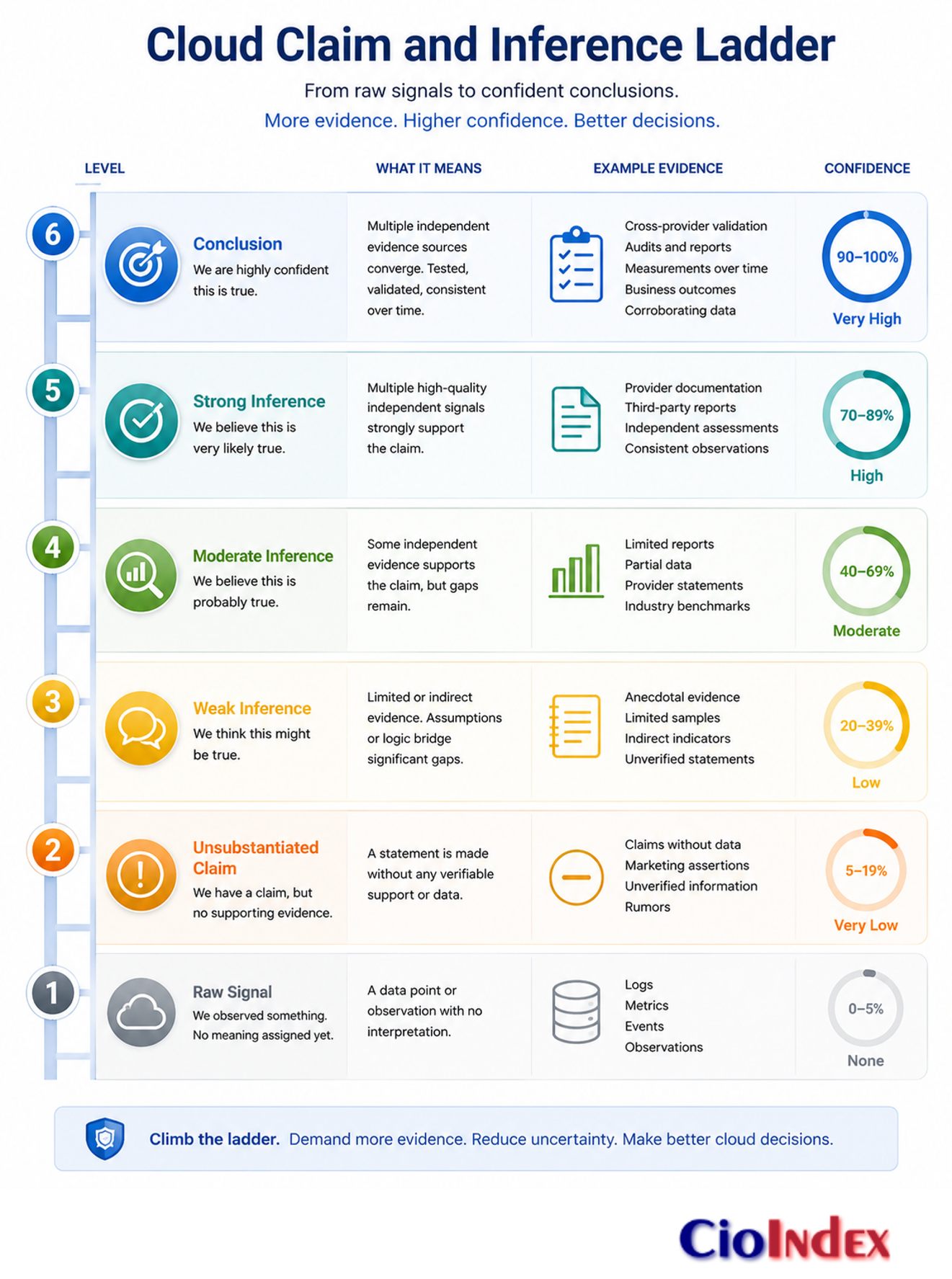
The Value and Control Test helps leaders make the cloud decision before or during adoption. The Claim and Inference Ladder performs a different job: it evaluates the claims made after a migration, implementation, or operating change. It distinguishes what has been observed from the broader conclusions the organization may be tempted to draw.
| Level | Observation | What it establishes | What it does not establish | Stronger evidence needed |
|---|---|---|---|---|
| 1. Placement | Workload runs in a cloud environment | Hosting location and provider service are operational | Modernization, efficiency, resilience, or savings | Architecture and operating evidence |
| 2 Provisioning | Capacity can be obtained rapidly | Infrastructure lead time decreased | Product delivery improved | End-to-end flow and release evidence |
| 3. Elasticity | Resources scale with demand | Capacity responds to load | Costs are optimized or application is resilient | Unit cost, performance, and failure evidence |
| 4. Operational transfer | Provider performs selected infrastructure or platform work | Some tasks moved to the provider | Enterprise responsibility or risk disappeared | Responsibility mapping and control evidence |
| 5. Economic effect | Cloud unit or total cost changed | Consumption economics changed | Business value increased | Product, customer, risk, and financial attribution |
| 6. Strategic value | The operating model improved enterprise outcomes | Cloud contributed to a business capability | Cloud alone caused the outcome or remains the best model | Counterfactuals, competing explanations, and sustained evidence |
The ladder protects leaders from two opposite errors.
The first is declaring success because a workload moved. The second is declaring failure because the cloud bill exceeds an incomplete on-premises comparison. Both substitute one observation for a wider judgment.
The Ladder therefore evaluates the strength of the evidence; it does not replace the original cloud-fit decision or the operating model required to produce value.
Benefits of Cloud Computing Are Conditional
Cloud computing can create material benefits, but each benefit depends on specific operating conditions.
Faster Access to Capacity and Services
Teams can obtain infrastructure, platforms, databases, analytics, and other capabilities without waiting for physical acquisition and installation. NIST identifies rapid provisioning and on-demand self-service as defining characteristics.[1]
The benefit is not the provisioning speed itself. It is the decision or delivery delay removed from the value stream. If architecture review, testing, security approval, data access, or release governance remains slow, rapid infrastructure may not improve time to outcome.
Elastic Capacity
Cloud services can expand and contract with demand. This can reduce the need to purchase enough permanent capacity for peak loads.
Elasticity creates value when:
- the workload can scale technically;
- scaling rules are valid;
- state and dependencies do not become bottlenecks;
- capacity can also scale down;
- cost changes remain observable;
- performance and availability targets are preserved.
An auto-scaling group that only grows is automated overspending, not elasticity.
Access to Managed Capabilities
Managed databases, integration platforms, security services, analytics, and AI capabilities can reduce the work required to build and operate foundational technology.
The value depends on whether the transferred work is genuinely non-differentiating and whether the organization can govern the new dependency. A managed service may reduce patching and operations while increasing data, interface, commercial, and portability dependence.
Variable and Measured Consumption
Measured service can convert some fixed-capacity decisions into consumption decisions. It can improve cost visibility at a granular level.
It can also turn architectural inefficiency, abandoned experimentation, and uncontrolled demand into continuously accumulating expense. FinOps exists because the variable-cost model requires active collaboration, allocation, forecasting, optimization, and value management.[9]
Geographic Reach and Resilience Options
Providers offer regions, availability zones, networks, and managed services that can support geographic distribution and recovery patterns difficult for many organizations to build alone.
These are options, not automatic outcomes. Workload design, identity, data replication, dependency mapping, operating procedures, and testing determine whether the business can actually recover.
Standardization and Automation
Cloud platforms can make infrastructure, policies, deployment, and evidence more repeatable through code and service catalogs.
Standardization creates value when teams use common patterns without forcing every workload into one design. A landing zone, policy library, or golden path should reduce repeated decision work while preserving an escalation route for legitimate exceptions.
Cloud Risks and Limitations Arise From Unseen Responsibilities and Dependencies
Cost Is Variable, Not Necessarily Lower
GAO has repeatedly found that organizations can struggle to track cloud costs, savings, and avoidances consistently. Its 2022 review highlighted cybersecurity, procurement, workforce, and cost-and-savings tracking as four major challenges.[5]
Cloud cost depends on:
- architecture;
- usage pattern;
- service selection;
- commitments;
- licensing;
- data movement;
- resilience design;
- engineering behavior;
- allocation discipline;
- operating model.
The correct comparison is not simply monthly cloud bill versus prior hardware expense. It is the total cost and value of the business capability under credible alternatives.
Security Responsibility Can Become Ambiguous
Providers secure large portions of the platform, but customers retain significant duties. The exact boundary changes by service. Ambiguity creates gaps: each party may perform its part correctly while the combined system remains exposed.
CISA’s Cloud Security Technical Reference Architecture addresses shared services, migration, and cloud security posture management for secure federal adoption.[4] The important lesson extends beyond government: cloud security requires architecture, continuous configuration visibility, identity discipline, and explicit responsibility—not just provider certifications.
Concentration Can Be Hidden
An organization may use many services but still depend on one:
- identity provider;
- cloud control plane;
- region;
- DNS service;
- software vendor;
- data platform;
- managed database;
- integration service;
- specialist workforce.
Concentration is not always wrong. It may create economies, skill depth, and operational simplicity. It becomes dangerous when the dependency is not visible, tested, priced, or governed.
Portability Can Be Overstated
Containers, open interfaces, and infrastructure as code may improve portability. They do not make whole business systems portable by themselves. Data gravity, managed services, network design, identity, licenses, operations, and skills can dominate the movement cost.
NIST has long treated interoperability and portability as important cloud-adoption requirements and standards concerns.[3]
Cloud Can Accelerate Poor Decisions
Automation reduces friction. That is useful when the design and policy are sound. It is dangerous when they are not.
A bad architecture can be deployed globally in minutes. A misconfigured identity policy can expose many resources at once. An invalid cost-allocation rule can charge the wrong products continuously. A flawed template can reproduce the same weakness across hundreds of accounts.
The answer is not to restore manual gates everywhere. It is to make high-value decisions explicit, encode sound defaults, observe outcomes, and retain controlled exceptions.
Common Cloud Failure Patterns
1. Data-Center Substitution
The organization moves virtual machines but retains manual provisioning, static capacity, slow release controls, and server-centric ownership.
Failure: Hosting changed; the operating model did not.
2. Migration as Strategy
The program measures applications moved rather than business capabilities improved.
Failure: Placement becomes a proxy for value.
3. Elasticity Without Economics
Resources scale automatically, but no one owns unit cost, scale-down behavior, or demand quality.
Failure: Technical elasticity becomes financial opacity.
4. Shared-Responsibility Fog
Provider certifications are treated as proof that the workload is secure and compliant.
Failure: Inherited controls, customer controls, configuration, and business obligations are not reconciled.
5. Multicloud by Accident
Different teams buy different platforms without common identity, network, security, data, cost, or operating patterns.
Failure: Vendor diversity increases complexity without creating deliberate resilience.
6. Portability Theater
The organization standardizes containers but depends deeply on proprietary data services, identity, operational tools, and skills.
Failure: One portable layer conceals a non-portable system.
7. Cloud-Native Maximalism
Teams decompose systems into many services because the architecture is fashionable rather than because independent scaling, deployment, ownership, or failure isolation creates value.
Failure: Distributed complexity exceeds the benefit.
8. Central Governance Bottleneck
A cloud team requires manual approval for routine actions in the name of control.
Failure: The organization recreates the ticket queue that cloud self-service was meant to remove.
9. Decentralization Without Guardrails
Every team receives broad freedom without enforceable identity, network, data, security, cost, and lifecycle controls.
Failure: Speed increases faster than accountability.
10. Permanent Temporary Architecture
A migration exception, pilot design, or emergency workaround becomes the long-term platform.
Failure: Transitional debt becomes institutional dependency.
When Cloud Computing Fits It Creates Disproportionate Value
Cloud is a stronger fit when one or more of these conditions are material:
- demand is variable or uncertain;
- rapid environment creation affects delivery;
- managed capabilities reduce non-differentiating work;
- geographic reach matters;
- experimentation should be inexpensive and reversible;
- infrastructure automation improves reliability and evidence;
- the organization needs consumption visibility;
- internal data-center scale or capability is insufficient;
- the workload benefits from standardized platform services;
- business value justifies the provider dependency.
Potential CIO use cases include:
- digital products with variable demand;
- data and analytics platforms;
- development and test environments;
- disaster recovery;
- collaboration and SaaS platforms;
- event-driven integration;
- AI experimentation and production services;
- global customer services;
- temporary high-performance workloads;
- modernization of commodity infrastructure operations.
When Cloud Dependence Exceeds the Value Created
Cloud may be a weaker fit—or require a specialized model—when:
- latency and deterministic performance requirements cannot be met;
- data-location or sovereignty constraints are incompatible with available services;
- equipment must remain physically close to an industrial or edge process;
- the workload is stable, highly utilized, and economically superior on owned infrastructure;
- provider service limits conflict with the application;
- required skills and governance do not exist;
- the commercial dependency is unacceptable;
- exit costs exceed the value created;
- the organization lacks credible identity, network, data, or security foundations;
- a managed service would transfer a differentiating capability the enterprise should retain.
The decision is rarely “cloud or no cloud” for the entire enterprise. It is workload, capability, data, and service specific.
A CIO Decision Case: Managed AI Service or Portable Platform?
Suppose a company wants to build an AI-assisted claims-review capability.
A provider-managed AI platform offers fast access to models, security features, scaling, monitoring, and integrated data services. The organization could reach a pilot quickly.
A more portable architecture using containers, open model interfaces, and separately managed data services would preserve greater placement flexibility. It would also require more engineering, operations, security integration, and model-lifecycle capability.
The decision cannot be resolved by declaring either speed or portability universally superior.
The CIO should ask:
- How differentiating is the model and workflow?
- What data may be sent to the service?
- Which provider controls are inherited, and which remain ours?
- How quickly must the organization learn whether the use case creates value?
- What is the likely scale and cost shape?
- Which service-specific features materially improve the outcome?
- What would make relocation necessary?
- Can data, prompts, evaluations, policies, and workflow logic be exported?
- What capability must the organization retain even if the provider changes?
A rational decision might be:
- use the managed service for bounded discovery;
- isolate business logic and evaluation assets from provider-specific interfaces where practical;
- establish cost, quality, security, and exit evidence before scale;
- accept selected provider dependence where it creates disproportionate value;
- preserve an alternative route for the components whose reversibility matters most.
This is not avoidance of lock-in. It is governed dependency.
The Value and Control Test identifies where cloud fits and which conditions must be governed. The Claim and Inference Ladder establishes how strongly later evidence supports claims of cloud value. Between those two activities lies execution: the operating practices required to turn a defensible cloud decision into a controlled and measurable business capability.
A CIO Operating Model for Cloud Computing: Execute and Govern the Decision
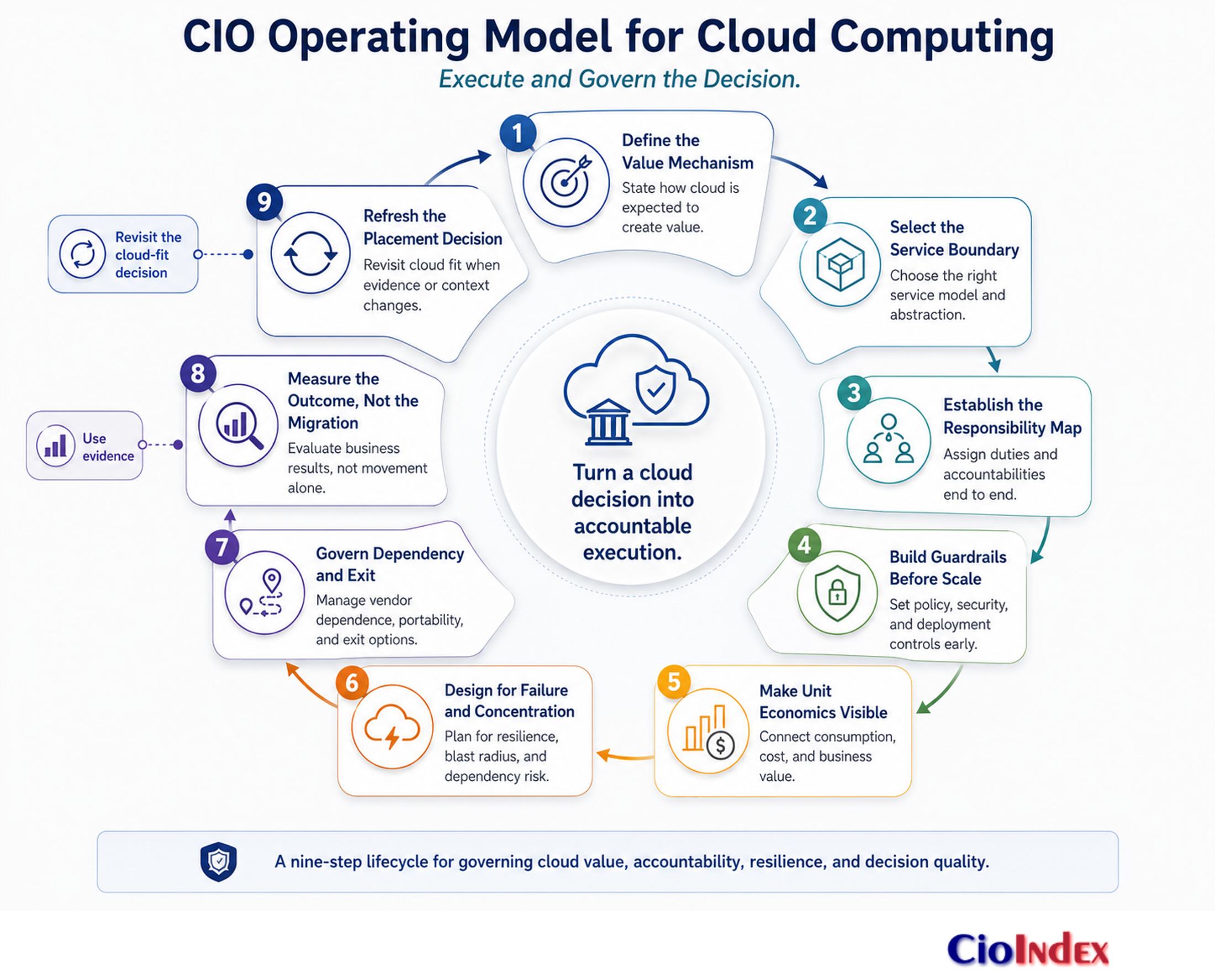
Step 1: Define the Value Mechanism
State why cloud is expected to improve the business capability:
- remove capacity delay;
- support variable demand;
- obtain a managed capability;
- improve recovery options;
- accelerate experimentation;
- standardize deployment;
- increase geographic reach;
- improve consumption visibility.
Do not use “move to cloud” as the value proposition.
Step 2: Select the Service Boundary
Choose IaaS, PaaS, SaaS, serverless, private, hybrid, or another model according to the work that should transfer and the control that should remain.
Step 3: Establish the Responsibility Map
For each workload, assign provider, platform, product, security, data, finance, vendor, and business responsibilities. Bind inherited controls to customer-operated controls and required evidence.
Step 4: Build Guardrails Before Scale
Create enforceable patterns for:
- identity;
- network boundaries;
- encryption;
- logging;
- data classification;
- approved regions and services;
- tagging and ownership;
- backup and recovery;
- vulnerability management;
- cost controls;
- lifecycle and deletion.
Automate routine enforcement and preserve governed exceptions.
Step 5: Make Unit Economics Visible
Connect consumption to products, environments, customers, teams, and outcomes. Define the units that matter: cost per transaction, customer, model inference, environment, data product, release, or business service.
Step 6: Design for Failure and Concentration
Map what fails together. Test recovery of the business service, not merely the infrastructure component. Include identity, data, network, provider control plane, suppliers, and human decision rights.
Step 7: Govern Dependency and Exit
Record provider-specific dependencies, the value they create, movement constraints, licensing terms, data-export methods, skills, contractual rights, and trigger conditions for review.
Step 8: Measure the Outcome, Not the Migration
Track whether the expected value mechanism occurred:
- capacity delay removed;
- release flow improved;
- recovery performance strengthened;
- unit economics improved;
- operational work decreased;
- product experimentation accelerated;
- customer or mission outcomes changed.
Use the Cloud Claim and Inference Ladder to distinguish evidence of placement, provisioning, elasticity, operational transfer, economic effect, and strategic value.
Step 9: Refresh the Placement Decision
Revisit placement when demand, architecture, provider services, regulation, risk, economics, or business importance changes. Cloud placement is a lifecycle decision, not a permanent classification.
When the evidence or operating context changes materially, rerun the relevant dimensions of the Cloud Value and Control Test.
Cloud Computing Versus Related Concepts
| Concept | Primary meaning | Relationship to cloud computing | Common confusion |
|---|---|---|---|
| Virtualization | Abstracts physical computing resources | Important enabling technology | A virtualized data center is automatically a cloud |
| Hosting or outsourcing | Another party operates infrastructure or applications | May use cloud services | Remote ownership equals cloud capability |
| Cloud native | Architecture and practices designed for dynamic, automated environments | Exploits cloud characteristics | Containers or microservices alone create value |
| Edge computing | Processes data near devices, users, or physical operations | Often complements central cloud services | Edge replaces cloud or is unrelated to it |
| Colocation | Customer equipment operates in a third-party facility | Can support hybrid architectures | Renting facility space is cloud computing |
| SaaS | Complete software consumed as a service | One cloud service model | SaaS adoption equals enterprise cloud strategy |
| FinOps | Operating framework for technology value and financial accountability | Governs variable consumption and value | Cost cutting alone is FinOps |
| Multicloud | Deliberate architecture across providers | One possible cloud strategy | Multiple provider contracts equal resilience |
Is Cloud Computing Still Relevant?
Cloud computing is no longer an emerging alternative at the edge of enterprise IT. It is a foundational service model for software, infrastructure, data, security, analytics, and AI.
Its maturity changes the executive question.
Early cloud strategy often asked whether the enterprise should adopt public cloud. Today, most organizations already consume cloud through SaaS, infrastructure, platforms, developer services, data products, or AI capabilities. The harder problem is governing a mixed estate while deciding where deeper provider dependence creates value and where it creates unacceptable risk.
Recent U.S. public-sector evidence shows that the original promises and the enduring management challenges coexist. GAO reports benefits from cloud adoption, but also persistent difficulties involving security, acquisition, workforce, cost tracking, restrictive licensing, and procurement coordination.[5][6][7][8]
AI increases cloud relevance because model development and operation can require large, rapidly changing pools of compute, data, networking, and managed services. It also makes capacity concentration, cost visibility, data control, sustainability, and provider dependency more consequential.
The fourth insight is therefore:
Cloud maturity does not make cloud strategy obsolete. It moves strategy from adoption to selective dependence.
The mature enterprise is not the one that maximizes cloud usage. It is the one that knows which capabilities should be consumed as services, which responsibilities must remain explicit, which dependencies are worth accepting, and how to change course when the evidence changes.
The Real Test of Cloud Computing
Cloud computing should not be judged by:
- the percentage of workloads migrated;
- the number of cloud accounts;
- the size of the cloud contract;
- the number of certified engineers;
- the presence of containers;
- the number of providers;
- the reduction in owned servers.
It should be judged by whether the organization can:
- obtain and change capacity at the speed the business requires;
- transfer non-differentiating work without losing necessary control;
- understand responsibility across provider and customer boundaries;
- connect consumption to value;
- design and test resilience across real dependencies;
- govern concentration and restrictive commercial practices;
- make provider dependence an explicit choice;
- reverse or redesign decisions when assumptions fail.
The final executive question is not:
Should we move to the cloud?
It is:
Which technology capabilities should become programmable services, what value mechanism justifies the change, what responsibilities and dependencies remain ours, and what evidence would cause us to adapt, relocate, or stop?
Frequently Asked Questions
What is cloud computing in simple terms?
Cloud computing is the delivery of computing resources and software as on-demand network services. Instead of purchasing and operating every underlying component directly, consumers obtain standardized services that can often be provisioned rapidly, scaled, measured, and controlled through software.
What are the five characteristics of cloud computing?
NIST identifies on-demand self-service, broad network access, resource pooling, rapid elasticity, and measured service.[1]
What are IaaS, PaaS, and SaaS?
IaaS provides infrastructure resources, PaaS provides managed application or data platforms, and SaaS provides complete applications. Moving from IaaS toward SaaS generally transfers more technical operating responsibility to the provider, while the customer retains responsibility for business use, data, identities, governance, and outcomes.
Is cloud computing cheaper than on-premises IT?
It can be, but lower cost is not automatic. Results depend on workload shape, architecture, utilization, service selection, licensing, data movement, commitments, resilience, and governance. Cloud also creates value through speed, managed capabilities, elasticity, and reduced operating work, which should be evaluated separately from simple infrastructure cost.
Is cloud computing secure?
Cloud providers can supply extensive security capability, but security is shared. Providers secure selected layers; customers remain responsible for data, identities, configurations, applications, access, and other controls depending on the service model. A secure provider does not guarantee a securely configured workload.
What is hybrid cloud?
Hybrid cloud combines distinct cloud environments—such as private and public cloud—that remain separate but are connected to support data or application movement and coordinated operation.
What is multicloud?
Multicloud generally means using services from more than one cloud provider. A deliberate multicloud architecture requires integrated decisions about placement, identity, network, security, data, operations, skills, cost, and recovery. Multiple independent contracts do not by themselves create a multicloud strategy.
What is the difference between cloud hosted and cloud native?
Cloud hosted means the application runs in a cloud environment. Cloud native means the application and operating approach are designed to exploit dynamic infrastructure, automation, managed services, observability, resilience, and frequent change. An application can be cloud hosted without being cloud native.
What is vendor lock-in in cloud computing?
Vendor lock-in occurs when technical, data, skills, commercial, or licensing dependencies make changing providers or architectures prohibitively difficult or expensive. Avoiding all dependence is usually unrealistic. The stronger practice is to identify, price, justify, and govern dependency and preserve reversibility where it matters.
When should an organization not use public cloud?
Public cloud can be a weak fit when latency, physical proximity, deterministic performance, data-location constraints, economics, provider limits, or control requirements cannot be met. The decision should be workload specific rather than ideological.
References
- Peter Mell and Timothy Grance, The NIST Definition of Cloud Computing, NIST SP 800-145, 2011.
- Eric Simmon, Evaluation of Cloud Computing Services Based on NIST SP 800-145, NIST SP 500-322, 2018.
- Mark Badger, Timothy Grance, Robert Patt-Corner, and Jeff Voas, Cloud Computing Synopsis and Recommendations, NIST SP 800-146, 2012; and NIST cloud standards and technology-roadmap materials.
- Cybersecurity and Infrastructure Security Agency, U.S. Digital Service, and FedRAMP, Cloud Security Technical Reference Architecture, version 2.
- U.S. Government Accountability Office, Cloud Computing: Federal Agencies Face Four Challenges, GAO-22-106195, 2022.
- U.S. Government Accountability Office, Cloud Computing: Selected Agencies Need to Implement Updated Guidance for Managing Restrictive Licenses, GAO-25-107114, 2024.
- U.S. Government Accountability Office, Cloud Computing: Federal Government Needs to Address Procurement Challenges, GAO-26-107530, 2026.
- U.S. Government Accountability Office, Cloud Computing: Private Sector Leading Practices in Acquisition, Cybersecurity, and Workforce Development, GAO-25-106369, 2025.
- FinOps Foundation, FinOps Framework, including the 2026 framework definition and public-cloud guidance.
- Amazon Web Services, Shared Responsibility Model and AWS Risk and Compliance guidance.
- Microsoft, Shared Responsibility in the Cloud, Microsoft Learn.
- Google Cloud, Shared Responsibilities and Shared Fate on Google Cloud.
- Cloud Native Computing Foundation, Cloud Native Definition and Cloud Native Glossary.
Author
Sourabh Hajela is the Founder, Executive Editor, and CEO of CIO Index, Inc., with more than three decades of experience in technology strategy, planning, governance, and enterprise IT capability. His work focuses on helping CIOs translate technology models into sound operating choices, accountable execution, and measurable business outcomes. That perspective informs this article’s treatment of cloud computing not as a destination or procurement category, but as a programmable operating model whose value depends on demand fit, service abstraction, responsibility clarity, economic observability, resilience, concentration management, and reversibility.
Research and Editorial Method
This article is a CIO Index synthesis based on current U.S. government standards and guidance, federal oversight evidence, official provider responsibility models, current professional operating frameworks, and vendor-neutral cloud-native definitions. Established definitions, provider claims, public-sector findings, CIO Index interpretations, and illustrative cases are distinguished. The CIO Index Cloud Value and Control Test™ and the Cloud Claim and Inference Ladder™ are original analytical frameworks; they are not NIST standards or validated scientific assessments.
Sources and current-status claims were reviewed through July 17, 2026. Provider service boundaries, government guidance, licensing practices, and cloud operating frameworks should be checked again before procurement, architecture, compliance, or migration decisions.