

COBIT is a framework for the enterprise governance and management of information and technology. It helps governing bodies and management translate stakeholder needs into goals, priorities, decision rights, practices, information, capabilities, performance measures, and review mechanisms.
Technology decisions no longer stay inside the IT department. Business units buy software, product teams deploy cloud services, functions automate work with artificial intelligence, vendors operate critical processes, and boards remain accountable for the resulting value, risk, resources, and regulatory exposure.
That is the problem COBIT is designed to address.
In simple terms, COBIT gives an enterprise a structured way to decide what must be governed, who is accountable, how governance and management should work together, what evidence should be reviewed, and how the system should be adjusted as conditions change. ISACA describes COBIT 2019 as the current iteration of a framework for the governance and management of information and technology across the whole enterprise, not only within the IT function.
But COBIT is often misunderstood. Some organizations treat it as a catalog of controls. Others see it mainly as an audit reference, a process model, or a maturity-scoring exercise. Those uses may be part of a COBIT initiative, but they miss its governing purpose.
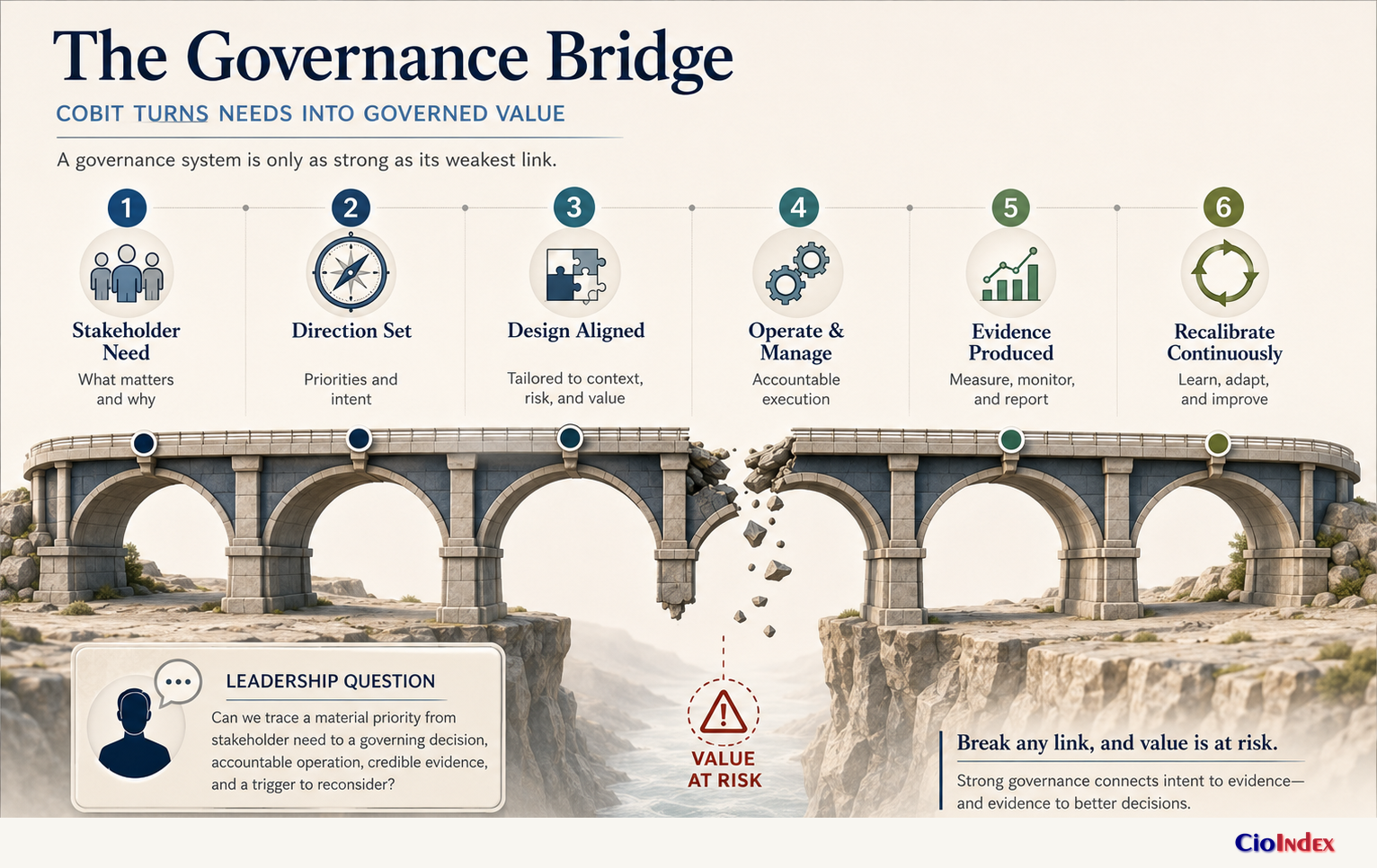
That misunderstanding leads to the article’s central distinction: COBIT is not a control checklist to implement; it is a governance system that must convert stakeholder needs into direction, tailored design, accountable operation, credible evidence, and recalibration.
The consequence is equally important: COBIT adoption is not COBIT value. A governance system creates value only when those links work together and leaders can show what changed, what the evidence supports, and when the design should be reconsidered.
This article explains COBIT 2019’s purpose, principles, components, governance-management distinction, tailoring, value conditions, failure patterns, and the tests CIOs can use to distinguish enterprise governance from documentation.
COBIT at a glance
| Question | Direct answer |
|---|---|
| What is COBIT? | A framework for governing and managing enterprise information and technology. |
| Who publishes it? | ISACA. |
| What is the current iteration? | COBIT 2019, current as of July 24, 2026. |
| What is its scope? | The whole enterprise, including governing bodies, executives, business functions, IT, and relevant third parties. |
| What does it contain? | Principles, seven governance-system components, 40 governance and management objectives, design factors, a goals cascade, performance management, and implementation guidance. |
| What problem does it solve? | It helps translate stakeholder needs and enterprise goals into governed priorities, accountabilities, practices, information, capabilities, and evidence. |
| Is COBIT a control checklist? | No. Controls and assurance can support COBIT, but a functioning governance system requires more than documented controls. |
| Is COBIT the same as ITIL, ISO/IEC 27001, or NIST CSF? | No. COBIT can provide an enterprise governance layer that works with more specialized management, security, risk, architecture, and service frameworks. |
| Must every enterprise implement all 40 objectives? | No. COBIT 2019 is explicitly designed to be tailored to enterprise context and priorities. |
Version status: COBIT 2019 remained current on July 24, 2026. Because ISACA planned an update later in 2026, verify the latest release before using version-specific details.
The table describes COBIT’s architecture. The harder question is whether those elements operate as one governance system.
Why COBIT exists: technology decisions no longer stay inside IT
Enterprise dependence on information and technology has outgrown the organizational boundaries traditionally used to manage it.
A marketing team can select a customer platform that changes data obligations. A finance function can automate decisions that alter control risk. A product team can commit the enterprise to a cloud architecture. A business executive can accept vendor concentration that later becomes an operational dependency. A board can approve a digital strategy without seeing the technology capabilities, accountabilities, and risk assumptions required to execute it.
These are not merely technical choices. They are enterprise choices expressed through technology.
The resulting governance challenge is a conversion problem. Stakeholders express needs such as growth, resilience, compliance, trust, cost discipline, innovation, or faster delivery. Those needs must be translated into enterprise goals. The goals must shape technology-related priorities. The priorities must become decisions, ownership, policies, practices, resources, information, capabilities, and measures. Results must then be reviewed against the original need.
When that conversion chain is weak, organizations often compensate with more committees, policies, dashboards, controls, and reports. Activity increases, but accountability remains unclear. Measures accumulate, but decisions do not change. Projects complete, but the enterprise cannot show that the underlying need was met.
COBIT provides an architecture for making that governance system explicit. It helps the enterprise connect stakeholder value, governance direction, management execution, and performance evidence in one coherent system.
COBIT is a governance system, not a control checklist
The word control is embedded in COBIT’s history, and controls remain important. Yet COBIT 2019 is better understood as a governance-system framework than as a list of controls to implement.
A checklist asks whether required items exist or were completed. A governance system asks a wider set of questions:
- Which stakeholder needs and enterprise outcomes matter most?
- Who has authority to evaluate options and set direction?
- Which governance and management objectives deserve priority?
- Which structures, policies, information, skills, behaviors, processes, and technologies must work together?
- What capability level is appropriate for each priority?
- What evidence would show that decisions, capabilities, outcomes, and value have changed?
- When should the design be adjusted?
A control inventory may provide evidence within that system. It cannot substitute for the system.
Consider a hypothetical enterprise responding to board concern about artificial intelligence. The technology team maps a large set of controls to COBIT and reports 95 percent completion. The dashboard appears reassuring. Yet the organization has not defined its model-risk appetite, who may approve exceptions, which business executive owns an automated decision, what evidence triggers human intervention, or when a use case must be stopped.
The controls may be real. The governance is still incomplete.
This distinction matters because organizations can become audit-ready while remaining decision-poor. They can produce policies, meeting minutes, assessment scores, and evidence packs without resolving the choices that determine value and risk. COBIT should make those choices visible, assignable, reviewable, and adaptable.
Governance and management are different jobs
COBIT makes a deliberate distinction between governance and management.
Governance evaluates stakeholder needs, conditions, and options; sets direction through prioritization and decision-making; and monitors performance and conformance against agreed objectives. Management plans, builds, runs, and monitors activities in alignment with that direction.
| Governance | Management |
|---|---|
| Evaluates stakeholder needs, options, conditions, and tradeoffs | Plans and organizes the work needed to follow direction |
| Sets priorities and direction | Builds, acquires, implements, operates, supports, and monitors |
| Assigns or confirms decision authority and accountability | Executes through processes, teams, services, projects, and controls |
| Monitors whether objectives, value, risk, and resource expectations are being met | Produces operational evidence and escalates exceptions |
| Is typically accountable to the governing body and executive leadership | Is typically the responsibility of senior and middle management |
The distinction is not a debate about titles. It prevents one of the most common governance failures: asking the same group to execute the work, judge whether the direction is still appropriate, and declare its own performance adequate.
For example, a cloud platform team may be responsible for improving service reliability and cost visibility. Management can select tools, redesign operations, negotiate contracts, and report results. Governance must still decide the enterprise’s tolerance for concentration risk, the authority to approve exceptions, the outcomes that justify dependence, and the evidence that would trigger redesign or exit.
COBIT does not require every decision to be made by the board. It does require the enterprise to distinguish the governing decision from the management activity and assign each to an appropriate level.
How COBIT works: from stakeholder needs to governed action
COBIT’s operating logic begins with stakeholder needs and translates them into a governable system.
One of its central mechanisms is the goals cascade. In COBIT 2019, stakeholder drivers and needs are translated into enterprise goals, which are then mapped to alignment goals and relevant governance and management objectives. COBIT 2019 uses 13 enterprise goals and 13 alignment goals in this translation.
The cascade matters because broad aspirations are not directly governable.
“Improve customer trust” is a stakeholder concern. It may translate into enterprise goals involving customer-oriented service, compliance, business continuity, or managed risk. Those goals may create alignment priorities for security, data quality, service availability, portfolio choices, skills, or innovation. The relevant COBIT objectives can then help the enterprise identify accountabilities, practices, information, and capability needs.
The cascade is not a mathematical proof that one practice will produce one outcome. It is a traceability mechanism. It helps leaders test whether technology priorities are anchored in enterprise needs rather than inherited from the IT plan, a vendor roadmap, an audit finding, or the loudest stakeholder.
A sound use of the cascade therefore asks:
- What stakeholder need or enterprise pressure are we responding to?
- Which enterprise outcome expresses that need?
- Which information-and-technology alignment result is required?
- Which governance and management objectives materially contribute?
- What evidence would show that the chain is working?
The goal is not to map everything to everything. The goal is to make the reasoning behind priority and accountability inspectable.
This logic foreshadows the CIO Index Governance Chain: Need -> Direction -> Design -> Operation -> Evidence -> Recalibration. The full model appears later, after the official COBIT elements and their failure conditions have made its need visible.
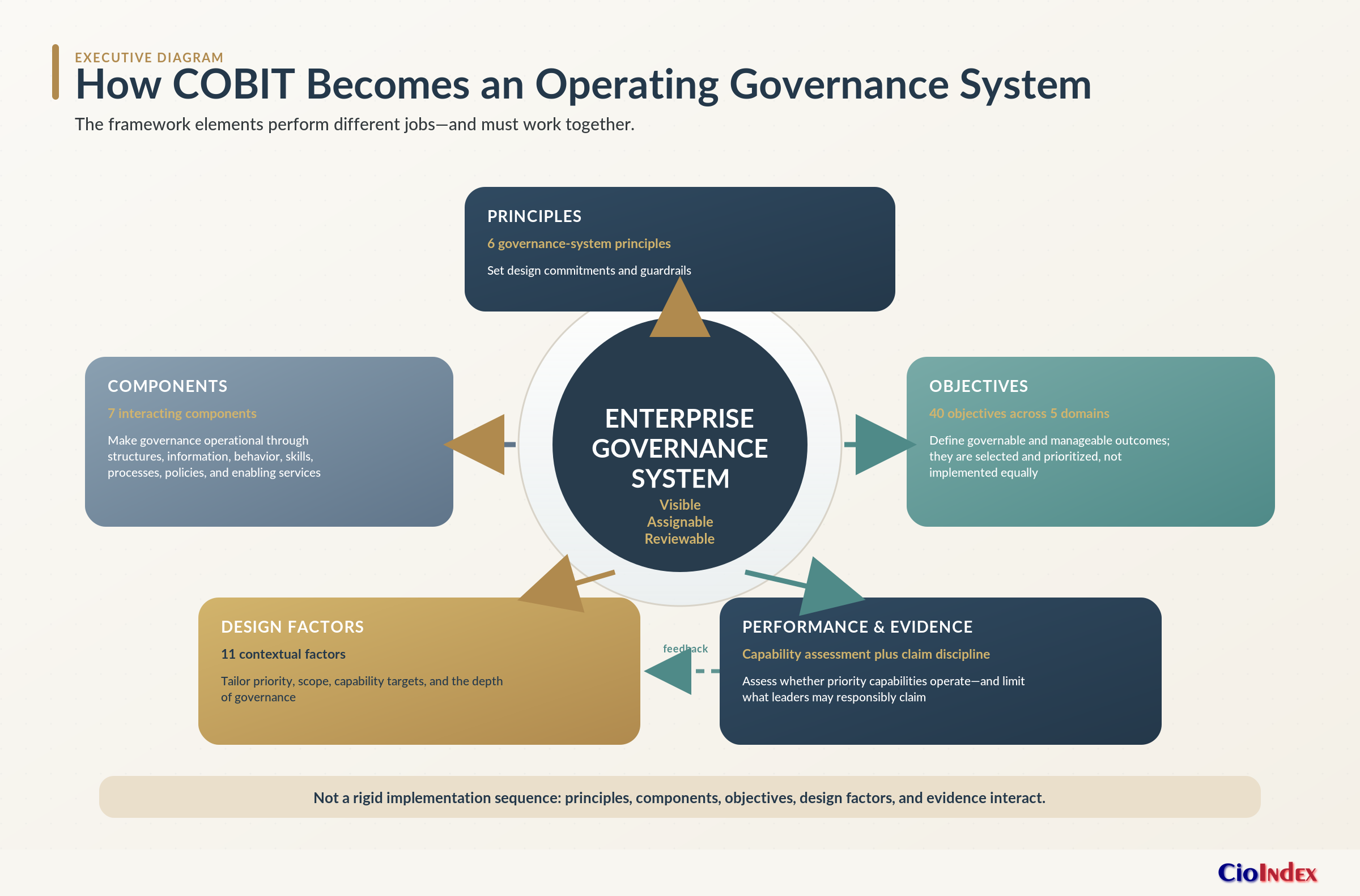
Those elements perform distinct jobs: principles define design commitments; components make them operational; objectives define outcomes to govern and manage; design factors tailor priority; and performance management tests capability. They form one governance architecture.
The six principles of a COBIT governance system
COBIT 2019 defines six principles for a governance system. The first establishes the purpose of governance. The others determine whether that purpose can survive the way the enterprise actually works.
1. Provide stakeholder value
The governance system should satisfy stakeholder needs and generate value from the use of information and technology. Value involves balancing benefits, risk, and resources rather than maximizing one dimension in isolation.
Governance objectives should begin with an enterprise need. A well-documented process disconnected from a valued outcome has weak governing justification.
2. Use a holistic approach
Stakeholder value cannot be produced by a process in isolation. A governance system is built from interrelated components: structures, policies, information, culture, people, skills, processes, and technology.
A new approval process cannot repair governance when authority is ambiguous, incentives reward bypass, information arrives late, or the forum lacks expertise to challenge a recommendation.
3. Create a dynamic governance system
A holistic design is still incomplete if it cannot change. The governance system should respond when strategy, technology, risk, regulation, operating models, or stakeholder expectations change.
Governance is not a one-time implementation. A system designed for centralized infrastructure and annual planning may become unfit under cloud platforms, product operating models, AI-enabled decisions, or decentralized purchasing.
4. Distinguish governance from management
Adaptation also depends on clear decision roles. Governance and management have different purposes, activities, structures, and accountabilities; separating them protects direction and oversight from being absorbed into execution.
The test is whether the enterprise can identify who evaluates and directs, who executes, who supplies evidence, and who can challenge or change direction.
5. Tailor the system to enterprise needs
Clear roles do not make a generic design fit. COBIT is not intended to be implemented identically everywhere; enterprise strategy, goals, risk, issues, sourcing, technology, size, regulation, and delivery methods affect what the system should emphasize.
COBIT’s breadth is a design resource, not an implementation mandate. The enterprise must make a narrower, explicit, defensible choice.
6. Cover the enterprise end to end
Tailoring narrows effort; end-to-end scope prevents the design from shrinking back into an IT-only concern. Governance of information and technology includes all relevant enterprise functions, processes, information, technology, and stakeholders.
Enterprise technology decisions cannot be dismissed as internal IT concerns simply because a technology team operates the system.
COBIT 2019 also defines three principles for the framework itself: it should use a conceptual model, remain open and flexible, and align with major related standards, frameworks, and regulations. Those principles support COBIT’s role as an integrating architecture rather than a closed method that must replace everything else.
The seven components that make governance operational
The principles describe how a governance system should behave. COBIT 2019’s seven components identify what must work together for that behavior to become operational. They are not seven optional workstreams; they are interacting conditions.
| Component | What it contributes | Typical failure when weak |
|---|---|---|
| Processes | Organized practices and activities that produce outcomes | Procedures exist, but do not connect to decisions or responsibilities |
| Organizational structures | Forums, roles, committees, authorities, and escalation paths | Decisions are discussed, but no one owns or can enforce them |
| Principles, policies, and procedures | Rules and guidance that shape consistent action | Policies are generic, conflicting, outdated, or routinely bypassed |
| Information | Inputs, records, measures, reports, and knowledge used to decide and operate | Dashboards measure activity rather than outcomes, arrive too late, or lack trusted data |
| Culture, ethics, and behavior | Norms and incentives that influence what people actually do | Teams optimize locally, hide exceptions, or treat governance as administrative friction |
| People, skills, and competencies | Judgment and capability required to perform and challenge the work | Forums approve decisions they cannot evaluate, or execution depends on scarce individuals |
| Services, infrastructure, and applications | Technology and services that enable governance and management practices | Tool limitations, fragmented platforms, or inaccessible evidence prevent the intended process |
The component model is one of COBIT’s strongest correctives to checklist thinking.
Suppose an enterprise introduces an architecture-review process. The process is documented, and every project is required to submit a design. Yet the architecture board has no authority to stop nonconforming investments, business sponsors can escalate around it, reviewers lack current cloud expertise, portfolio data does not reveal duplicate capabilities, and project incentives reward speed over reuse.
The process exists. The governance component system does not.
A COBIT-based design should therefore ask not only, “Which process do we need?” but also, “What structure, information, policy, behavior, skill, and enabling service must make the process effective?”
The 40 governance and management objectives and five domains
The components describe the conditions that make governance possible. The COBIT 2019 core model then defines 40 governance and management objectives: outcomes and related guidance the enterprise may use when designing the system.
They are grouped into five domains:
| Domain | Governing purpose |
|---|---|
| EDM — Evaluate, Direct and Monitor | Governing-body activities that evaluate options, set direction, and monitor outcomes |
| APO — Align, Plan and Organize | Strategy, architecture, innovation, portfolio, budget, people, relationships, agreements, suppliers, quality, risk, data, and security planning |
| BAI — Build, Acquire and Implement | Programs, requirements, solutions, availability, organizational change, change enablement, acceptance, knowledge, assets, and configuration |
| DSS — Deliver, Service and Support | Operations, service requests and incidents, problems, continuity, security services, and business-process controls |
| MEA — Monitor, Evaluate and Assess | Performance, internal control, compliance, and assurance |
Only EDM is a governance domain in COBIT’s governance-management distinction. The other four are management domains.
The 40 objectives are not a list of equally urgent requirements. They are a reference model from which the enterprise determines relevance and priority. A regulated financial institution, a digital product company, a public agency, and a small professional-services firm may use the same framework while emphasizing different objectives, structures, capability targets, and evidence.
This is why reproducing all 40 objectives is less useful than understanding how the model should be designed. The executive task is not to admire the completeness of the catalog. It is to select the objectives that matter to the enterprise’s decision burden and make their relationships operational.
How COBIT is tailored to the enterprise
The core model provides breadth; the design factors determine which parts of that breadth deserve priority in this enterprise. COBIT 2019 introduced a more explicit design approach so organizations can create a governance system fitted to their context rather than adopt the framework wholesale.
The design guidance uses 11 design factors:
- Enterprise strategy
- Enterprise goals
- Risk profile
- I&T-related issues
- Threat landscape
- Compliance requirements
- Role of IT
- Sourcing model for IT
- IT implementation methods
- Technology adoption strategy
- Enterprise size
These factors affect which governance and management objectives receive higher or lower priority and what target capability may be appropriate.
ISACA’s design workflow can be summarized in four steps: understand the enterprise context and strategy; determine the initial scope of the governance system; refine that scope; and resolve conflicts before concluding the design.
This creates a practical sequence.
An enterprise first establishes its strategic and operating context. It then uses enterprise goals, risk, and current issues to identify an initial set of governance priorities. It refines that view using factors such as regulatory pressure, sourcing, delivery methods, technology adoption, and size. Where factors pull in different directions, leaders make and document a reasoned choice.
For example, a fast-growing enterprise facing cloud cost overruns, provider concentration, duplicated platforms, and rapid product delivery might raise priorities related to portfolio management, architecture, supplier management, cost transparency, risk, availability, and change. It would not follow that every related objective should be driven to the highest capability level. The enterprise must decide where stronger capability changes a material decision or outcome and where lighter governance is sufficient.
A comprehensive framework becomes practical only after the enterprise decides what not to prioritize.
That decision is not a weakness in COBIT adoption. It is the essence of COBIT design.
How COBIT performance management works
Tailoring establishes where stronger governance capability is justified. COBIT performance management then helps organizations assess whether the selected processes and components operate at the intended level and where improvement is needed. For process capability, COBIT 2019 uses levels from 0 to 5.
At a high level:
- Level 0 indicates incomplete capability.
- Level 1 indicates that the process achieves its purpose to some degree through performed activities.
- Level 2 adds managed and controlled performance.
- Level 3 adds defined and standardized practice.
- Level 4 adds quantitative management.
- Level 5 adds continuous improvement and optimization.
The scale should not become a universal ambition to reach level 5 everywhere. A target capability should reflect the importance of the objective, the consequences of failure, the variability of the work, the evidence need, the enterprise’s context, and the cost of stronger capability.
More importantly, capability scoring must not be confused with enterprise value.
The Adoption-to-Value evidence ladder
Within the Governance Chain previewed earlier, this ladder governs the Evidence link. It separates what leaders can observe from what those observations actually establish and prevents a capability score from carrying a stronger claim than the evidence supports.
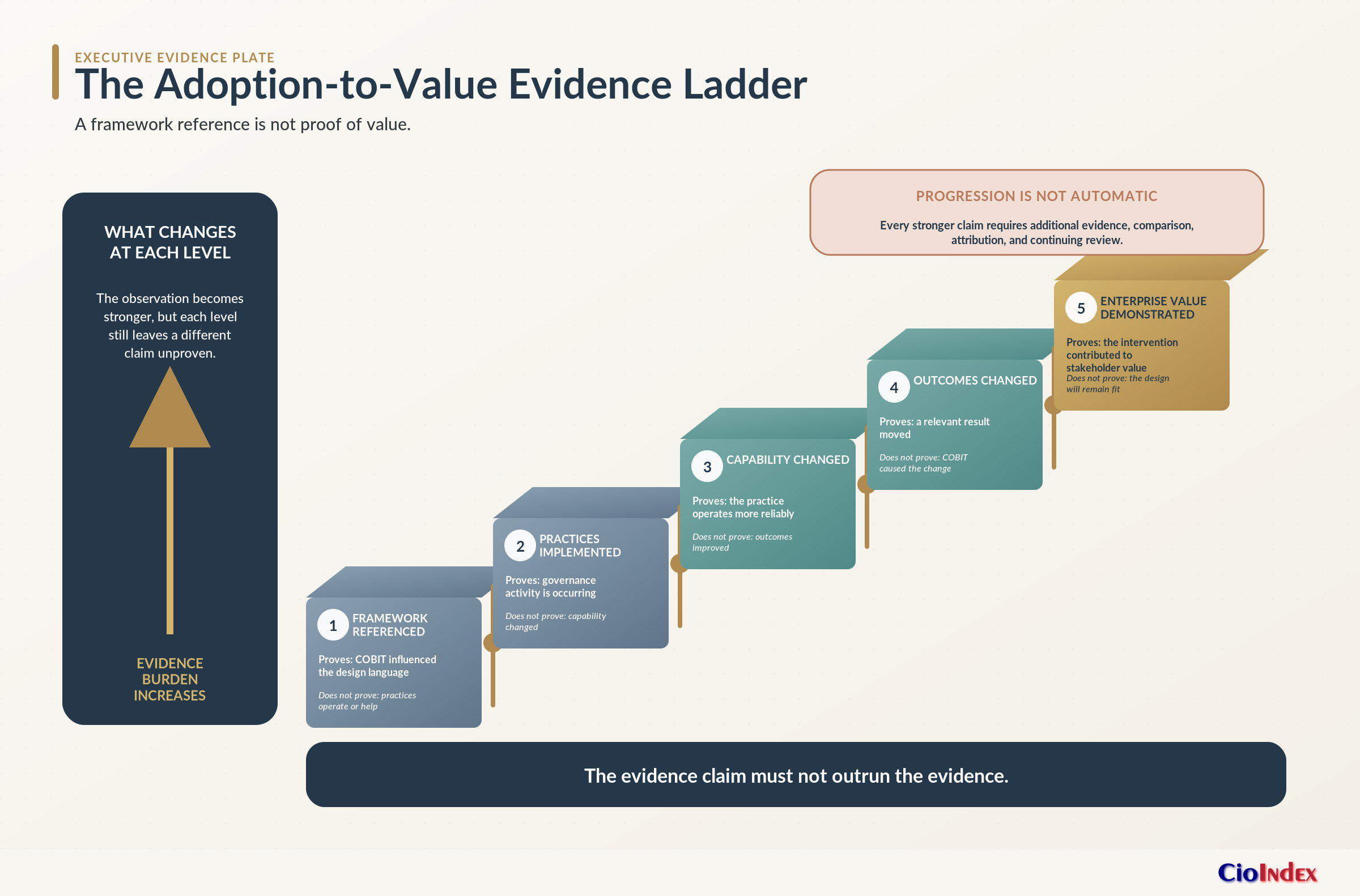
The following CIO Index ladder separates increasingly strong claims:
| Level | What can be observed | What it establishes | What it does not establish |
|---|---|---|---|
| Framework referenced | Policies, mappings, project plans, or controls cite COBIT | COBIT influenced the design language | That practices are operating or useful |
| Practices implemented | Processes, roles, meetings, controls, and reports exist | Governance activity is occurring | That operating capability changed materially |
| Capability changed | Work is repeatable, owned, measured, and improved at the target level | The organization can perform the relevant practice more reliably | That the intended enterprise outcome improved |
| Outcomes changed | Decision quality, service, risk exposure, cost, compliance, or another target moved | A relevant outcome changed | That COBIT caused the change or that value exceeds cost |
| Enterprise value demonstrated | Benefits, risk, and resources improved against an agreed baseline with credible attribution | The governance intervention contributed to stakeholder value | That the design will remain fit as conditions change |
This ladder protects leaders from a common inference error: treating documented adoption as proof of benefit.
A high assessment score can be useful evidence. It is not self-interpreting. Executives still need to know what changed, compared with what baseline, through which mechanism, at what cost, with what residual uncertainty, and whether the result matters to stakeholders.
What value can COBIT create?
COBIT can support several forms of enterprise value, but the benefits are conditional. The framework does not automatically improve alignment, risk, compliance, cost, or performance merely because it is adopted. Each claimed benefit should therefore be located on the Evidence Ladder: what changed, what the evidence establishes, and what remains uncertain?
Traceability from need to action
The goals cascade and core model can help an enterprise connect stakeholder needs to enterprise goals, alignment priorities, governance objectives, management practices, and evidence.
This improves decision quality when the mapping is selective, the assumptions are visible, and leaders use the chain to challenge priorities. It becomes administrative overhead when teams map everything to everything and no choice changes.
Clearer accountability and decision rights
COBIT’s governance-management distinction, responsibility guidance, structures, and components can expose who evaluates, directs, executes, informs, monitors, and escalates.
Accountability improves when those rights are explicit and supported by authority, information, competence, and consequences. A RACI chart alone does not create ownership.
Integration across specialized frameworks and obligations
COBIT is open and designed to align with relevant standards, frameworks, regulations, and practices. It can provide a common governance architecture across service management, cybersecurity, risk, architecture, data, privacy, compliance, project delivery, and internal control.
Integration creates value when COBIT clarifies the enterprise decision and each specialist framework retains a distinct operating job. It fails when organizations create duplicate control libraries, overlapping committees, and several versions of the same evidence.
Deliberate prioritization of governance effort
Design factors can help leaders focus governance capacity where strategy, risk, regulation, sourcing, technology, and current issues create the greatest decision burden.
Prioritization creates value when it changes resources, capability targets, forums, measures, and escalation. It does not create value when every objective remains “high priority” after the exercise.
More disciplined assurance and improvement
Performance management can help the enterprise assess whether priority capabilities are operating at an appropriate level and where improvement is warranted.
Assurance becomes decision-useful when it tests the claims leaders care about. Evidence of process conformance may be adequate for one question and inadequate for another. A clean control result does not by itself prove resilience, business value, strategic alignment, or acceptable risk.
What COBIT does not do
COBIT is broad, but it is not a substitute for executive judgment or specialized management knowledge.
ISACA guidance explicitly cautions that COBIT does not tell an enterprise what the best IT strategy or architecture is, what technologies it should use, or how much it should spend. Rather, it helps structure which decisions should be taken, how, and by whom.
COBIT is therefore not:
- a complete description of an enterprise’s technology environment;
- a technical architecture method;
- a product configuration guide;
- a detailed service-management operating procedure;
- a cybersecurity control catalog that replaces specialist security frameworks;
- an automatic compliance certification;
- a universal organization chart;
- a promise that adopting the framework will improve performance.
COBIT can govern the system through which those choices are made. It cannot make the choices on behalf of the enterprise.
This boundary is a strength. Governance frameworks become dangerous when their structure is mistaken for an answer. COBIT does not make better technology decisions; it makes the decision system visible, assignable, and reviewable. Strategy, context, expertise, and leadership must still supply the judgment.
Where COBIT adoption fails
Most COBIT failures are not caused by a missing process description. They arise when the framework’s breadth is converted into administrative activity without a governing logic.
Treating COBIT as a control checklist
Teams map controls, collect evidence, and track completion while leaving stakeholder priorities, decision rights, tradeoffs, and outcome measures unresolved.
The result is governance theater: strong evidence that work occurred, weak evidence that the right decisions were governed.
Collapsing governance into management
Operational leaders set direction, execute the work, measure it, and determine whether the result is acceptable. Governing bodies receive polished reports but do not make or revisit material choices.
The fix is not another committee. It is clarity about which decisions require independent evaluation, direction, challenge, escalation, and monitoring.
Mistaking metrics for proof
An enterprise reports assessment scores, control coverage, project completion, uptime, ticket closure, or policy adoption as evidence of governance success.
These measures may establish activity or capability. They do not necessarily establish better outcomes, causal contribution, or enterprise value. The evidence claim must not outrun the evidence.
Four other recurring breakdowns reveal where the surrounding system is weak:
| Failure pattern | What happens | Governance correction |
|---|---|---|
| Implementing all objectives at equal priority | The core model becomes a large transformation program, and scarce attention is spread across documentation rather than material decisions. | Use context and design factors to distinguish objectives needing deeper capability, baseline discipline, or no immediate action. |
| Building a process-only system | Procedures exist, but structures, information, culture, behavior, skills, policies, and enabling services do not support them. | Design the full component system so authority, incentives, information, competence, and tools reinforce the process. |
| Treating implementation as a one-time project | Documents and training are completed while strategy, technology, sourcing, risk, and regulation continue to change. | Establish recurring review and recalibration triggers rather than closing governance as a project. |
| Mixing COBIT 5 and COBIT 2019 without control | Legacy terminology, counts, process descriptions, and design assumptions silently shape current decisions. | Declare the version governing current design, preserve useful legacy mappings deliberately, and control transitions. |
The version-control point is not cosmetic. COBIT 2019 expanded the core model to 40 objectives, introduced design factors more explicitly, and changed performance-management treatment.
Across all seven patterns, the failure is the same: one or more links between enterprise need, direction, design, operation, evidence, and recalibration has broken.
The CIO Index COBIT Governance Chain
The failure patterns differ, but each breaks the same governing logic. Executives therefore need a compact way to test whether COBIT is functioning as a governance system.
The CIO Index COBIT Governance Chain is a bounded interpretive model derived from COBIT’s goals cascade, governance-management distinction, design approach, component model, and performance logic. It is not an ISACA model and does not replace the COBIT Design Guide.
The three CIO Index devices have distinct jobs: the fit test sets scope, the Governance Chain finds broken links, and the Evidence Ladder determines what leaders can responsibly claim.
1. Need
What stakeholder concern, enterprise goal, risk, opportunity, resource constraint, or obligation requires governance?
A weak chain starts with a framework requirement: “We need to implement COBIT.” A strong chain starts with an enterprise need: “We need to govern AI-enabled customer decisions because value, accountability, privacy, and model risk cross several functions.”
2. Direction
What governing decision is required? Which outcome, risk appetite, priority, principle, or constraint will direct management?
Direction should be specific enough to shape choices. “Manage risk” is not direction. “Require named business ownership, model validation, human override, exception authority, and quarterly risk review for high-impact AI decisions” is closer to governable direction.
3. Design
How should the governance system be tailored? Which objectives, components, structures, practices, information, skills, policies, and capability targets are necessary?
Design is where COBIT’s breadth becomes a fit-for-purpose system. It should also state what is intentionally not included or not raised to a high capability target.
4. Operation
How will management plan, build, run, support, monitor, and escalate within the direction? Who owns the activities and outputs?
Operation connects governance to real work. Without it, direction remains a policy aspiration.
5. Evidence
What evidence would show that practices operate, capability changed, outcomes improved, and stakeholder value was affected? What does the evidence not prove?
Evidence should be proportionate to the claim. Control completion supports a different conclusion from reduced risk exposure or improved value realization.
6. Recalibration
What change, exception, result, or external development should trigger a review of direction or design?
A governance system should not merely monitor whether management followed the plan. It should also test whether the plan and governing assumptions remain appropriate.
The chain exposes where governance breaks. If a priority has no governing decision, it stalls between Need and Direction. If direction produces no owned operating mechanism, it breaks between Design and Operation. If dashboards cannot support the claim leaders make, it breaks at Evidence. If results never cause direction to change, Recalibration is absent.
This gives executives a diagnostic stronger than “Have we implemented COBIT?”
A practical test: when should an enterprise use COBIT?
The Governance Chain asks whether a COBIT-based system works. The fit test asks an earlier question: whether COBIT is the right level of governance architecture for the problem and how broadly it should be used.
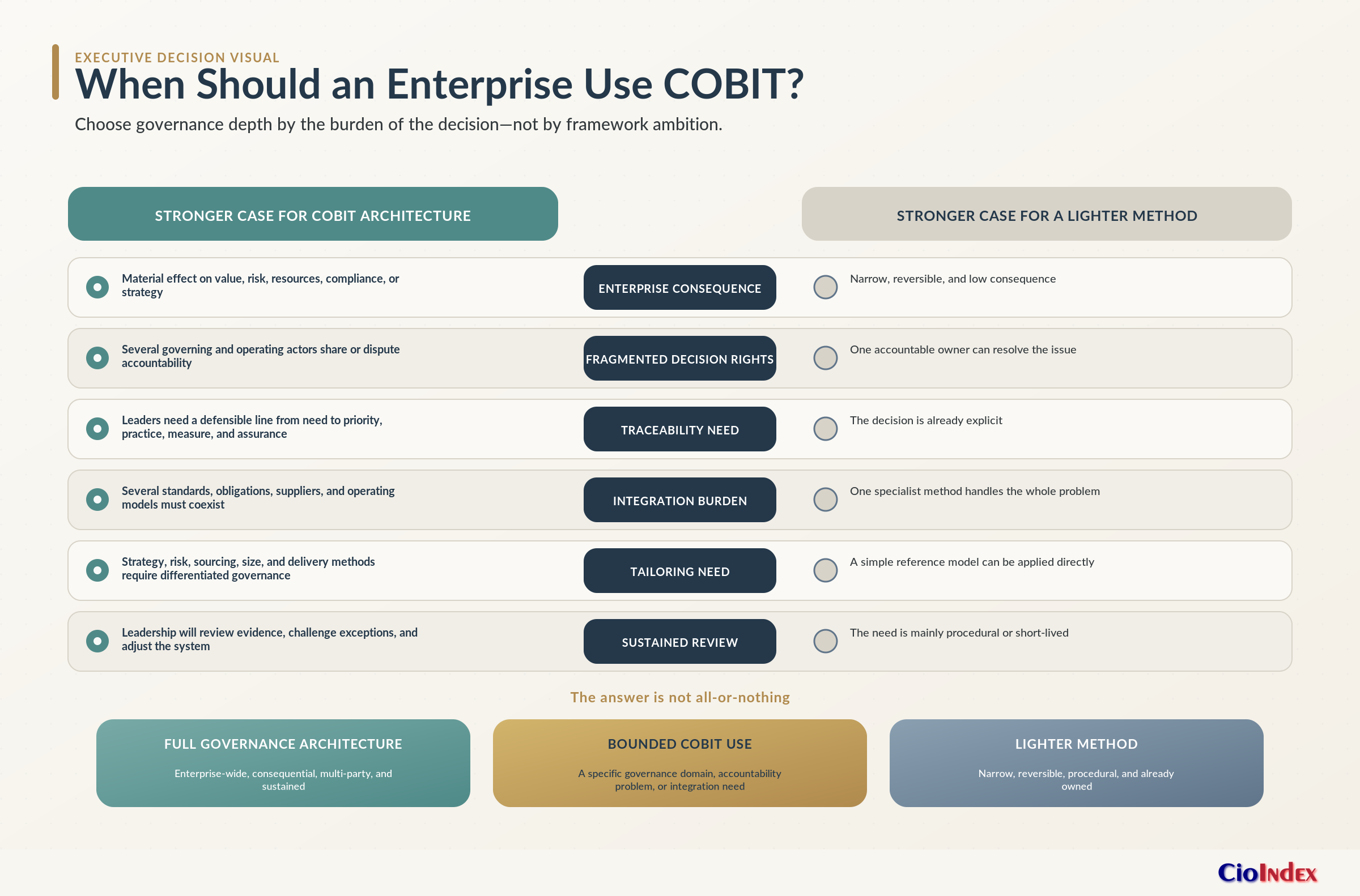
COBIT is most useful when the governance problem is enterprise-wide, consequential, multi-party, or difficult to integrate. The following questions are a CIO Index diagnostic, not an official ISACA assessment.
| Test | Evidence that COBIT may fit | Evidence that a lighter method may fit |
|---|---|---|
| Enterprise consequence | Technology choices materially affect value, risk, resources, compliance, or strategic execution | The issue is narrow, reversible, and low consequence |
| Fragmented decision rights | Boards, executives, business units, IT, risk, audit, and suppliers share or dispute accountability | One accountable owner can resolve the issue through an existing process |
| Traceability need | Leaders need a defensible line from stakeholder need to priority, practice, measure, and assurance | The decision is already explicit and does not require a broad governance architecture |
| Integration burden | Several standards, methods, regulations, and operating models must coexist | A specialist standard or procedure can handle the whole problem |
| Tailoring need | Strategy, risk, sourcing, size, and delivery methods require differentiated governance | The organization intends to copy a reference model without design work |
| Sustained review | Leadership will review evidence, challenge exceptions, and adjust the system | The initiative is mainly a documentation or certification exercise |
COBIT may be a poor fit when leadership wants the appearance of governance without taking governing decisions, when the problem is purely technical and procedural, or when the organization lacks the sponsorship and capacity to sustain a dynamic system.
It may still be useful in a bounded way. An enterprise does not need an all-or-nothing adoption decision. It can use COBIT to redesign a specific governance domain, clarify accountability, integrate assurance, diagnose a failed decision chain, or establish a common reference model across multiple practices.
How COBIT fits with ITIL, ISO standards, COSO, NIST and other frameworks
COBIT often sits beside frameworks with narrower jobs. The useful question is not which framework wins a feature comparison, but which layer of the enterprise decision each should own.
At a high level:
- ITIL (Version 5) guides digital product and service management. COBIT can govern the enterprise choices, accountabilities, and performance expectations around that work.
- ISO/IEC 38500:2024 gives governing bodies principles for effective, efficient, and acceptable IT use. COBIT offers a broader architecture for operationalizing governance.
- ISO/IEC 27001:2022 defines information-security management-system requirements. COBIT connects security to broader enterprise priorities, accountability, and assurance.
- NIST Cybersecurity Framework 2.0 defines high-level cybersecurity outcomes. COBIT situates them within enterprise governance and management responsibilities.
- COSO’s Internal Control—Integrated Framework provides organization-wide control guidance. COBIT translates those expectations into information-and-technology governance and management.
- The TOGAF Standard and other architecture methods guide enterprise architecture. COBIT clarifies decision ownership, goal alignment, and conformance monitoring.
COBIT’s useful role is often that of an integrator: it creates a common governance system while specialist frameworks supply deeper methods and practices. Integration should preserve ownership boundaries. Using COBIT does not require relabeling every specialist activity as a COBIT process.
Detailed COBIT-versus-ITIL, COBIT-versus-ISO, and COBIT-versus-NIST decisions deserve separate comparison pages because the right answer depends on the searcher’s task, scope, and required output.
Is COBIT still relevant?
Yes. As of July 24, 2026, COBIT 2019 remains ISACA’s current COBIT iteration, and ISACA continues to publish COBIT resources and topic guidance for changing areas such as information security, cloud, digital transformation, risk, privacy, DevOps, and artificial intelligence. ISACA also announced in April 2026 that a COBIT update was planned for later in the year, so organizations should verify the latest release status before relying on version-specific details.
Its relevance does not come from being newer than every specialist framework. It comes from addressing a persistent executive problem: enterprises depend on information and technology across organizational boundaries, while accountability, direction, evidence, and adaptation remain fragmented.
COBIT remains useful when it is treated as a dynamic and tailored governance system. It becomes less useful when organizations freeze it into a historical process map, pursue maturity for its own sake, or use the framework’s authority to avoid making contextual decisions.
Current relevance therefore depends on current design. An enterprise should revisit its COBIT system when strategy, business models, sourcing, technology adoption, regulation, threat exposure, delivery methods, or stakeholder expectations materially change.
Frequently asked questions about COBIT
What does COBIT stand for?
COBIT originated as an abbreviation associated with “Control Objectives for Information and Related Technology.” In current ISACA usage, COBIT functions as the framework’s name rather than as a phrase that must be expanded whenever it appears. The framework has also broadened well beyond a control-objectives catalog.
Who owns and maintains COBIT?
ISACA publishes and maintains COBIT. The framework, official publications, training, and related intellectual property are ISACA resources.
What is COBIT 2019?
COBIT 2019 was ISACA’s current iteration on July 24, 2026. It updated the principles, core model, design approach, performance management, and guidance for tailored governance systems. Because ISACA planned an update later in 2026, confirm the latest release before using version-specific details.
Is COBIT only for large enterprises?
No. COBIT 2019 treats enterprise size as a design factor. Smaller organizations can use narrower scope, simpler structures and evidence, and lower capability targets when the governance burden does not justify more depth.
Is COBIT only for auditors or compliance teams?
No. COBIT serves governing bodies, executives, business leaders, technology management, risk, security, data, architecture, service, portfolio, audit, and compliance. Treating it only as an audit reference weakens its enterprise-governance purpose.
Does COBIT require all 40 objectives?
No. COBIT 2019 is designed to be tailored. Design factors help determine which objectives should receive priority and what target capability is appropriate.
What is the difference between a COBIT objective and a control?
A COBIT objective describes an intended governance or management outcome and related practices. A control is a specific risk-modifying or reliability measure. Controls may support an objective, but they do not replace its accountability, processes, information, structures, skills, behavior, or enabling services.
Can COBIT be used with ITIL, ISO/IEC 27001, NIST CSF, or other frameworks?
Yes. COBIT can provide the governance architecture while specialized frameworks supply detailed operating or technical guidance.
Is COBIT a certification?
COBIT is a framework. ISACA offers training and credentials, but a credential does not establish an effective enterprise governance system.
How should an organization start with COBIT?
Start with a material governance need and enterprise context, not the full catalog. Clarify goals, risk, decision rights, and scope; then use design factors to select priorities, capability targets, evidence, and an iterative path.
The question to carry into the next governance meeting
COBIT gives an enterprise a rich architecture for governing and managing information and technology. Its principles, components, objectives, goals cascade, design factors, and performance model can make a fragmented decision system visible.
But a framework cannot govern by itself.
The final test is not whether COBIT appears in policy documents, control maps, process assessments, or audit evidence. It is whether the enterprise has converted a stakeholder need into direction, designed a system appropriate to its context, enabled accountable management action, reviewed evidence at the right level of claim, and changed course when the evidence or context required it.
The executive question is:
For this priority, can we trace the stakeholder need to an explicit governing decision, a tailored design, accountable operation, credible evidence, and a defined trigger to reconsider?
When the answer is yes, COBIT is functioning as a governance system. When the answer is no, the next task is not to add more framework. It is to repair the broken link in the governance chain.
Sources and Applicability Note
This article uses ISACA material as the authority for COBIT structure, terminology, principles, components, objectives, design, and performance. The CIO Index Governance Chain, Evidence Ladder, examples, fit test, and executive interpretations are original analytical devices, not official ISACA models.
COBIT is an ISACA trademark and framework. Organizations should consult the licensed official COBIT publications for complete objective descriptions, detailed practices, mappings, design guidance, implementation guidance, performance criteria, and permitted use.