
ITIL is an adaptable framework for managing digital products and services so that organizations can create and sustain value for customers, users, the business, and other stakeholders. The current framework is ITIL (Version 5), introduced in January 2026. It connects guiding principles, governance, value chain activities, product and service lifecycle management, value streams, management practices, four management dimensions, and continual improvement.[1][2]
In simple terms, ITIL gives an organization a shared way to decide what value a digital product or service should create, how work should move across teams and suppliers, which management capabilities are needed, how risk should be governed, and how the system should learn and improve.
That definition is only the starting point. The employee-access and customer-onboarding situations used below are composite illustrations, not reported case studies. Consider an employee-access service that reports 96 percent achievement against a two-day service-level target. The metric looks strong, yet employees still wait a week because incomplete requests are closed and resubmitted, exceptions move through email, and no one owns the complete journey. Every participating team may be performing its assigned process correctly while the total service fails the stakeholder.
This exposes the central management problem that ITIL must solve: implementing ITIL practices is not the same as improving a value stream. Practices provide capabilities. Value streams connect those capabilities to an outcome. Unless the organization manages the relationship, framework activity can increase while service value remains unchanged.
This article explains what the current ITIL framework is, why it exists, how its elements work together, and how leaders can distinguish useful adoption from process ceremony. The final test is practical: does the initiative improve value, flow, and learning, with the right controls across all three?
ITIL definition: ITIL is a configurable management framework for designing, delivering, operating, supporting, governing, and continually improving digital products and services around stakeholder value.
What ITIL Means Today
ITIL originated in the late 1980s as the Information Technology Infrastructure Library, guidance developed to improve the consistency of IT service management. The name later became a stand-alone term; IBM notes that ITIL has not formally referred to the expanded phrase since 2013.[4]
The history matters because it explains two persistent misconceptions. The first is that ITIL is mainly about infrastructure, help desks, and operational processes. The second is that ITIL is a fixed operating model that an organization implements in full.
Modern ITIL is broader. ITIL (Version 5) is positioned around digital product and service management across the full lifecycle, including product-centric and AI-enabled operating environments.[1][2] It addresses how products and services are discovered, designed, delivered, supported, governed, experienced, and improved. Its value streams may cross product management, software delivery, cybersecurity, architecture, operations, finance, suppliers, customer experience, and business teams.
ITIL is also adaptable guidance rather than a rigid checklist. Organizations select and configure the concepts and practices that fit their outcomes, scale, risks, technology, and maturity.[5][6] The framework supplies a management language and a set of capabilities; it does not eliminate the need to design an operating model.
ITIL (Version 5) is the current framework. It is being introduced through a phased release, while ITIL 4 remains available during the transition.[2][3] PeopleCert’s current plan is to sunset ITIL 4 modules on December 31, 2027, although organizations should recheck that date before making certification decisions.[3]
The change from older versions is therefore more than a new label. ITIL is best understood today as a coordination system for digital products and services: a way to connect value, work, decisions, technology, suppliers, experience, risk, and improvement.
Why ITIL Exists
Digital products and services rarely fail because one team lacks a process document. They fail because the organization does not manage the whole system coherently.
A customer-facing service may depend on a product team, identity platform, cloud provider, service desk, cybersecurity function, data service, finance rule, vendor contract, and business process. Each group can achieve its local objective while the total experience remains slow, unreliable, expensive, or confusing.
This is the problem ITIL exists to address. Its purpose is to help an organization move from fragmented activity to coordinated value creation. PeopleCert’s current Foundation description frames value as something co-created among providers, consumers, and other stakeholders while considering outcomes, costs, risks, experience, and sustainability.[1]
That is a broader test than whether IT closed a ticket, deployed a release, met an uptime target, or completed a practice assessment. Those results may matter, but none proves that the stakeholder received the intended value.
The employee-access example makes the difference visible. Closing each request within two days is an output of a local process. Providing accurate access with acceptable effort, control, speed, and auditability is the end-to-end outcome. If the organization measures only the first, a strong dashboard can conceal a weak service.
ITIL helps leaders connect considerations that otherwise remain separated:
- stakeholder outcomes and service experience;
- end-to-end flow and functional responsibilities;
- adaptable delivery and governance;
- internal teams and external suppliers;
- technology, information, people, processes, and controls;
- current performance and continual improvement.
ITIL does not remove the tensions among these considerations. Speed can still compete with control. Standardization can still conflict with local needs. Automation can increase scale while reducing transparency. Supplier efficiency can weaken internal capability. The framework’s contribution is to make those tensions visible inside one management system so leaders can decide rather than merely inherit the tradeoffs.
How the ITIL Framework Works
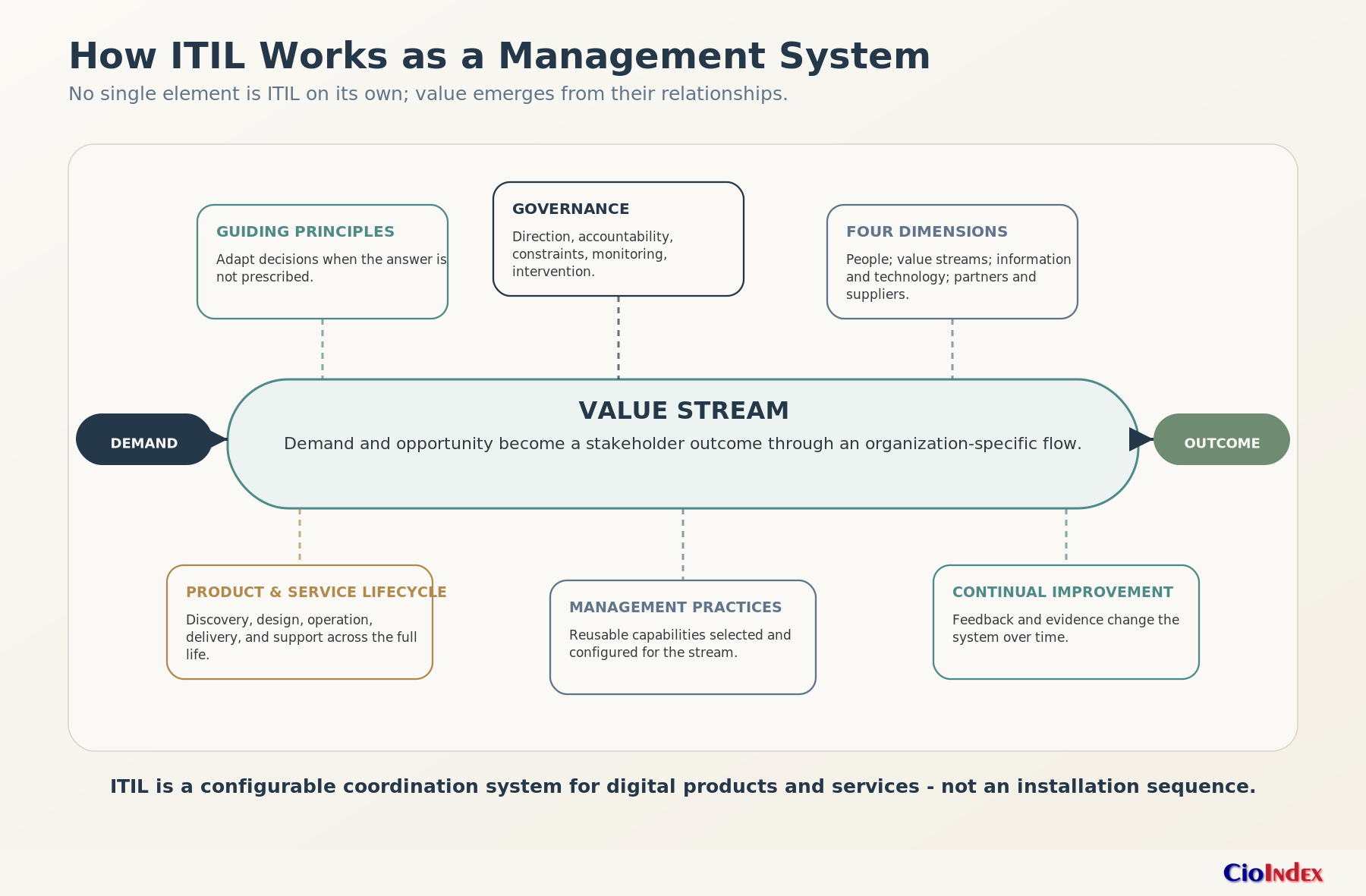
ITIL works by connecting several management elements around a real product, service, or stakeholder outcome. No single element is “ITIL” on its own.
| ITIL element | What it contributes | Management question |
| Guiding principles | Adaptable guidance for decisions and behavior | How should we think and act when the answer is not prescribed? |
| Governance | Direction, evaluation, accountability, monitoring, and constraints | Who decides, who is accountable, and what boundaries apply? |
| Four dimensions | A whole-system view of people, flow, technology, and suppliers | Are we designing the whole system or optimizing one part? |
| Product and service lifecycle | Management across discovery, design, operation, delivery, and support | How will this product or service be managed throughout its life? |
| Value streams | Organization-specific paths from demand to outcome | How does demand become value in this situation? |
| Management practices | Reusable organizational capabilities and guidance | Which capabilities must perform consistently to support the stream? |
| Continual improvement | Feedback, evidence, learning, and change | What are we learning, and what should improve next? |
PeopleCert describes the ITIL Value System as bringing together guiding principles, governance, value chain activities, management practices, and continual improvement.[1] Version 5 also emphasizes product and service lifecycle activities, value stream management, and the four dimensions as part of its Foundation-level operating logic.[1]
The table is an orientation map, not an installation plan. The framework produces value through the relationships among the elements.
Demand and Value Orient the System
Work begins because someone needs an outcome or because the organization sees an opportunity. The need may be faster customer onboarding, more reliable payroll, stronger cyber resilience, lower employee effort, or a new AI-enabled product.
ITIL does not begin with a process. It begins with a reason to act and a definition of the value to be created.
Value is not identical to an output. Installing a platform, publishing a service catalog, completing a change, or closing an incident are outputs. Value is the beneficial change stakeholders experience, considered alongside cost, risk, experience, sustainability, and other consequences.[1]
This distinction protects leaders from optimizing what is easy to count. In the employee-access service, ticket closure is measurable. Accurate and timely access with a reconstructable control trail is the outcome that matters.
Guiding Principles and Governance Shape Decisions
The guiding principles provide adaptable decision guidance. Familiar principles inherited from ITIL 4 include focusing on value, starting where you are, progressing iteratively with feedback, collaborating and promoting visibility, thinking and working holistically, keeping it simple and practical, and optimizing and automating.[5]
Governance performs a different job. It establishes direction, authority, accountability, constraints, monitoring, escalation, and intervention. A principle may encourage a team to keep a solution simple. Governance determines who may accept the associated risk, which evidence is required, and which limits cannot be crossed.
This is why control should not be confused with approval volume. More approvals can obscure accountability and create queues. Effective governance places the right decision with the right owner, within explicit boundaries, supported by evidence.
The Four Dimensions Keep the Design Whole
ITIL asks organizations to consider four dimensions together:[1]
- Organizations and People – roles, skills, structure, culture, capacity, incentives, communication, and leadership.
- Value Streams and Processes – work, decisions, queues, handoffs, controls, procedures, and end-to-end flow.
- Information and Technology – data, knowledge, applications, infrastructure, automation, architecture, security, and technical capability.
- Partners and Suppliers – external providers, contracts, ecosystems, dependencies, sourcing choices, and shared controls.
The dimensions prevent a procedural diagnosis from hiding a different cause. A slow access request may appear to require a better workflow. The actual constraint may be poor role data, unclear authorization rights, a supplier interface, or a technical integration. Improving the visible process while ignoring the real constraint makes the process more orderly, not necessarily more effective.
Lifecycle Activities, Value Streams, and Practices Connect the Work
ITIL (Version 5) describes product and service lifecycle activities spanning discovery, design, operation, delivery, and support.[1] These are not the five stages of the old ITIL v3 service lifecycle. The current model reflects how modern organizations manage integrated digital products and services across their lives.
Lifecycle thinking widens the diagnosis. A support failure may originate in discovery because the need was misunderstood, in design because supportability was omitted, in delivery because adoption was weak, or in operation because feedback does not reach the product team.
A value stream is the organization-specific sequence of activities, decisions, information, and handoffs used to create a particular outcome. One stream may restore a disrupted service. Another may onboard a customer, release a regulated product change, or provide employee access. PeopleCert explicitly includes identifying, mapping, and managing value streams to improve flow, visibility, and outcomes.[1]
Management practices supply reusable capabilities to the stream. ITIL (Version 5) retains 34 practices, with adjustments for the new guidance, organized into Product and Service management practices and General management practices.[3] A value stream does not use every practice. It draws on the capabilities required for its context and outcome.
Continual Improvement Closes the Loop
Continual improvement is embedded in ITIL rather than reserved for an annual process review.[1] The organization gathers evidence, compares performance with the intended value, identifies constraints and unintended effects, changes the system, and tests again.
This turns ITIL from a static library into an adaptive management system. It also creates a management obligation: a mature process is not automatically a useful process. If products, technology, risks, suppliers, or stakeholder expectations change, the configuration must be reconsidered.
The Central Management Lesson: Adopt Value Streams, not Practices
Organizations often begin an ITIL initiative by assessing process maturity, selecting an ITSM tool, assigning practice owners, and planning to implement a long list of practices. This appears disciplined. It can also create what CIO Index calls the practice trap.
The practice trap occurs when the organization improves each management capability separately but never redesigns the path through which stakeholders receive value.
Incident management becomes more consistent. Change enablement gains approvals. The service desk standardizes categories. Supplier management creates reviews. Measurement produces dashboards. Yet the customer or employee still experiences delays, repeated questions, ownership gaps, and conflicting priorities.
The problem is not that the practices are unnecessary. The problem is that they have become the units of transformation.
CIO Index judgment: The practical unit of ITIL adoption should be a value stream with a measurable outcome, not an isolated practice.
This is a CIO Index interpretation, not an official ITIL rule. It follows from the framework’s emphasis on value, value streams, lifecycle management, adaptability, and continual improvement.[1][5][6]
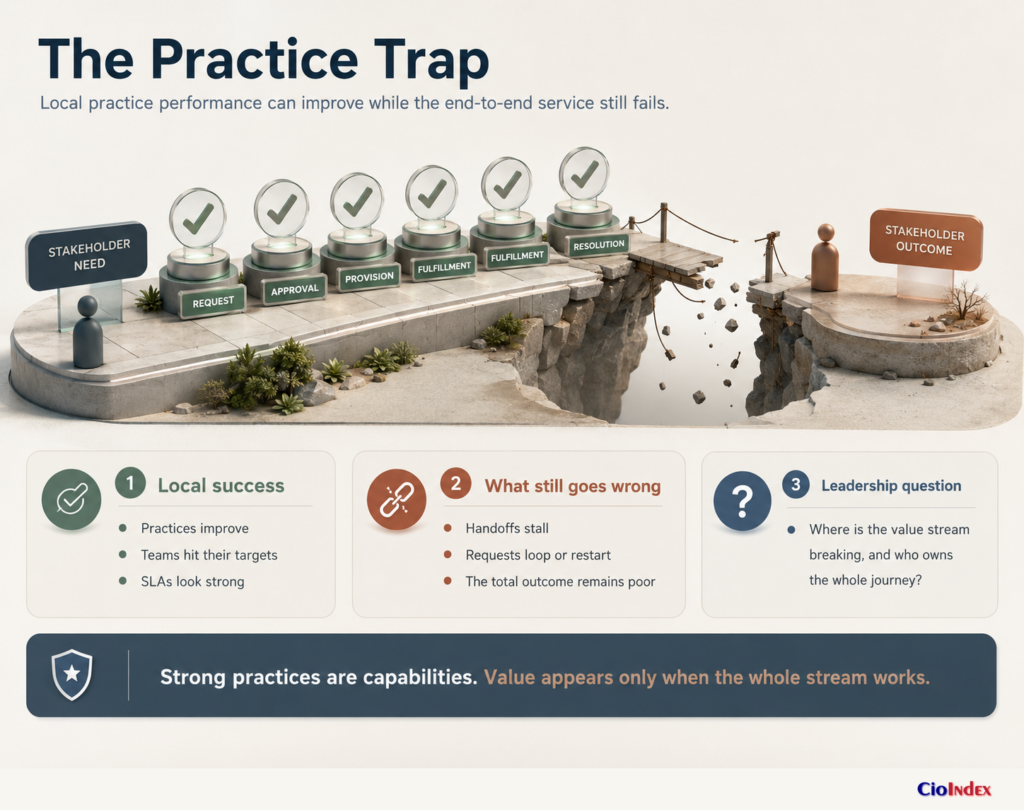
Return to the employee-access service. Improving request fulfillment, service-level management, information security management, measurement, and the service desk independently may make each capability more consistent. But the stakeholder outcome improves only when the capabilities operate together across request intake, authorization, identity data, segregation-of-duties checks, provisioning, verification, exceptions, communication, and revocation.
The local SLA illustrates the danger. Ninety-six percent achievement can coexist with a poor total outcome when rejected requests are counted as completed, employees must resubmit, and manual exceptions are disconnected from the original decision trail. The measure is not useless. It is incomplete, and the incompleteness changes the management conclusion.
A second example is digital customer onboarding. Product, security, compliance, engineering, a third-party identity provider, operations, and support can all pursue reasonable local objectives. The onboarding journey still fails if customers re-enter information, security exceptions arrive late, supplier rejections have no accountable resolution path, and support cannot see why onboarding stopped. The decisive improvement may be a product-and-service design change, not a new support procedure.
Starting with a value stream changes the questions leaders ask:
- Which stakeholder outcome is underperforming?
- Where does work wait, loop, fail, or lose context?
- Which decisions lack owners or evidence?
- Which risks require guardrails?
- Which practices are needed to improve this stream?
- What should be standardized, automated, delegated, or removed?
- How will we know whether the total outcome improved?
The organization does not need to “implement ITIL” as an abstract program. It needs to improve an important flow using the minimum coherent set of ITIL capabilities, then learn from the result.
What ITIL Can Improve – and Under What Conditions
ITIL can create significant management value when it is applied to the right problem and adapted well. The benefits are not automatic properties of the framework. Each depends on a mechanism, enabling conditions, and evidence that the total outcome changed.
| Potential improvement | How ITIL can contribute | Conditions and evidence to look for |
| Shared language and alignment | Creates consistent concepts for products, services, value, practices, risk, experience, and improvement | Different functions make compatible decisions; fewer disputes arise from conflicting definitions; governance forums use the language to resolve tradeoffs |
| End-to-end visibility | Uses value streams to expose queues, rework, handoffs, supplier dependencies, and decision gaps | Total elapsed time, stakeholder effort, rework, and outcome quality become visible alongside local measures |
| Consistency with adaptability | Provides reusable practices without requiring identical implementations | Standards reduce avoidable variation while local design remains proportional to risk, scale, and context |
| Governance and accountability | Connects direction, decision rights, controls, measures, and escalation to the managed product or service | Owners can make bounded decisions; exceptions are visible; controls change behavior rather than merely produce approvals |
| Reliability and recoverability | Strengthens relevant capabilities such as incident response, problem investigation, continuity, monitoring, change, knowledge, and supplier coordination | Service outcomes improve without shifting unacceptable cost, risk, or failure demand elsewhere |
| Continual learning | Embeds feedback and improvement in the management system | Measures trigger decisions; assumptions are challenged; practices, tools, roles, and controls change when evidence requires it |
The same discipline defines what ITIL cannot do by itself.
ITIL cannot determine the organization’s business strategy, decide which products should exist, or discover what customers will value. It cannot substitute for leadership when executives avoid tradeoffs or refuse to assign authority. It cannot create collaboration simply by renaming roles and processes.
It also cannot repair a poor product architecture through service-management procedure alone. Engineering, architecture, security, product, and design judgment remain necessary. An ITSM platform cannot guarantee value either; it can automate the current operating model, including its waste and weak measures.
The framework therefore improves management capability, not reality by declaration. Implementing a practice is activity. Configuring a tool is an output. A changed capability may produce a better outcome. Business value follows only when the outcome matters, the causal explanation is credible, and the gain is not outweighed by new cost, risk, dependency, or stakeholder effort.
Where ITIL Adoption Goes Wrong
Most ITIL failures are not caused by the absence of guidance. They occur when the framework becomes detached from the outcome it was meant to improve.
The Framework Becomes the Goal
Teams begin asking whether a process is “ITIL compliant,” how many practices have been implemented, or whether maturity scores increased. Documentation grows because conformity is easier to audit than value. A large practice portfolio can consume years of effort without proving that the most important services improved.
ITIL is not a rigid checklist, and organizations should apply what fits their needs.[6] Certification, terminology, and process consistency may support capability development. They are not substitutes for stakeholder outcomes.
The Tool or the Local Metric Becomes the Operating Model
Organizations often adopt the workflows, fields, categories, approvals, and reports supplied by an ITSM platform. Those defaults are convenient, but they encode generic assumptions about roles, decisions, measures, and boundaries.
The same problem appears in metrics. Ticket closure, deployment frequency, availability, approval turnaround, and cost can all be useful. Any one can also reward behavior that damages the total outcome. When the dashboard determines what the organization can see, tool configuration becomes management design by default.
Control Becomes Approval Volume
More approval steps can create the appearance of safety while making accountability less clear. Effective governance defines who can decide, using what evidence, within which constraints, and when escalation is required. It does not require every decision to move upward.
A control that reduces one risk but creates long queues, workarounds, or emergency exceptions may be poorly placed. The answer is not to abandon control; it is to redesign the control around the actual risk and the end-to-end flow.
The Organization Ignores Context and Stops Learning
Process diagrams often assume skills, incentives, data, cooperation, supplier behavior, and technical capability that do not exist. The four dimensions are a reminder that those conditions are part of the service design.
Even a successful configuration can become a constraint when products, architecture, regulations, suppliers, or stakeholder expectations change. Continual improvement is the safeguard against turning yesterday’s useful practice into today’s bureaucracy.
These failure patterns share one cause: the organization protects the form of ITIL while losing sight of the value stream. The remedy is not less discipline. It is discipline applied to the whole outcome.
The CIO Index Value-Flow-Learning Test
CIO Index uses three connected ideas in this article. They do different jobs:
- The practice trap names the failure: practices become the units of transformation while the end-to-end outcome remains unmanaged.
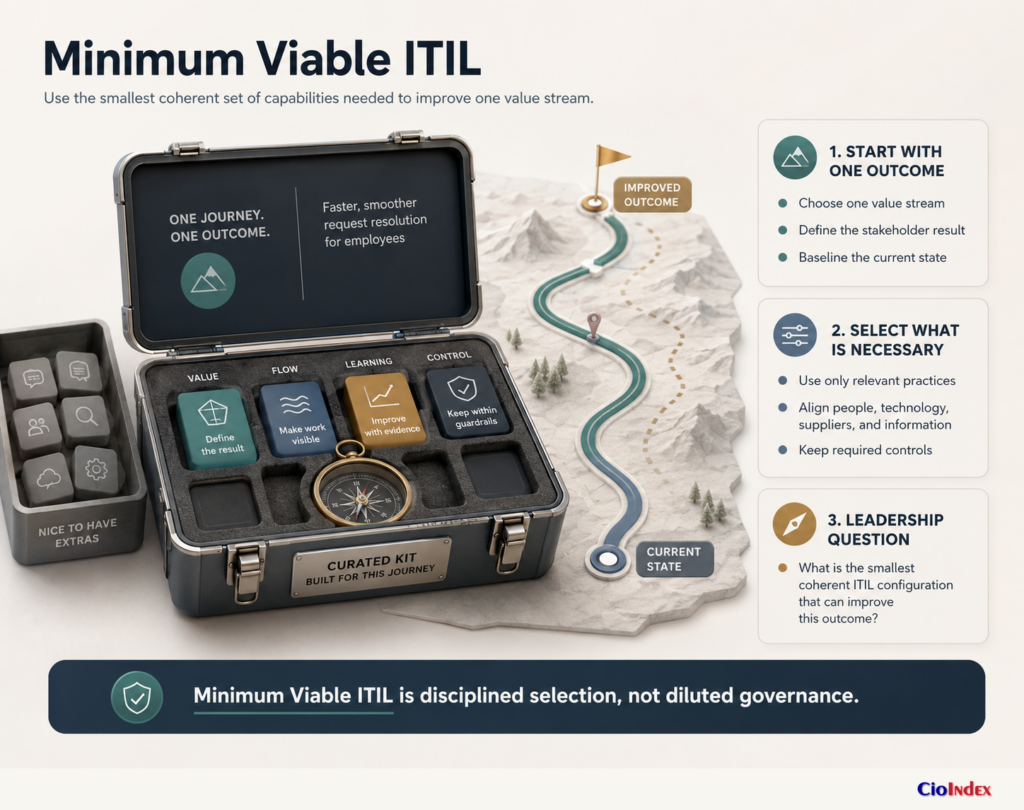
- Minimum Viable ITIL describes the configuration strategy: use the smallest coherent set of ITIL capabilities needed to improve the chosen value stream and meet its controls.
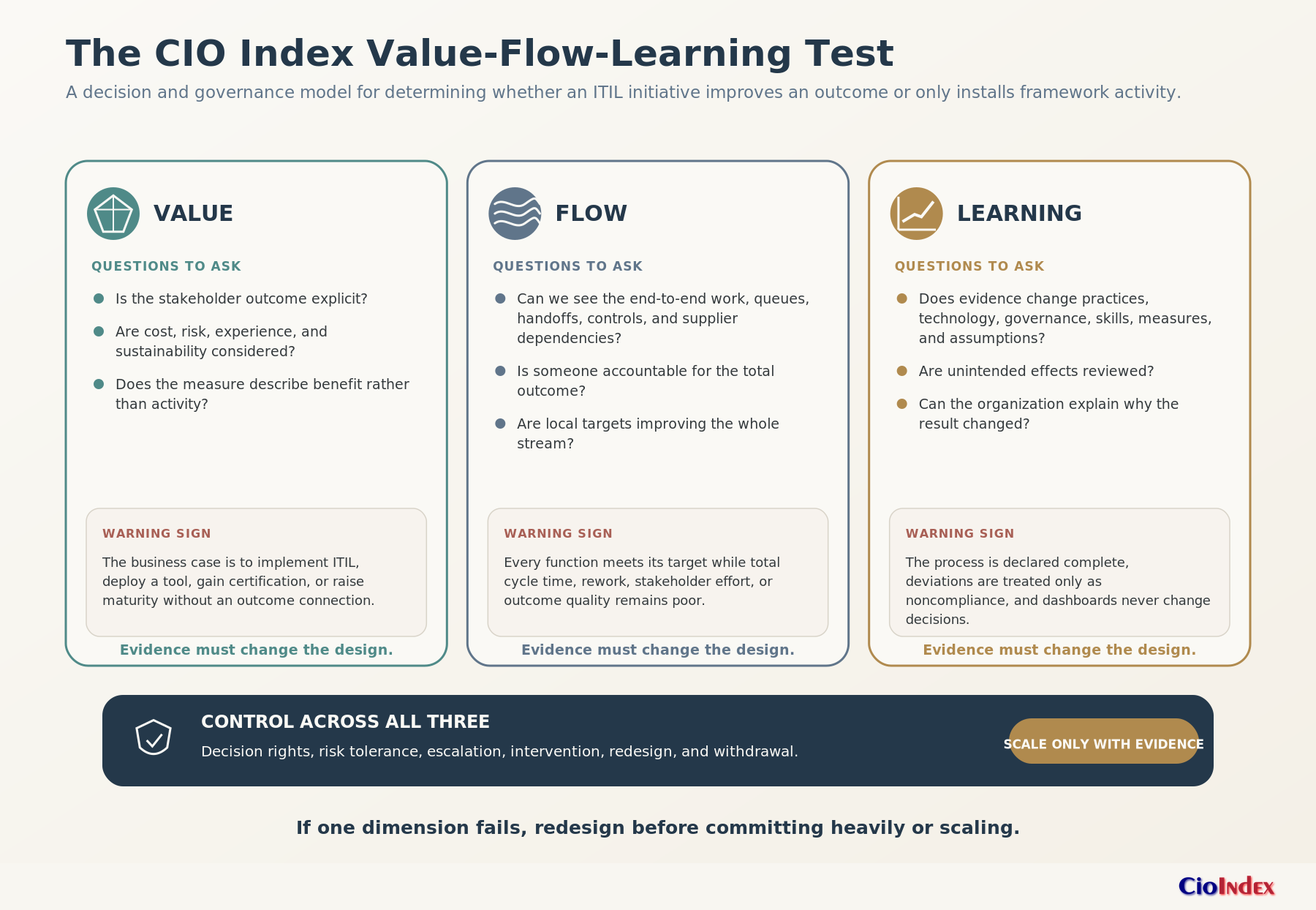
- The Value-Flow-Learning Test is the decision and governance model: determine whether the initiative is connected to an outcome, improves the real flow, and changes through evidence.
Control operates across all three parts of the test. The following model is CIO Index analysis, not an official PeopleCert or ITIL framework.
| Test | Questions to ask | Warning signs |
| Value | Is the stakeholder outcome explicit? Are cost, risk, experience, and sustainability considered? Does the measure describe benefit rather than activity alone? | The business case is to “implement ITIL,” obtain certification, deploy a tool, or raise a maturity score without an outcome connection |
| Flow | Can the organization see the end-to-end work, decisions, queues, handoffs, controls, and supplier dependencies? Is someone accountable for the total outcome? | Every function meets its target while total cycle time, rework, stakeholder effort, or outcome quality remains poor |
| Learning | Is there a feedback loop that changes practices, technology, governance, skills, measures, and assumptions? Are unintended effects reviewed? | The process is declared complete, deviations are treated only as noncompliance, and dashboards never change decisions |
Control is not a fourth silo. Value must remain within acceptable risk. Flow needs controls at the points where they affect the relevant decision or exposure. Learning requires review, escalation, correction, and withdrawal when a change creates harm.
A proposal that fails one part of the test should not automatically be rejected. It should be redesigned before the organization commits heavily or scales it. The test changes the burden of proof: the initiative must demonstrate more than framework activity.
How to apply ITIL Without Creating Bureaucracy
A practical adoption begins with a bounded management problem and uses the Value-Flow-Learning Test to guide configuration.
Value: Choose the Outcome Before the Practices
Select one consequential, recurring product or service value stream. Examples include restoring a critical service, onboarding a customer, granting employee access, releasing a regulated product change, or resolving a high-impact problem.
Name the primary consumers and stakeholders. Define the outcome and the conditions that matter: experience, risk, cost, sustainability, continuity, or compliance. Set the stream’s boundaries. “Resolve an incident” may begin when disruption is detected and end when service and stakeholder confidence are restored, not when a ticket changes status.
Establish a baseline before redesigning the work. Evidence may include total elapsed time, active work time, queue time, rework, failure demand, first-time-right rate, stakeholder effort, risk exceptions, cost, service impact, and outcome quality. Available data is not automatically useful evidence; tool timestamps may omit work performed in email, chat, spreadsheets, supplier portals, or meetings.
Flow: Map the System and Select the Minimum Capabilities
Trace the real work, decisions, information, systems, teams, suppliers, and controls. Identify where work waits, loops, loses context, changes owner, or requires an exception.
Inspect all four dimensions. A bottleneck that looks procedural may originate in missing skills, weak data, a contract, or a technical limitation.
Then select the practices that supply the capabilities the stream needs. Define what each practice contributes, who owns the capability, and how it interacts with the rest of the flow.
This is Minimum Viable ITIL: not a diluted framework, but the smallest coherent configuration that can improve the chosen outcome while satisfying the required controls.
Learning: Change Iteratively and Test the Mechanism
Test a manageable change and make the hypothesis visible. What should improve? Why should the change produce that result? What unintended effect might appear?
A change that reduces cycle time but increases control exceptions is not an unqualified success. A new approval that reduces one risk but doubles failure demand may need redesign. A supplier workflow that improves contract compliance while increasing customer abandonment may have optimized the wrong boundary.
Review both the outcome and the mechanism. If performance improves, determine why before copying the design elsewhere. If it does not, change the assumptions, configuration, measures, or scope rather than defending the implementation.
Control: Govern the Tradeoffs and Decide Whether to Scale
Assign accountability for both value and risk. Define who can accept exceptions, which evidence is required, what limits apply, and when leaders must intervene.
Scale only when the organization can explain how the configuration improved the outcome and why the mechanism should transfer. Different products and services may require different practices, controls, suppliers, measures, and degrees of standardization.
The scale decision should have a stop condition. If total outcome measures fail to improve, stakeholder effort shifts elsewhere, control exposure exceeds tolerance, or the configuration cannot adapt, redesign or withdraw it. Reproducing the form of a successful workflow without its conditions creates standardization without value.
How ITIL Relates to ITSM, DevOps, COBIT, and ISO/IEC 20000
ITIL is often compared with approaches that solve different management problems. The relationship is usually complementary rather than competitive.
| Concept | Primary role | Relationship to ITIL |
| ITSM | The broad discipline of managing IT-enabled services | ITIL is one framework used within ITSM. ITSM is the field; ITIL is a body of guidance.[4] |
| DevOps | Improves collaboration, flow, automation, feedback, and reliability across software delivery and operations | DevOps can shape how a value stream is engineered; ITIL adds broader product and service management, governance, practices, and lifecycle context |
| COBIT | Governance and management of enterprise information and technology | COBIT can frame enterprise governance objectives and controls; ITIL can provide more detailed product and service management guidance |
| ISO/IEC 20000 | A certifiable service-management system standard | ISO/IEC 20000 specifies requirements; ITIL provides adaptable guidance that can help design and improve relevant capabilities |
The useful question is not “Which framework wins?” It is “Which management problem does each approach help solve, and how can the useful mechanisms coexist without duplicate structures or conflicting language?”
A mature organization may use COBIT to frame governance, ISO/IEC 20000 for management-system requirements, DevOps and SRE for delivery and reliability practices, and ITIL to coordinate digital product and service management. The operating model should integrate the mechanisms rather than create parallel framework organizations.
Frequently Asked Questions
What does ITIL Stand For?
ITIL originally stood for Information Technology Infrastructure Library. The expanded name reflects its origin, but ITIL has been treated as a stand-alone term since 2013, and the modern framework is much broader than infrastructure management.[4]
What is the Main Purpose of ITIL?
The main purpose of ITIL is to help organizations manage digital products and services so they create and sustain stakeholder value. It provides guidance for coordinating governance, lifecycle activities, value streams, practices, people, technology, suppliers, and continual improvement.
Is ITIL the Same as ITSM?
No. ITSM is the broader discipline of planning, delivering, managing, and improving IT-enabled services. ITIL is a framework organizations can use within that discipline.[4]
Is ITIL Only for Large IT Departments?
No. The framework is adaptable, but the amount of structure should fit the organization’s scale, risk, complexity, and needs. A small team may use the guiding principles, one visible value stream, a few relevant practices, and a lightweight improvement loop. It does not need to reproduce an enterprise bureaucracy.
Does an Organization Need to Implement all 34 ITIL practices?
No. The 34 practices describe capabilities available to support products, services, value streams, and organizational management.[3] A specific value stream uses the practices relevant to its outcome and context. Attempting to implement every practice simultaneously is a portfolio choice, not a framework requirement.
Is ITIL a Process Framework?
That description is incomplete. Older editions were commonly taught through processes and a service lifecycle. Current ITIL includes practices, but also guiding principles, governance, dimensions, lifecycle activities, value streams, value chain activities, and continual improvement. It is better understood as a digital product and service management framework.
What is the Current Version of ITIL?
The current version is ITIL (Version 5). It was introduced in January 2026 and is being released in phases. ITIL 4 remains available during the transition.[2][3]
How Should a CIO Begin Using ITIL?
Begin with one important product or service value stream, not a framework-wide rollout. Define the intended value, baseline the current outcome and flow, inspect all four dimensions, select the minimum relevant practices, assign governance, improve iteratively, and review the result through value, flow, learning, and control.
The Practical Takeaway
ITIL gives an organization a shared structure for managing digital products and services as systems of people, decisions, technology, suppliers, controls, and work. Its principles shape choices. Governance supplies direction and accountability. The dimensions keep the design whole. Lifecycle activities connect discovery through support. Value streams make the actual flow visible. Practices provide reusable capabilities. Continual improvement prevents the operating model from becoming static.
But none of those elements creates value merely because it appears in a policy, tool, organization chart, certification plan, or maturity assessment.
The decisive move is to connect ITIL to a real outcome. Choose one consequential value stream. Define the value and boundaries. See the whole flow. Apply only the capabilities needed. Govern the tradeoffs. Learn from evidence. Scale only when the mechanism is understood.
The question for the next executive review is therefore not “How much ITIL have we implemented?” It is:
Which value stream are we trying to improve, what evidence would demonstrate that its total outcome changed, and what result would cause us to redesign or stop the initiative?
If the organization cannot answer all three parts, it is not yet managing ITIL as a value system. It is managing framework activity.
References
[1] PeopleCert, “ITIL Foundation (Version 5),” https://www.peoplecert.org/browse-certifications/it-governance-and-service-management/ITIL-1/itil-5-foundation-version-50-4154
[2] PeopleCert, “New ITIL Explained for Certified Professionals,” January 30, 2026. https://www.peoplecert.org/news-and-announcements/itil-version-5-explained
[3] PeopleCert, “ITIL FAQ – Frequently Asked Questions about ITIL,” https://www.peoplecert.org/help-and-support/faq-itil
[4] IBM, “What Is the IT Infrastructure Library (ITIL)?,” https://www.ibm.com/think/topics/it-infrastructure-library
[5] Atlassian, “ITIL 4: Guiding Principles and Practices,” https://www.atlassian.com/itsm/itil
[6] TechTarget, “What Is ITIL? A Guide to the IT Infrastructure Library,” September 18, 2024. https://www.techtarget.com/searchdatacenter/definition/ITIL