

Six Sigma is a structured management and process-improvement discipline used to improve the performance of repeatable processes. It combines defined improvement projects, measurement, analytical methods, tested changes, and process control to reduce consequential variation and defects.
ISO 13053-1 describes Six Sigma as a business-improvement methodology built around DMAIC and addresses project management, roles, expertise, and training across manufacturing, service, and transactional processes. (ISO 13053-1)
In practical terms, Six Sigma helps an organization investigate why a recurring process produces unreliable or defective outcomes, test whether a proposed change improves the process, and establish controls intended to preserve the improvement.
That description explains how the method works. It does not yet answer the more important executive question: whether Six Sigma belongs in the situation at all.
Is the organization trying to reduce harmful variation in a repeatable process—or impose predictability on work that is still uncertain, evolving, or poorly defined?
Six Sigma creates value when the process, intended outcome, measurement system, economics, and need for control fit the method. When those conditions are absent, greater analytical discipline can make the organization more precise without making it more correct.
What Is Six Sigma?
The term Six Sigma is used in several connected ways.
It can refer to:
- a statistical concept concerning process variation and capability;
- a structured method for improving an existing process;
- a project and governance system;
- a family of analytical and quality-management practices;
- an organizational capability supported by trained practitioners and sponsors.
These meanings belong together. None defines the full discipline on its own.
Six Sigma is therefore not simply:
- the DMAIC acronym;
- a target of 3.4 defects per million opportunities;
- a collection of statistical tools;
- a belt-certification system.
Those elements may support a Six Sigma program, but they are not the same thing as Six Sigma itself.
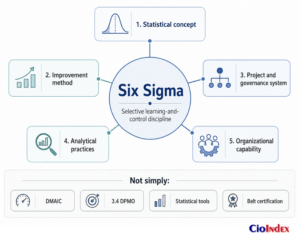
The CIO Index view is that Six Sigma is best understood as a selective learning-and-control discipline. It creates a formal way to learn why a process behaves as it does, test a change, and govern the process after the intervention.
The method belongs where a recurring process can be measured credibly, changed, and governed. The same discipline that can make a valid process reliable can also make a poor process reliably wrong when the target, measure, intervention, or control is invalid.
What Problem Is Six Sigma Designed to Solve?
Six Sigma is designed primarily for recurring process-performance problems involving:
- defects;
- delays;
- rework;
- unstable performance;
- repeated failures;
- unreliable handoffs;
- inconsistent service;
- poor process capability.
A suitable Six Sigma problem is not merely something management wants improved. It must be a process that can be bounded, measured, investigated, changed, and governed.
Consider a CIO reviewing inconsistent restoration times for critical incidents.
The service-management platform contains thousands of tickets, timestamps, severity classifications, escalation histories, and vendor records. The data appear more than sufficient.
Then the operating team compares definitions.
One group starts the restoration clock when monitoring raises an alert. Another starts when an engineer accepts the incident. Some teams stop the clock at technical recovery; others wait for business validation. Vendor waiting is included inconsistently. Severity may be revised after closure. Related incidents may be counted separately or together.
The organization has abundant data, but it does not yet have a credible baseline.
The first task is not root-cause analysis. It is determining whether apparently comparable incidents are actually comparable and whether “restoration time” means the same thing throughout the process.
A measurable-looking problem is not necessarily a validly measured problem.
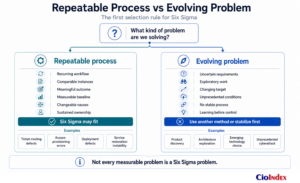
Six Sigma is a weaker initial fit when the central issue is:
- an uncertain strategy;
- product discovery;
- architecture exploration;
- rapidly changing requirements;
- an unprecedented cyberattack;
- a one-time executive decision;
- a process that does not yet meaningfully exist.
Those problems may be important. Measurement does not automatically turn them into process-variation problems.
For leaders, the first selection rule is:
Repeatable process versus evolving problem.
How Does Six Sigma Work?
Six Sigma converts a broad operating concern into a series of disciplined decisions.
The team must determine:
- what problem is actually being solved;
- which outcome matters;
- whether the current process can be measured credibly;
- which explanations remain plausible after testing;
- which intervention changes the result;
- who will own the process afterward;
- what evidence would justify revising or withdrawing the control.
Each decision depends on the quality of the one before it.
Weak measurement produces weak explanations. Weak explanations produce uncertain interventions. A control plan attached to an unverified intervention can preserve the wrong result.
That dependency is the logic behind DMAIC.
What Is DMAIC?
DMAIC is the principal five-phase method used to improve an existing process.
| Phase | Decision to resolve | Typical output | Common failure |
|---|---|---|---|
| Define | Are we solving the right problem for the right stakeholder within a workable boundary? | Charter, scope, outcome, requirements, ownership | Defining the project around a metric or presumed solution |
| Measure | Can the process and baseline be measured credibly? | Process map, operational definitions, measurement plan, baseline | Treating available data as trustworthy without validation |
| Analyze | Which explanations remain credible after the evidence tests competing causes? | Prioritized drivers and rejected or strengthened hypotheses | Declaring the most familiar explanation to be the root cause |
| Improve | Which intervention produces a verified improvement without unacceptable side effects? | Pilot evidence and implementation decision | Implementing the first plausible solution |
| Control | Who will detect, interpret, and respond when performance changes? | Owner, monitoring, response, review, and withdrawal rules | Creating a dashboard without decision ownership |
ISO 13053-1 identifies DMAIC as the typical Six Sigma methodology while separately addressing project management, expertise, roles, and training. DMAIC is central to Six Sigma, but it is not the entire system. (ISO 13053-1)
The phases are sequential in logic, not rigidly linear in practice.
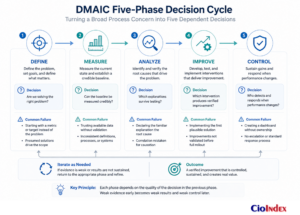
A pilot may expose a measurement problem. Analysis may show that the project scope is wrong. A control review may reveal that the process owner cannot sustain the intervention. Returning to an earlier phase can show that the method is supporting learning rather than merely producing documents.
A team can still complete every phase and fail to improve the operating result.
It may produce a charter, process map, baseline, cause analysis, solution plan, and control dashboard. Those outputs show that the method was followed. They do not establish that:
- the selected outcome was valid;
- the explanation was correct;
- the intervention produced the result;
- the wider operating system improved;
- the improvement persisted.
Method completion and operating improvement are different claims.
DMAIC Versus DMADV
DMAIC is used when an existing process has a sound enough design to improve.
DMADV—Define, Measure, Analyze, Design, and Verify—is used when a new product, service, or process must be created or when the existing design requires fundamental replacement.
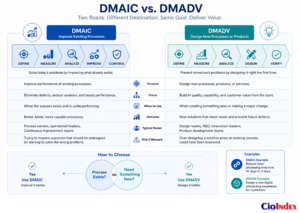
The choice turns on the condition of the process:
- DMAIC: Why is the current process underperforming, and how can it be improved?
- DMADV: What design will satisfy the required outcome?
Using DMAIC on a fundamentally broken design may preserve the wrong structure. Using DMADV before requirements and tradeoffs are sufficiently understood may formalize assumptions that should still be tested.
DMADV is a common Design for Six Sigma roadmap, but Design for Six Sigma is broader than one universally standardized sequence.
What Does “Six Sigma” Mean Statistically?
The word sigma refers to standard deviation, a statistical measure of dispersion.
Process-capability analysis compares the behavior of a stable process with its specification limits. The commonly used (C_p) index compares the specification width with six standard deviations of process spread. (C_{pk}) also accounts for whether the process is centered between the specification limits.
These measures depend on assumptions concerning:
- process stability;
- specification limits;
- process variation;
- centering;
- distribution shape.
NIST’s process-capability guidance emphasizes these dependencies and distinguishes capability from simple defect counting. (NIST Process Capability)
Does Six Sigma Mean 3.4 Defects per Million Opportunities?
Not exactly.
A centered normal process whose specification limits lie six standard deviations above and below the mean has a theoretical two-tailed nonconformance probability of approximately 0.002 parts per million.
Under a centered normal distribution model, the exact probability of a process producing a defect beyond $\pm 6\sigma$ is approximately 2 in a billion:

Converted precisely to parts per million (PPM), the result is approximately 0.00197 defects per million opportunities:

The familiar benchmark of 3.4 defects per million opportunities (DPMO) uses a different convention altogether. It accounts for real-world variation over time by assuming that the process mean may shift up to 1.5 standard deviations from its short-term centered position, leaving the nearer specification limit 4.5 standard deviations away.
The 1.5-sigma shift is a practical Six Sigma modeling convention—it is not a universal statistical law stating that every process naturally drifts by exactly that amount.
DPMO Depends on What the Organization Counts
The arithmetic for calculating Defects Per Million Opportunities (DPMO) is straightforward, but the governance behind it requires precise operational definitions:

While the arithmetic is simple, the governance is not. The process owner must clearly define the unit, the defect, the opportunity, the process population, the measurement period, and the inclusion or exclusion rules.
Changing the number of opportunities can change the reported DPMO even when the customer’s actual experience has not improved. A precise calculation cannot repair a weak operational definition.
The arithmetic is simple. The governance is not.
The process owner must define:
- the unit;
- the defect;
- the opportunity;
- the process population;
- the measurement period;
- inclusion and exclusion rules.
Changing the number of opportunities can change the reported DPMO even when the customer’s experience has not improved.
A precise calculation cannot repair a weak operational definition.
What Does an Organization Need to Use Six Sigma?
A CIO can fund training, appoint Black Belts, and launch projects—and still have no real Six Sigma capability.
The sponsor may not own the problem. The process owner may lack authority to change it. Finance may reject the savings claim. Frontline staff may know that the official process map bears little resemblance to the work. The analyst may have data but no reliable definitions.
Capability exists only when those pieces work together.
A responsible Six Sigma effort needs:
- a consequential process problem;
- a meaningful outcome;
- credible measurement;
- a sponsor willing to challenge assumptions;
- a process owner with authority;
- analytical capability;
- access to the people who perform the work;
- resources to test and implement the intervention;
- independent benefit validation;
- ownership after the project closes.
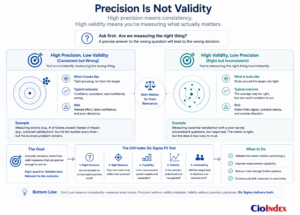
Precision Is Not Validity
The measurement system includes the definitions, procedures, people, technology, classifications, timing, transformations, and assumptions used to create the evidence.
A team should determine whether measurements are:
- repeatable;
- reproducible;
- sufficiently accurate;
- stable over time;
- appropriately resolved;
- traceable to their source.
But reliability is only half the test.
Precision answers whether the organization can measure consistently. Validity asks whether it is measuring an outcome that should guide the decision.
In the critical-incident example, every timestamp might be captured perfectly while the restoration boundary remains wrong. A reliable measure can still represent the wrong process, customer outcome, defect, or incentive.
Reliable measurement of the wrong thing is still the wrong evidence.
Certification Is Not Capability
ISO 18404 provides an international competency reference for selected Six Sigma, Lean, and combined implementation roles and organizations, including Green Belt and Black Belt competencies. It does not establish the market meaning of every belt used by every provider. (ISO 18404)
Certification schemes vary in their:
- bodies of knowledge;
- experience requirements;
- examinations;
- project requirements;
- recertification;
- accreditation;
- role definitions.
A certificate may show that someone met the requirements of a particular scheme. It does not show, by itself, that the practitioner can:
- select the right project;
- challenge an invalid measure;
- distinguish correlation from cause;
- navigate a resistant process owner;
- validate a financial claim;
- sustain operating change.
Certification contributes to capability. It does not substitute for capability.
Where Is Six Sigma Used?
Six Sigma originated in industrial quality improvement, but it is not limited to manufacturing. ISO 13053 applies the methodology to manufacturing, service, and transactional processes. (ISO 13053-1)
The stronger selection signal is not the industry. It is the nature of the process.
Healthcare and Service Operations
Six Sigma and Lean Six Sigma have been applied to:
- scheduling;
- patient flow;
- laboratory turnaround;
- billing;
- staffing;
- referral management;
- support services;
- error reduction.
The evidence is stronger for defined operating outcomes—time, flow, rework, and error rates—than for broad clinical, financial, workforce, or systemwide effects.
A review of reported Six Sigma healthcare applications found that 67% reported initial improvement in the principal process measure, while 10% reported sustained improvement. The same review found that 28% reported cost savings and 8% reported revenue enhancement. These percentages describe the published applications included in that review; they are not estimates of the likelihood that a new project will succeed. (Healthcare Six Sigma review)
A separate review found that the broader healthcare evidence for Six Sigma and Lean was methodologically weak, with few studies using strong statistical evaluation of project outcomes. (Healthcare evidence review)
The practical boundary is especially important in healthcare:
The goal is not to make every patient journey identical. It is to make the parts that should be reliable more reliable while preserving variation justified by patient need, professional judgment, and uncertainty.
IT and Software
Documented Six Sigma and Lean Six Sigma applications include:
- software-process improvement;
- software-defect handling;
- help-desk improvement;
- overdue-ticket reduction;
- support resolution;
- CMMI-linked improvement;
- software-intensive design.
The evidence consists largely of organizational cases, technical reports, and practitioner implementations rather than one body of controlled comparative research.
Other technology processes may fit the method but should be treated as potential applications until the process and evidence satisfy the Fit Test. These include:
- recurring infrastructure failures;
- repetitive deployment defects;
- access provisioning;
- data-quality correction workflows;
- vendor performance;
- repeatable security operations.
For CIOs, the useful distinction remains:
Repeatable process versus evolving problem.
Six Sigma may fit a recurring ticket-routing defect. It is less likely to determine which emerging technology the organization should adopt.
It may improve a repeatable deployment process. It does not select the enterprise architecture.
It may reduce recurring access-provisioning errors. It is not the primary method for understanding an unprecedented attack by an adaptive adversary.
The critical-incident restoration example in this article is illustrative. It is informed by documented service and support applications but is not presented as a sourced case.
What Are the Benefits of Six Sigma?
A suitable Six Sigma project may reduce:
- defects;
- rework;
- delays;
- process instability;
- the cost of poor quality.
It may also increase usable capacity, improve service reliability, or create clearer process ownership.
The number improved. That is useful evidence—but it is not yet an explanation.
Demand may have changed. Staffing may have increased. A vendor may have corrected a defect. Another initiative may have affected the process. The measurement rule may have shifted during the project.
A before-and-after difference shows that performance changed. Attribution requires stronger evidence.
Financial Benefits Are Separate Claims
The project team can show that rework fell. Finance must decide whether that created:
- lower expenditure;
- avoided future cost;
- usable capacity;
- revenue;
- no booked benefit at all.
Those claims are not interchangeable.
| Financial claim | What it means | Evidence required |
|---|---|---|
| Projected savings | Benefit expected if assumptions hold | Forecast method and assumptions |
| Cost avoidance | Future expenditure expected to be prevented | Credible avoided-cost baseline |
| Capacity value | Time or resources made available | Evidence that capacity was productively redeployed |
| Realized cost reduction | Actual expenditure decreased | Finance-validated cost evidence |
| Revenue or retention effect | Improvement contributed to commercial value | Strong attribution beyond the process change |
| Sustained net benefit | Benefits persisted after implementation and control costs | Follow-up, costs, ownership, and independent validation |
This classification is a CIO Index analytical framework, not an accounting standard.
Reducing rework does not automatically reduce booked expense. Releasing capacity does not automatically create cash. Financial benefit is a separate evidence claim, not an automatic translation of process improvement.
What Are the Limitations of Six Sigma?
Six Sigma can fail even when the project team follows the method.
The wrong project may have been selected. The process may not be sufficiently repeatable. The desired outcome may be poorly defined. Measurement may be unreliable. The sponsor may have committed to a solution before the analysis begins. The process owner may resist a change that shifts work or accountability. The analytical and control burden may exceed the value of the problem.
It can also create harm.
Local Optimization
A service desk may improve closure time by transferring tickets sooner.
A vendor may meet its response target while total restoration time worsens.
A department may reduce its cost by shifting work downstream.
A data-quality project may increase rule compliance while encouraging staff to enter plausible but false values.
The selected metric improved. The operating system did not.
The Control Paradox
Control can sustain a mistake when the selected process boundary, measure, target, or intervention is wrong. Stronger monitoring and standardization may make the error more consistent and harder to challenge.
The answer is not weaker control. It is governed control.
A control plan should define:
- how performance will be maintained;
- who will respond when it changes;
- what exceptions are legitimate;
- what evidence triggers review;
- when the measure, intervention, or process design should be revised or withdrawn.
Does Six Sigma Suppress Innovation?
Not inherently.
The problem arises when a method designed to reduce unwanted variation in a defined process is imposed on work whose purpose is to:
- generate alternatives;
- discover needs;
- test uncertain assumptions;
- change direction.
Six Sigma can improve the repeatable processes surrounding innovation, including testing, release, deployment, defect management, reliability, and operational handoff.
It should not force premature consistency onto discovery itself.
These failure patterns are more than lessons for projects that have already gone wrong. They are conditions leaders should test before approving the project.
Six Sigma is best treated as a selective learning-and-control discipline for repeatable process problems. It is useful when the organization can define a meaningful outcome, measure the process credibly, test an intervention, justify the added rigor, and govern the result. The CIO Index Six Sigma Fit Test™ examines those conditions. Measurement validity protects the learning from optimizing the wrong outcome; control review protects the organization from sustaining the wrong solution.
When Should You Use Six Sigma?
Six Sigma is a learning-and-control discipline for repeatable process problems. The Fit Test determines whether the work is sufficiently stable, meaningful, measurable, valuable, and governable to justify that discipline.
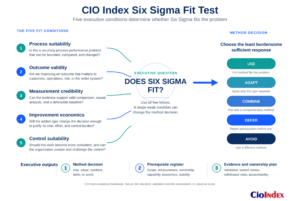
The CIO Index Six Sigma Fit Test™ examines five high-value conditions:
- Process suitability
- Outcome validity
- Measurement credibility
- Improvement economics
- Control suitability
The five dimensions do not exhaust every organizational, regulatory, technical, ethical, or sector-specific consideration.
The Fit Test is not:
- an official Six Sigma standard;
- an ISO model;
- a validated scientific assessment;
- a universal score.
| Fit condition | Executive question | Evidence to examine | Possible decision |
|---|---|---|---|
| Process suitability | Is this a recurring process-performance problem that can be bounded and changed? | Recurrence, comparability, process map, ownership | Use, redefine, stabilize, or route elsewhere |
| Outcome validity | Are we improving an outcome that matters? | Customer, business, service, risk, and system consequences | Continue or redefine the target |
| Measurement credibility | Can the evidence support comparison and analysis? | Definitions, repeatability, bias, lineage, baseline | Analyze or repair measurement first |
| Improvement economics | Will the added rigor change the decision enough to justify its burden? | Consequence, opportunity cost, implementation cost, likely value | Use fully, simplify, narrow, or avoid |
| Control suitability | Should this work become more consistent, and can the organization sustain it? | Judgment needs, exceptions, owner, response capability | Control, preserve discretion, adapt, combine, or defer |
A Fit Test review should produce three executive outputs.
First, a method decision:
- use;
- adapt;
- combine;
- defer;
- avoid.
Second, a prerequisite register identifying weaknesses in:
- scope;
- measurement;
- ownership;
- capability;
- economics;
- process stability.
Third, an evidence and ownership plan defining how operating improvement, financial benefit, control performance, and withdrawal conditions will be validated—and who remains accountable after the project team leaves.
Use the Least Burdensome Sufficient Method
The relevant question is not whether Six Sigma could be applied.
It is whether the additional rigor is likely to improve the decision enough to justify:
- analytical effort;
- training;
- implementation cost;
- organizational attention;
- control burden.
A limited operational correction may be enough. Another problem may need Lean, statistical process control, Agile experimentation, design thinking, architecture analysis, or a policy change. Some problems require Six Sigma combined with another method.
Method selection should follow the problem.
How Is Six Sigma Different from Related Methods?
Six Sigma overlaps with several improvement and management approaches. The distinctions below describe characteristic emphasis, not exclusive boundaries.
Six Sigma and Lean
Six Sigma emphasizes:
- variation;
- defects;
- measurement;
- causal analysis;
- process capability;
- control.
Lean emphasizes:
- value;
- flow;
- delay;
- handoffs;
- work in progress;
- unnecessary activity.
Lean Six Sigma combines the two. Evidence from a Lean Six Sigma project should not be represented as proof of Six Sigma’s isolated contribution.
Six Sigma and Statistical Process Control
Statistical process control helps an operating team determine whether a process is stable and detect changes in its behavior.
A Six Sigma project goes further by defining a problem, testing explanations, evaluating an intervention, and transferring the result into control.
Some problems need monitoring and response, not a full improvement program.
Six Sigma and Agile
Agile supports iterative development and learning under changing requirements.
Six Sigma may improve repeatable processes around Agile delivery, including:
- testing;
- deployment;
- defect handling;
- release operations;
- incident follow-up.
It should not eliminate the experimentation that makes Agile useful.
Six Sigma and CMMI
CMMI helps organizations establish and institutionalize process capability.
Six Sigma can investigate selected performance problems within or across those processes. Software Engineering Institute material has treated the approaches as complementary rather than interchangeable. (SEI: CMMI and Six Sigma)
Six Sigma and Root-Cause Analysis
Root-cause analysis is one part of a wider improvement effort.
Six Sigma also addresses:
- problem selection;
- measurement validity;
- intervention testing;
- project governance;
- control.
Not every root-cause investigation warrants a full Six Sigma project.
What Should CIOs Know About Six Sigma?
A CIO should resist two easy conclusions. The first is that Six Sigma is an old manufacturing method with no place in technology. The second is that every recurring technology metric is a Six Sigma opportunity. The stronger position is selective.
Six Sigma may provide value in:
- service restoration;
- software-quality processes;
- support routing;
- infrastructure operations;
- transaction processing;
- access provisioning;
- vendor performance;
- data-quality controls;
- recurring compliance processes.
Before approving a project, the sponsor should be able to answer five questions.
- Problem: Is this a recurring process problem, and what operating outcome should improve?
- Evidence: Are the event definitions, boundaries, and measures credible enough to support comparison?
- Intervention: What evidence will separate a real cause from a familiar assumption, and is the cause within the organization’s control?
- Consequence: What might improve locally while cost, risk, customer experience, or workload worsens elsewhere?
- Ownership: Who validates the result, accepts legitimate exceptions, owns the process, and decides when the control should change?
The roles should also be clear.
The sponsor decides whether the problem deserves organizational attention. The practitioner structures the analysis. Frontline staff reveal where the formal process differs from actual work. The process owner must live with the result. Finance validates the economic claim.
A project without those accountabilities is not made credible by a belt structure.
Is Six Sigma Still Relevant?
Yes—but selectively.
Six Sigma remains institutionally current. ISO 13053-1 remains published and was last confirmed in 2022, while ISO 18404 was confirmed in 2025. Current technical work, standards activity, and contemporary projects show that organizations still use the method. (ISO 13053-1) (ISO 18404)
What the evidence does not establish is that Six Sigma remains dominant, that adoption is growing, or that it belongs in every modern improvement portfolio.
Six Sigma increasingly appears alongside:
- Lean;
- digital analytics;
- automation;
- process mining;
- Quality 4.0;
- sector-specific management systems.
These tools can improve observation, analysis, and monitoring. They cannot determine whether the organization selected the right process, outcome, measure, or intervention.
Six Sigma remains relevant because defects, delays, rework, unstable performance, and unreliable execution remain relevant.
That does not make every current problem a Six Sigma problem.
The Real Test Is Whether the Method Fits the Problem
The mature organization is not the one that applies Six Sigma most widely. It is the one that selects the method deliberately.
Six Sigma belongs where a recurring process has:
- a meaningful outcome;
- credible evidence;
- changeable causes;
- sufficient economic consequence;
- an owner capable of sustaining and challenging the result.
It should be adapted when full rigor is disproportionate, combined when another method addresses a different part of the problem, deferred when prerequisites are missing, and avoided when control would reduce necessary learning or adaptability.
The final executive question is not:
Should our organization adopt Six Sigma?
It is:
Which operating problems justify Six Sigma, what must be validated before it is used, and what evidence would cause us to change course or stop?
Frequently Asked Questions
Who Developed Six Sigma?
Six Sigma emerged at Motorola during the mid-1980s. Engineer Bill Smith is widely credited with developing and naming the core concept, while Mikel Harry helped codify and spread the methodology and Robert Galvin provided executive sponsorship. Motorola formally recognized Six Sigma as a company initiative in 1986 and received the inaugural Malcolm Baldrige National Quality Award in 1988. General Electric later helped popularize Six Sigma as a broad enterprise-management system after adopting it under Jack Welch in 1995. GE did not invent the method, and neither company’s performance should be attributed to Six Sigma alone.
Is Six Sigma the Same as DMAIC?
No. DMAIC is the principal five-phase improvement method associated with Six Sigma. Six Sigma also includes statistical concepts, project selection, governance, practitioner capability, process ownership, and organizational support.
Does Six Sigma Always Mean 3.4 Defects per Million Opportunities?
No. The 3.4-DPMO figure is a conventional long-term interpretation that assumes a 1.5-standard-deviation shift. It is not the complete definition of Six Sigma or a universal statistical law.
Can Six Sigma Be Used Outside Manufacturing?
Yes. Six Sigma and Lean Six Sigma have documented applications in services, healthcare, software, support operations, and transactional processes. Fit depends on process characteristics rather than the industry label.
Do You Need Certification to Use Six Sigma?
No universal certification is required. A credential may provide evidence of knowledge or experience within a particular scheme, but requirements vary and certification alone does not establish operating capability.
When Should Six Sigma Not Be Used?
Six Sigma is a weaker fit when the work is non-repeatable, exploratory, poorly defined, weakly measured, undergoing fundamental design change, or unlikely to justify the cost of formal analysis and control.
Is Six Sigma Obsolete?
No. Current standards, technical activity, and contemporary use show that Six Sigma remains active. Its relevance is selective rather than universal.
Author: Sourabh Hajela
Founder, Executive Editor, and CEO, CIO Index, Inc.
Sourabh Hajela is the Founder, Executive Editor, and CEO of CIO Index, Inc., with more than three decades of experience in technology strategy, planning, governance, and the delivery of enterprise IT capability. His work focuses on helping CIOs translate management methods into sound operating decisions, accountable execution, and measurable business outcomes. That perspective informs this article’s treatment of Six Sigma not as a universal quality program, but as a selective method whose value depends on process fit, credible measurement, organizational ownership, economic consequence, and the ability to govern—and challenge—the resulting controls.
Research and Editorial Method
This article is a CIO Index synthesis based on current international standards, official institutional guidance, peer-reviewed research, documented organizational applications, professional technical sources, and counterevidence.
Established facts, disputed conventions, reported case outcomes, CIO Index interpretations, and illustrative examples are treated separately. Case studies demonstrate application and reported outcomes; they do not establish universal effectiveness.
The standards and evidence used for this article were checked through July 16, 2026. Standards status, certification requirements, provider rules, and emerging digital-integration practices should be reviewed again before they are used for procurement, credential evaluation, or program design.