
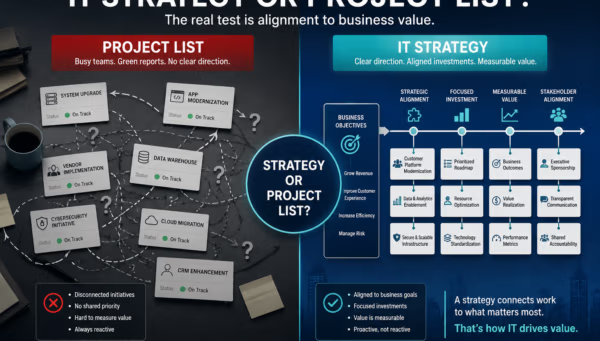
Executive Summary of the 5 Signs Your IT Strategy Is Really a Project List
Many organizations believe they have an IT strategy because they have active projects, funded initiatives, roadmaps, steering committees, and delivery updates. The problem is that a busy project portfolio can create the illusion of strategy without providing real direction.
This executive brief helps CIOs and senior IT leaders challenge that illusion. It explains why a list of IT projects is not the same as an IT strategy and shows how disconnected initiatives, unclear priorities, reactive work, completion-based metrics, and weak stakeholder alignment can make IT look productive while strategic value remains uncertain.
The brief is organized around five warning signs that IT strategy may have become a project list. It also uses the “Watermelon Project” metaphor — green on the outside, red on the inside — to explain how project reports can look healthy while value, adoption, delivery substance, or stakeholder trust is weak.
Use this brief before an IT strategy refresh, roadmap review, portfolio discussion, steering committee meeting, or executive alignment session. It is not a diagnostic tool, assessment, template, or implementation playbook. Its value is in creating shared understanding and giving leaders a practical way to discuss whether current IT activity is truly advancing business strategy.
When to Use 5 Signs Your IT Strategy Is Really a Project List
Use this when:
- Your organization has many IT initiatives underway, but leaders are not sure whether they add up to a coherent strategy.
- Project dashboards look healthy, but executives are questioning whether IT is delivering measurable business value.
- Departments are pursuing technology projects independently without a shared enterprise technology direction.
- IT leaders need to explain why project activity is not the same as strategic progress.
- A steering committee needs a practical way to discuss portfolio alignment without turning the conversation into a project-by-project status review.
- The CIO is preparing for an IT strategy refresh, roadmap review, or stakeholder alignment conversation.
- Teams are measuring completion, but not whether completed work changed business outcomes.
What The 5 Signs Your IT Strategy Is Really a Project List Is
This executive brief is a CIO-facing awareness and alignment deck that helps IT and business leaders recognize when an apparent IT strategy has become a project list. It provides a clear distinction between IT strategy and project activity, five warning signs of strategic drift, a memorable Watermelon Project risk metaphor, and a high-level path toward stronger business alignment, roadmap discipline, value measurement, and stakeholder engagement.
What’s Inside The 5 Signs Your IT Strategy Is Really a Project List
- A clear distinction between IT strategy and a project list: Explains why true IT strategy must connect technology investments to business objectives, while a project list often focuses on activity, urgency, and completion.
- Five signs of project-list thinking: Covers disconnected initiatives, lack of a unified North Star, reactive IT behavior, completion-over-value measurement, and weak stakeholder alignment.
- The Watermelon Project metaphor: Shows how green project status can hide red delivery realities beneath the surface.
- The cost of mistaking activity for direction: Highlights risks such as wasted resources, missed synergies, weak value measurement, firefighting, and declining stakeholder trust.
- Roadmap-as-communication guidance: Explains why a strategic IT roadmap should make priorities, milestones, and trade-offs visible to stakeholders.
- A high-level path toward real IT strategy: Covers business objectives, unified IT vision, strategic roadmap, proactive investment, value measurement, and stakeholder alignment.
- A brief before-and-after scenario: Shows how project chaos can be reframed through audit, roadmap discipline, and business-aligned portfolio decisions.
- Practical next-step prompts: Encourages leaders to begin with a project audit, roadmap discussion, and stakeholder engagement.
What You’ll Be Able to Create with The 5 Signs Your IT Strategy Is Really a Project List
- An executive alignment brief: A leadership-ready presentation or discussion aid that explains why a project list is not an IT strategy.
- A five-sign discussion guide: A structured conversation around disconnected initiatives, lack of vision, reactive IT, completion metrics, and stakeholder alignment.
- A Watermelon Project risk brief: A concise explanation of how healthy-looking project reports can hide weak value, adoption, or delivery substance.
- An IT portfolio alignment memo: A short leadership note asking whether active projects connect to named business objectives.
- A roadmap refresh conversation starter: A practical prompt for discussing whether the current roadmap communicates strategy or merely schedules projects.
- A stakeholder alignment brief: A discussion aid for showing why business sponsorship, shared vision, and feedback loops matter.
Mistakes The 5 Signs Your IT Strategy Is Really a Project List Helps You Avoid
- Treating a full project portfolio as proof that the organization has a real IT strategy.
- Funding initiatives because departments ask loudly rather than because they advance business objectives.
- Letting green project status hide missed outcomes, duplicated work, weak adoption, or hollow deliverables.
- Measuring success by closed projects, completed deployments, or met deadlines without asking whether business value was delivered.
- Building a roadmap that simply displays work instead of explaining strategic direction.
- Assuming stakeholder alignment exists because meetings are happening, even when leaders cannot clearly explain what IT is trying to achieve.
What The 5 Signs Your IT Strategy Is Really a Project List Helps You Do
- Clarify the difference between IT strategy and project activity.
- Give executives a shared language for discussing strategic drift.
- Recognize when IT is operating reactively instead of investing proactively.
- Challenge project-completion metrics that do not prove business impact.
- Reframe roadmap conversations around business objectives and trade-offs.
- Strengthen the case for a project audit, roadmap refresh, or stakeholder alignment effort.
Why The 5 Signs Your IT Strategy Is Really a Project List Is Worth a Closer Look
Instead of spending hours trying to explain why “busy” does not mean “strategic,” this brief gives CIOs a clear executive language for the problem. The five signs make the conversation easier to organize, while the Watermelon Project metaphor makes hidden delivery risk easier to discuss.
The brief is especially useful when leaders sense that something is wrong but lack a shared way to name it. It helps convert vague concern into a structured discussion about alignment, vision, value, and stakeholder trust.
This is not a diagnostic tool or strategy template. Its value is more focused: it helps leaders recognize the pattern, discuss the risk, and decide whether deeper audit, roadmap, or portfolio-alignment work is needed.
Best Fit / Not Best Fit for The 5 Signs Your IT Strategy Is Really a Project List
Best Fit
This brief is best for:
- CIOs preparing an executive conversation about IT strategy alignment.
- IT leaders who need to explain why project activity is not the same as strategic progress.
- Steering committees reviewing whether the IT roadmap reflects real business priorities.
- PMO and portfolio leaders examining whether active projects connect to business goals.
- Digital transformation leaders concerned that delivery activity is masking weak business outcomes.
- Organizations preparing for an IT strategy refresh, roadmap review, or portfolio-alignment discussion.
Not Best Fit
This executive brief is not the best fit if you need:
- A formal IT strategy diagnostic tool.
- A quantitative assessment or scoring model.
- A complete IT strategy template.
- A detailed IT roadmap builder.
- A project portfolio audit workbook.
- A KPI catalog or ROI measurement model.
- A governance operating model.
- A step-by-step implementation playbook.
For those needs, pair this executive brief with execution-grade templates, audit tools, roadmap formats, prioritization methods, and measurement worksheets.
How CIO Index Evaluated The 5 Signs Your IT Strategy Is Really a Project List
Before recommending a resource, CIO Index evaluates it for practical usefulness, current relevance, and CIO decision value. This executive brief was reviewed through our Integrity Suite to confirm whether it can help CIOs and IT leaders use their time well, apply the guidance responsibly, and extract value with confidence.
- Practicality Test
Score: 3.8 / 5
Final Assessment: Strong for executive awareness, alignment, and leadership conversation; limited as an execution toolkit. - Age Relevance Test
Score: 4.2 / 5
Final Assessment: Retain with context; the core concepts remain relevant, while external examples should not be overstated without verification. - CIO Signal-to-Action Scorecard
Score: 64 / 100
Final Assessment: Tier 3 — Support Material; useful as an executive alignment brief when paired with stronger execution artifacts.
Download this executive brief to help your leadership team understand when IT strategy has become a project list — and start the conversation needed to reconnect IT work to business value.