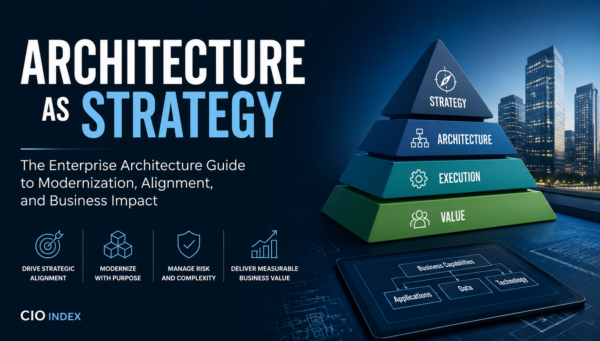
Executive Summary of CIO’s Guide to Enterprise Architecture Modernization
Enterprise architecture modernization succeeds when architecture becomes a governed business capability.
This guide helps CIOs move from fragmented technology estates to service-oriented adaptability by anchoring modernization in business capabilities, translating those capabilities into governed services, and sustaining the model through decision rights, Service Catalogue governance, architecture review gates, roadmap sequencing, maturity measurement, and KPIs.
Its practical value lies in the connection between capability mapping, service modelling, governance, and measurable modernization progress. It helps CIOs create the operating model behind modernization, not just the architecture description.
Use it when you need to move enterprise architecture modernization from idea to execution discipline.
What Is The CIO’s Guide to Enterprise Architecture Modernization?
Architecture as Strategy: A CIO’s Guide to Capability-Driven Enterprise Architecture Modernization is a practical CIO resource for turning enterprise architecture from a documentation function into a modernization governance discipline.
The guide explains how to use business capability mapping as the foundation for architecture modernization, service modelling as the translation layer between business needs and technology delivery, and EA governance as the control system for decisions, exceptions, ownership, and progress measurement.
Its core logic is simple:
Business Capabilities → Service Model → Service Catalogue → EA Governance → Roadmap → Maturity and KPIs
This makes the guide especially useful when a CIO needs to move enterprise architecture modernization from concept to operating discipline.
Why The CIO’s Guide to Enterprise Architecture Modernization
Matters
Modernization often starts with technology: a cloud migration, application replacement, platform consolidation, integration cleanup, or portfolio rationalization effort.
Those moves may be necessary, but they do not automatically create a more adaptable enterprise. Without a stable architecture model, modernization can preserve the same structural complexity under newer tools, cleaner platforms, and better language.
This guide helps CIOs shift the modernization conversation from systems to capabilities.
It addresses the problems that usually sit underneath legacy complexity:
- Unclear business capability traceability — limited visibility into how applications, services, platforms, and data support what the enterprise must be able to do.
- Technology-led investment decisions — modernization choices driven by platforms, vendors, or projects rather than capability needs and service outcomes.
- Weak service ownership — services exist, but ownership, consumers, lifecycle status, service quality, and accountability are not consistently governed.
- Architecture decision drift — major build, procurement, exception, and platform decisions happen without a consistent enterprise architecture control point.
- Low executive confidence — leaders struggle to see how architecture modernization reduces risk, improves agility, controls cost, or advances business priorities.
Why You Should Trust The CIO’s Guide to Enterprise Architecture Modernization
This guide is grounded in practical enterprise architecture disciplines that remain relevant across industries, operating models, and technology environments.
It brings together six durable practices:
- Capability mapping — defines what the enterprise must be able to do, independent of today’s processes, systems, vendors, or organization chart.
- Service modelling — translates capabilities into service definitions, contracts, consumers, quality expectations, interfaces, and ownership.
- Service Catalogue governance — turns service models into an operational registry that can be managed, measured, and improved.
- Architecture decision rights — clarifies who approves new services, platform selections, capability map updates, service retirements, and architecture exceptions.
- Architecture review gates — creates checkpoints before major build, procurement, or modernization decisions create new complexity.
- Maturity and KPI measurement — connects architecture health, delivery performance, and business value to executive oversight.
The result is a guide that helps CIOs make enterprise architecture modernization practical, defensible, and actionable.
What Makes This Guide Different
Many enterprise architecture resources explain frameworks. This guide focuses on how architecture changes modernization decisions.
Its differentiator is the connection between artifacts that are often managed separately:
Capability Map → Service Model → Service Catalogue → Decision Rights → Review Gates → Roadmap → KPIs
That connection matters because a capability map alone can become a static diagram. A Service Catalogue alone can become an ITSM inventory. An EA Board alone can become another approval layer. The value emerges when these elements work together as an operating model.
This guide is different because it:
- starts with business capabilities rather than applications or platforms;
- shows how capabilities become governed services;
- connects the Service Model to Service Catalogue governance;
- defines EA governance through decision rights, review gates, and escalation paths;
- includes a five-phase modernization roadmap and first 90-day action plan;
- links architecture modernization to maturity, investment logic, and KPIs.
It treats enterprise architecture as a leadership system for modernization, not just a modelling discipline.
What’s Inside The CIO’s Guide to Enterprise Architecture Modernization
The guide covers the full path from legacy architecture diagnosis to governed enterprise architecture modernization.
Inside, you will find guidance on:
- the legacy architecture trap and why fragmented technology estates constrain change;
- service-oriented architecture as a governance foundation;
- the relationship between SOA, microservices, APIs, cloud, hybrid environments, and AI-augmented EA;
- the three-layer architecture model: Business Model, Service Model, and Technology Model;
- capability definition, capability mapping, decomposition, and capability-to-service traceability;
- the Service Model as the bridge between business capabilities and technology implementation;
- Service Catalogue design, attributes, examples, and governance roles;
- EA alignment with programme governance and IT service management;
- EA Board design, decision rights, RACI, review gates, and exception handling;
- stakeholder engagement, common objections, and CIO-level positioning;
- a lean EA team model and minimum viable tooling stack;
- a first 90-day action plan;
- business case logic, ROI framing, maturity levels, and KPIs.
The guide is designed to help CIOs and IT leaders move from architecture analysis to architecture governance.
How to Use The CIO’s Guide to Enterprise Architecture Modernization
Use this guide when enterprise architecture modernization needs to move from discussion to disciplined execution.
A practical use path is:
- Diagnose the architecture problem
Identify where fragmented applications, brittle integrations, vendor dependencies, local workarounds, and platform exceptions are limiting change. - Define the capability baseline
Build a high-level capability map that describes what the organization must be able to do, independent of current systems or structures. - Translate capabilities into services
Use the Service Model to define service contracts, consumers, ownership, interfaces, quality expectations, and technology independence. - Operationalize services through a catalogue
Create a Service Catalogue structure that captures service IDs, owning capabilities, consumers, SLA tiers, platforms, lifecycle status, and data classification. - Establish architecture governance
Define the EA Board, decision rights, RACI, review gates, escalation paths, and architecture exception process. - Sequence modernization work
Use the roadmap and 90-day plan to move from baseline analysis to governance launch, service modelling, and measurable progress. - Measure maturity and value
Track architecture health, delivery performance, business value, and EA maturity over time.
The guide is best used during the Plan / Mobilize stage of enterprise architecture modernization. It also supports evaluation, decision-making, and ongoing governance.
What The CIO’s Guide to Enterprise Architecture Modernization
Helps You Deliver
This guide helps CIOs and enterprise architecture teams create the core artifacts needed to govern modernization.
You can use it to create:
- Legacy Architecture Diagnostic Brief — a clear explanation of the constraints created by fragmented systems, brittle integrations, vendor lock-in, and technology-led decisions.
- High-Level Capability Map — a business-centered view of what the enterprise must be able to do.
- Capability Decomposition Model — a hierarchy that breaks strategic capabilities into operational capabilities that can be owned and governed.
- Capability-to-Service Traceability Model — a mapping from capabilities to services, applications, processes, platforms, and technology dependencies.
- Service Model — a living architecture artifact that defines service contracts, consumers, ownership, interfaces, and quality expectations.
- Service Catalogue Starter Registry — a structured service inventory with ownership, consumers, SLA tiers, lifecycle status, platforms, and data classification.
- EA Governance Operating Model — a governance structure with EA Board mandate, cadence, decision authority, escalation logic, and service ownership.
- Decision Rights RACI — a role-clarity model for service design, capability map updates, platform selection, service retirement, and architecture exceptions.
- Architecture Review Gate — a formal checkpoint before major build, procurement, or modernization decisions.
- EA Modernization Roadmap — a five-phase path from diagnosis and modelling to governance, transformation, migration, optimization, and continuous improvement.
- 90-Day EA Launch Plan — a near-term mobilization plan for making EA modernization visible and actionable.
- EA Maturity and KPI Dashboard — a measurement model for tracking architecture health, delivery performance, business value, and maturity progression.
These outputs help turn architecture into a decision system for modernization.
What You Can Do With The CIO’s Guide to Enterprise Architecture Modernization
Use this guide to make enterprise architecture modernization more structured, explainable, and executable.
It can help you:
- clarify why modernization should begin with capabilities, not platforms;
- build a shared language between business leaders, architects, service owners, delivery teams, and finance;
- identify where technology decisions are creating new complexity;
- define ownership for capabilities, services, platforms, and architecture decisions;
- strengthen governance through EA Board discipline, RACI, and review gates;
- connect cloud, SaaS, API, and legacy modernization decisions to enterprise intent;
- make investment conversations more defensible through risk, cost, agility, maturity, and KPI logic;
- launch the first 90 days of EA modernization with a practical structure.
The practical value is not only that the guide explains enterprise architecture modernization. It helps CIOs use architecture to shape what gets funded, governed, standardized, retired, and measured.
Who Should Use The CIO’s Guide to Enterprise Architecture Modernization
This guide is designed for CIOs and senior IT leaders responsible for modernization, architecture governance, service transformation, platform strategy, and business-IT alignment.
It is especially useful for:
- CIOs who need to position enterprise architecture modernization as a strategic leadership discipline.
- Enterprise architects who need a practical structure for capability mapping, service modelling, and governance.
- Business capability owners who need clearer links between capabilities, services, and outcomes.
- IT transformation leaders who need to connect modernization work to business value.
- Service owners who need to define service contracts, lifecycle status, consumers, and catalogue entries.
- Portfolio and PMO leaders who need to integrate architecture review gates into delivery governance.
- ITSM leaders who need to connect Service Catalogue management with enterprise architecture.
- Cloud and platform leaders who need to govern cloud, SaaS, API, and platform services through enterprise architecture.
When to Use The CIO’s Guide to Enterprise Architecture Modernization
Use this guide when:
- legacy systems are slowing business change;
- application portfolios are fragmented or poorly governed;
- cloud, SaaS, API, or platform growth is creating service sprawl;
- architecture decisions are being made project by project;
- modernization priorities lack business capability traceability;
- service ownership and lifecycle accountability are unclear;
- decision rights and architecture review gates need to be formalized;
- the CIO needs a practical first 90-day EA modernization plan;
- leadership needs a clearer way to measure architecture maturity and value.
The guide is most useful before detailed technical execution begins, when CIOs must define the architecture operating model that will guide modernization decisions.
Download Architecture as Strategy: A CIO’s Guide to Capability-Driven Enterprise Architecture Modernization to structure your modernization effort around business capabilities, governed services, architecture decision rights, roadmap sequencing, and measurable architecture performance.