
Enterprise Architecture often becomes disconnected from business reality because most EA efforts stop at diagrams, standards, target-state models, and roadmaps. While these artifacts may define where the organization wants to go, they rarely influence the mechanisms through which enterprise change is actually governed and executed—such as investment decisions, modernization priorities, portfolio management, transition sequencing, governance approvals, and delivery accountability. As a result, architecture remains descriptive rather than operational.
The challenge is operationalizing Enterprise Architecture.
Operationalizing Enterprise Architecture means transforming EA from a static planning and documentation function into an active capability for enterprise governance and transformation execution. Instead of simply documenting how the enterprise should operate, operationalized EA directly shapes modernization decisions, funding priorities, governance processes, roadmap sequencing, transition planning, portfolio rationalization, standards management, and execution accountability. It embeds architecture into the organization’s planning, governance, investment, and execution processes through mechanisms such as traceability models, transition architectures, governance workflows, architecture decision logs, quality gates, portfolio rationalization frameworks, metrics, and measurable accountability.
This Enterprise Architecture Plan Template was designed specifically to solve that problem.
Instead of treating EA as a standalone architecture artifact, the template operationalizes Enterprise Architecture as an integrated enterprise governance and transformation execution system. It establishes a consistent enterprise architecture reference model, connects current-state and target-state architecture with transition sequencing, governance structures, portfolio decisions, roadmap traceability, investment alignment, and measurable business outcomes, and embeds governance, accountability, and decision-making directly into the planning process.
What makes this template effective is not simply the breadth of architecture coverage, but the way its components work together operationally. Strategy defines direction, architecture defines the target state, transition planning sequences change, governance structures guide decisions, and traceability ensures modernization initiatives remain aligned with business priorities and execution outcomes.
For CIOs, Chief Architects, enterprise architecture teams, and transformation leaders, the result is a practical framework for governing enterprise transformation through architecture—helping organizations prioritize initiatives, manage dependencies, align investments, and execute modernization in a more structured, traceable, and measurable way.
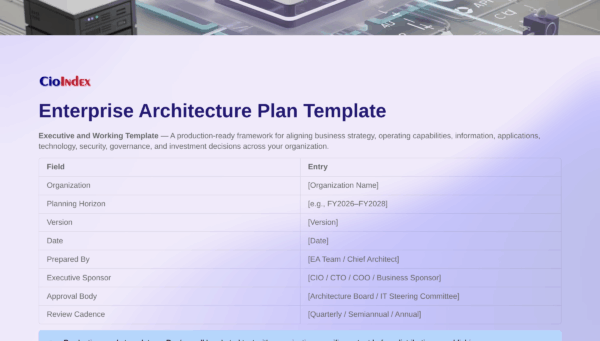
This Enterprise Architecture Plan Template provides a structured framework for aligning strategy, governance, modernization, portfolio decisions, standards, and transformation execution through a traceable enterprise architecture planning model. Unlike conventional EA templates focused primarily on documentation, this framework operationalizes enterprise architecture into a governed transformation system with transition-state planning, roadmap traceability, architecture decision governance, portfolio rationalization, and measurable accountability.
What Is This Enterprise Architecture Plan Template?
This is a production-ready Enterprise Architecture Plan Template designed to help organizations connect enterprise architecture with modernization planning, governance, portfolio management, transition sequencing, and operational execution.
Rather than focusing only on architecture documentation, the framework demonstrates how enterprise architecture can be operationalized into a structured planning and governance capability that guides modernization decisions, investment priorities, architecture standards, transition dependencies, and transformation accountability.
It provides a practical method for defining current-state and target-state architecture while also establishing the governance structures, traceability mechanisms, transition architectures, and roadmap sequencing needed to execute enterprise transformation in a disciplined way.
Why You Should Trust This Enterprise Architecture Plan Template
This framework reflects practical enterprise architecture and modernization governance experience rather than purely theoretical EA modeling.
Real-World Enterprise Architecture Focus
Designed to address the operational gap between enterprise architecture strategy and modernization execution.
Governance-Driven Structure
Integrates architecture governance, decision rights, standards management, quality gates, and portfolio oversight directly into the planning framework.
Transition-Oriented Planning
Recognizes that enterprise transformation requires governed intermediate transition states rather than only current-state and future-state models.
Traceability-Centered Design
Connects business objectives, capabilities, applications, technology, roadmap initiatives, investments, and metrics through a formal traceability structure.
Executive and Operational Alignment
Supports CIOs, Chief Architects, governance boards, portfolio leaders, and modernization teams responsible for enterprise-wide transformation execution.
This template reflects how mature organizations operationalize enterprise architecture as a transformation and governance discipline—not simply how they document architecture.
Why This Enterprise Architecture Plan Template Matters
Enterprise architecture becomes valuable only when it influences decisions.
Without a structured planning framework, architecture initiatives often become disconnected from funding priorities, governance structures, modernization sequencing, operational delivery, and measurable business outcomes.
This template helps solve those problems by:
- Connecting architecture strategy to modernization execution
- Establishing governance and decision accountability
- Creating traceability between strategy and investments
- Sequencing transformation through governed transition states
- Supporting portfolio rationalization and lifecycle management
- Aligning architecture initiatives with business outcomes
- Improving modernization transparency and execution discipline
Without these capabilities, enterprise architecture frequently becomes fragmented, theoretical, or disconnected from enterprise priorities.
This framework provides the operational structure needed to make enterprise architecture actionable.
What Makes This Enterprise Architecture Plan Template Different
This is not simply an enterprise architecture documentation template.
It is a governance-driven enterprise transformation planning framework.
Transition Architecture Focus
Introduces governed transition states such as Stabilize, Simplify, Modernize, and Optimize to operationalize modernization sequencing.
Strategic Traceability
Creates a “golden thread” connecting strategy, capabilities, applications, technologies, investments, roadmap initiatives, and metrics.
Decision-Centric Governance
Embeds architecture decision logs, standards governance, portfolio decision models, and decision-rights structures directly into the planning framework.
Portfolio Rationalization Integration
Supports application, platform, integration, and technology rationalization through structured evaluation and lifecycle governance.
Executive Governance Alignment
Designed for CIOs, governance boards, enterprise architects, modernization leaders, and portfolio teams—not just architecture practitioners.
The result is a framework that operationalizes enterprise architecture into a measurable modernization and governance discipline.
How to Use This Enterprise Architecture Plan Template
This template provides a structured method organizations can adapt to govern enterprise architecture and modernization planning.
Define Current and Target Architecture
Document current-state and future-state architecture across strategy, capabilities, applications, data, technology, security, and governance.
Identify Gaps and Dependencies
Perform structured gap analysis to identify modernization priorities, dependencies, risks, and required changes.
Establish Transition Architectures
Sequence enterprise transformation through governed transition states with defined outcomes and dependencies.
Govern Architecture Decisions
Use architecture decision logs, standards governance, quality gates, and decision-rights structures to operationalize governance.
Align Investments and Roadmaps
Connect modernization initiatives, portfolio decisions, and roadmap sequencing to architecture priorities and business outcomes.
Applied correctly, this framework becomes the operational mechanism through which enterprise architecture guides modernization execution.
What This Enterprise Architecture Plan Template Helps You Deliver
This framework enables organizations to create tangible enterprise architecture governance and modernization outputs.
Enterprise Architecture Plan
A complete enterprise architecture planning framework aligned to business strategy and modernization priorities.
Transition Architecture Roadmap
A governed sequencing model for managing enterprise transformation through intermediate transition states.
Enterprise Traceability Model
A structured mechanism connecting strategy, capabilities, applications, technologies, investments, and roadmap initiatives.
Architecture Governance Framework
A practical governance structure defining standards, decision ownership, approval mechanisms, and accountability.
Portfolio Rationalization Structure
A repeatable framework for evaluating, modernizing, standardizing, retaining, or retiring enterprise assets.
These deliverables transform enterprise architecture into a practical modernization governance capability.
What You Can Do With This Enterprise Architecture Plan Template
Using this framework improves both enterprise architecture discipline and modernization execution.
Improve Modernization Governance
Create structured oversight for modernization sequencing, standards management, and transition planning.
Strengthen Investment Alignment
Ensure portfolio decisions and modernization initiatives remain aligned with enterprise architecture priorities.
Reduce Fragmentation
Create a unified enterprise architecture language and planning structure across teams and initiatives.
Increase Architecture Accountability
Establish governance ownership, traceability, quality gates, and measurable accountability.
Operationalize Enterprise Architecture
Move enterprise architecture beyond documentation into a practical enterprise transformation management capability.
Ultimately, this template helps organizations govern enterprise transformation by improving how architecture decisions are structured, sequenced, aligned, and executed.
What You’ll Be Able to Create
This framework gives you a structured method to operationalize enterprise architecture and modernization governance—complete with:
- A Governed Enterprise Architecture Planning Model that aligns strategy, modernization, governance, and execution.
- A Transition Architecture Framework that sequences transformation through governed operational states.
- A Traceability Structure connecting business objectives, capabilities, applications, investments, and roadmap initiatives.
- A Portfolio Rationalization Model for evaluating and governing enterprise assets.
- A Governance and Decision Framework defining standards, ownership, approvals, and accountability.
- A Measurable Modernization Planning Process supported by metrics, quality gates, and operational governance.
These outputs ensure enterprise architecture remains connected to modernization execution and business outcomes.
Use this Enterprise Architecture Plan Template to create a practical, business-anchored enterprise architecture capability that connects strategy, governance, modernization, investments, and operational execution through a disciplined planning and governance framework.
Download this Custom Designed EA Plan Template.
Build a business-anchored Enterprise Architecture capability!
Requires All Access Pass.