To create an IT strategy framework, define the business decisions it must support, translate strategic needs into technology capabilities, establish evidence-based investment rules, assign decision rights, and test whether those rules lead to defensible choices. The finished framework should allow leaders to explain what IT should enable, why one investment should come before another, who can decide, and what evidence would change that decision.
The challenge is seldom a shortage of possible projects. Growth, resilience, efficiency, modernization, and emerging opportunities all compete for the same budget and delivery capacity. A framework gives those choices a common logic. This guide explains how to design that logic, adapt it to organizational conditions, apply it to a real decision, and determine whether the result is ready to use.
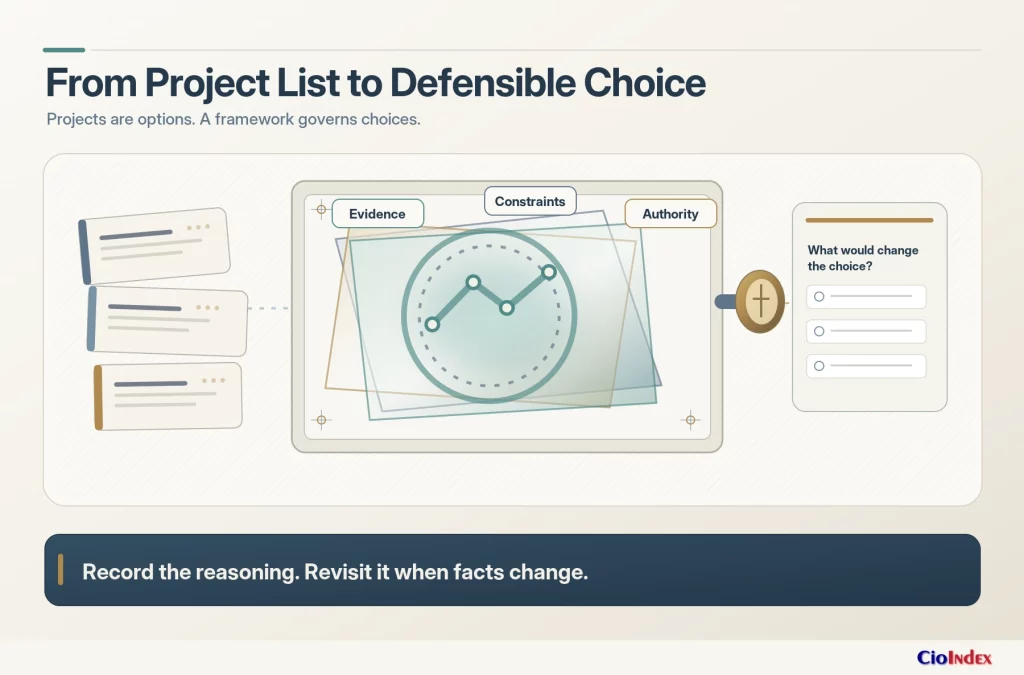
An IT strategy framework applies evidence, constraints and decision authority before leaders commit to an investment.
What You Are Actually Creating
An IT strategy framework is a repeatable structure for developing and governing IT strategy. It specifies the questions to answer, the relationships to examine, the criteria for making choices, and the way decisions are reviewed. The resulting IT strategy sets the direction and priorities; the roadmap schedules approved work; and a strategy template helps document the plan. A framework connects and governs those activities without taking the place of each one.
For the full conceptual definition, components, and related models, use the CIO Wiki article on IT Strategy Framework. This article deals with the construction problem: how do you design a framework that a CIO, business sponsor, architect, risk leader, and portfolio manager can use when they disagree?
A complete framework should make the following chain explainable:
Business objective or material risk → required capability → evidence of current and target conditions → strategic choice → investment and governance decision → delivered capability → observed outcome → review.
Every arrow matters. An objective alone does not identify a project. A capability gap does not establish which solution to buy. Completing a roadmap milestone does not prove that the business outcome was achieved. The framework must make those transitions explicit and testable.
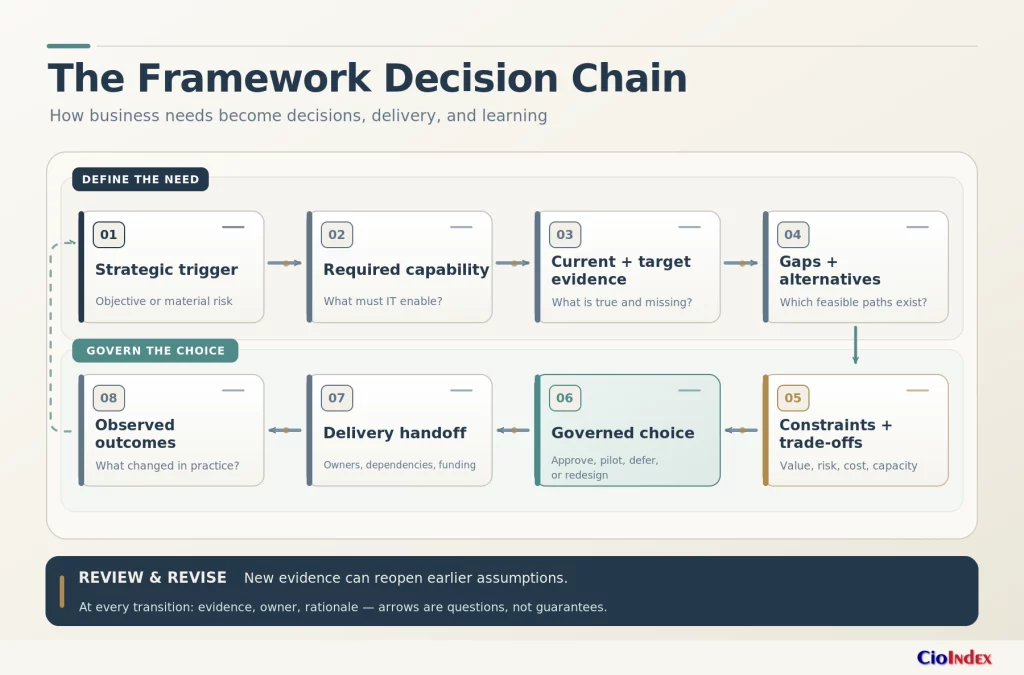
An IT strategy framework links business needs to accountable technology choices, delivery, outcome evidence, and continual review.
Choose the Right Design Approach Before Writing the Rules
There is no single seven-step formula that every enterprise should apply without adaptation. The construction questions are broadly reusable; their emphasis depends on the source of strategic pressure and on how the organization makes decisions.
| Starting condition | Sensible emphasis | Important safeguard |
| Business growth or service transformation | Begin with business outcomes and the capabilities that enable them | Avoid treating a sponsor’s preferred product as the requirement |
| Material cyber, regulatory, or operational exposure | Begin with obligations, exposure, and required control or resilience capabilities | Set minimum constraints before balancing discretionary returns |
| Legacy complexity or fragmented architecture | Begin with current-state evidence, shared dependencies, and target capabilities | Avoid replacing systems before the actual bottleneck is understood |
| Emerging AI or digital opportunity | Begin with a bounded opportunity hypothesis and a reversible experiment | Define evidence and stop conditions before committing at scale |
| Multiple divisions or acquired businesses | Emphasize shared decision principles, ownership, exceptions, and local autonomy | Do not impose a uniform technology answer where contexts differ |
These approaches can be combined. A regulated distributor may need business-led planning for growth and a risk-led path for a critical control gap. An organization with an immature business strategy may begin with a few explicit outcome hypotheses and revise them with business leaders as evidence improves. The framework should reveal those uncertainties rather than invent agreement.
Set the boundary first. Decide which investment, architecture, sourcing, risk, and exception decisions the framework will govern. Name the executive sponsor, accountable CIO or technology leader, participating business owners, and the existing decision forums. Record any non-negotiable legal or safety requirements, along with uncertainties that must remain open. Choose three upcoming decisions—one ordinary investment, one constrained trade-off, and one risk or exception—to test the framework later.
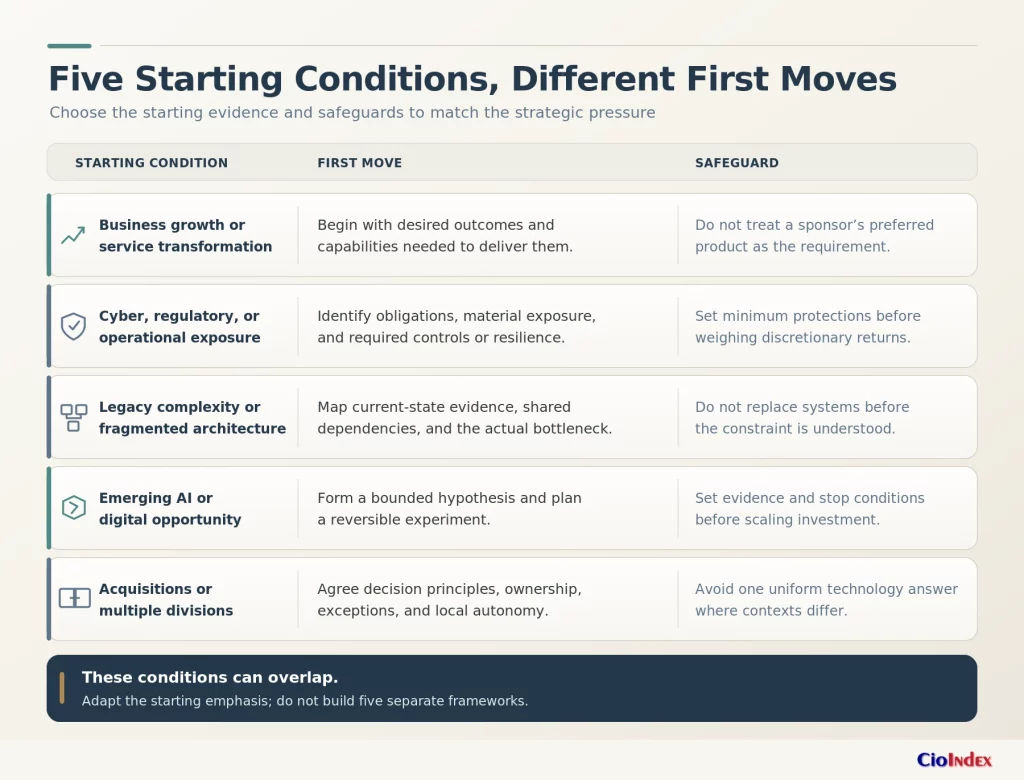
Five common starting conditions call for different evidence and safeguards when creating an IT strategy framework; organizations can combine approaches.
How to Build an IT Strategy Framework in Seven Steps
These steps follow a causal sequence: establish the decisions, identify required capabilities, test gaps, make choices, authorize them, measure outcomes, and challenge the result. Combine or scale steps for a smaller organization, but preserve the underlying logic.
Step 1: Define the Decisions and Translate Business Needs Into Capability Requirements
Start with what leadership needs to achieve, protect, or learn. Review business priorities, customer and operating problems, major obligations, and credible technology opportunities. Ask business sponsors what outcomes matter and how they would recognize progress. Where priorities conflict, record that conflict; it is an input to the framework, not a drafting inconvenience.
Next, separate desired outcome, capability, and proposed solution. A request for a new sales portal is a proposal. The underlying requirement might be more reliable order availability, easier customer self-service, or faster account onboarding. Each can imply a different technology response. An enterprise may also need to improve a capability for risk reasons even when no business sponsor has requested a visible feature.
Record the decision scope, outcome owner, required IT-enabled capability, known constraints, and the evidence that would support or challenge the proposed connection. Avoid asserting that one technology change will automatically create a business result.
Produce: a business-to-capability decision map with owners, assumptions, and priority tensions. Test: can a sponsor explain the capability need without referring to a vendor or project title?
Step 2: Establish the Current State, Target Capabilities, and Material Gaps
Assess each strategically relevant capability using evidence proportionate to the decision. Sources may include application and integration maps, service failures, control findings, process delays, technology costs, vendor dependencies, workforce constraints, and feedback from the teams who use the capability. Do not reduce several different problems to a single maturity score unless the scale is demonstrably suitable.
Describe the target state in operational terms. “Modern integration” is a slogan; “reconciled order and inventory data across channels within the agreed service tolerance” gives teams a condition to investigate. Compare the present state with that target and distinguish the apparent symptom from the underlying cause. A poor customer experience might arise from unreliable data, an unsuitable workflow, inaccessible design, or several interacting constraints.
State the strength of the evidence. A gap supported by production incidents deserves a different response from a suspected gap based on one interview. Map dependencies and capacity: one data-quality repair might unlock several later initiatives, while a popular front-end project could depend on a capability not yet working.
The six-step IT strategy approach described by IDC contributors in CIO Magazine separately addresses current-state understanding and gap analysis. That supports their importance to strategy development, although the framework design method here is CIO Index’s practical synthesis.
Produce: current-to-target capability evidence, gaps, confidence levels, dependencies, and accountable owners. Test: can the team explain which gap constrains a business outcome and what evidence could overturn that diagnosis?
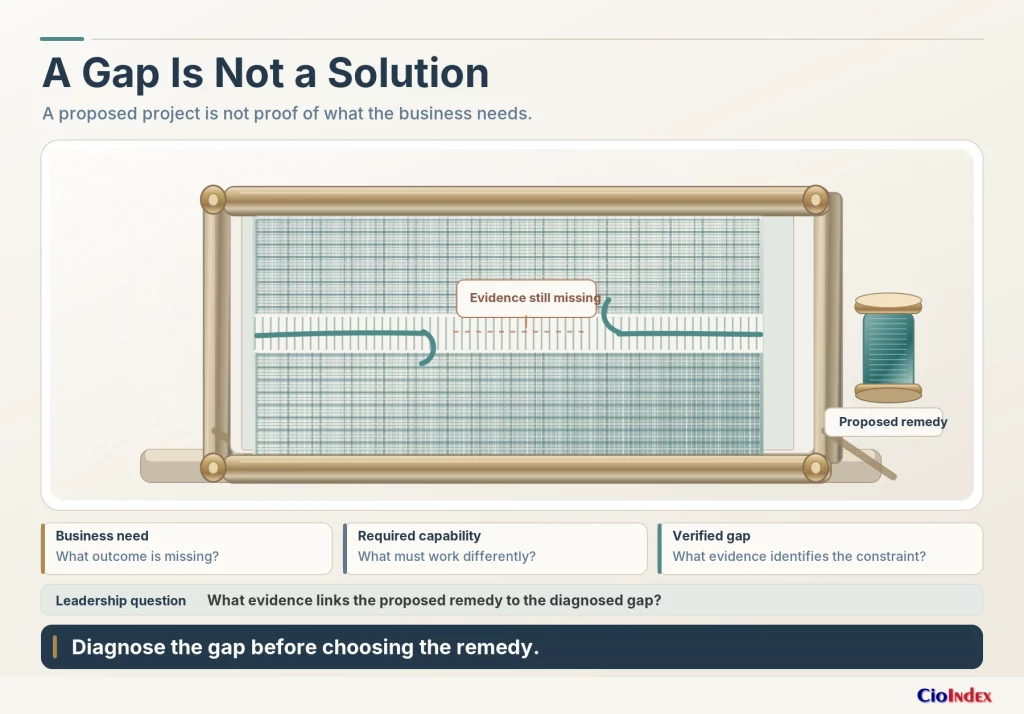
An incomplete evidence connection separates the business need from the proposed IT remedy; diagnose the capability gap before selecting a project.
Step 3: Set Strategic Principles, Hard Constraints, and Investment Decision Rules
Only after understanding needs and gaps should the framework decide how options will be judged. Separate three types of rules:
- Hard constraints: legal obligations, unacceptable risk exposures, mandatory security conditions, non-negotiable architecture or capacity limits. These determine whether a proposal is eligible or requires a different design.
- Trade-off criteria: business contribution, dependency reduction, delivery feasibility, total cost, time to value, uncertainty, reversibility, and opportunity cost. Their relative importance varies with the decision.
- Strategic principles: durable preferences such as reusing a shared capability where it materially improves cost or resilience, or using a pilot when the evidence of value is weak but learning is inexpensive.
Do not disguise judgment as precision with one universal weighted score. A critical risk response may warrant a mandatory gate; a speculative service innovation may warrant a low-cost experiment; a core-platform replacement may require a staged dependency analysis. Document when a principle applies, who can approve an exception, and what evidence should trigger reconsideration.
The framework should yield a real disposition—approve, test, redesign, defer, or decline—and an understandable reason. A deferred request needs a condition for reopening it. An approved investment needs its critical dependency, guardrails, and escalation path. Only then should approved work flow into a roadmap.
Produce: decision principles, eligibility conditions, alternative-evaluation criteria, and a compact decision record. Test: can two proposals with credible benefits be compared without changing the rules to favor a preferred sponsor?
Step 4: Connect Decisions to Governance and Exception Rights
Specify who proposes, evaluates, challenges, authorizes, and revisits a strategic choice. Business owners should own the intended business value; technology leaders must establish deliverability and capability implications; risk and architecture functions should challenge controls, dependencies, and standards where relevant. A small organization can assign several responsibilities to one forum, provided it does not hide conflicting accountability.
Distinguish routine approval, material exception, and urgent risk action. An exception should record what rule is being waived, why, by whom, for how long, and which compensating controls or review conditions apply. Where legal or safety requirements cannot be waived, the framework should say so without creating a fictional exception process.
This governance layer complements recognized governance frameworks rather than replacing them. ISACA describes COBIT 2019 as a framework for enterprise information and technology governance and management, with governance and management objectives; it is useful context for accountable decisions, but is not identical to an IT strategy-development method.
Produce: a decision-rights map with review forums, escalation paths, and exception records. Test: can a contested proposal reach an authorized decision without informal side agreements or missing control ownership?
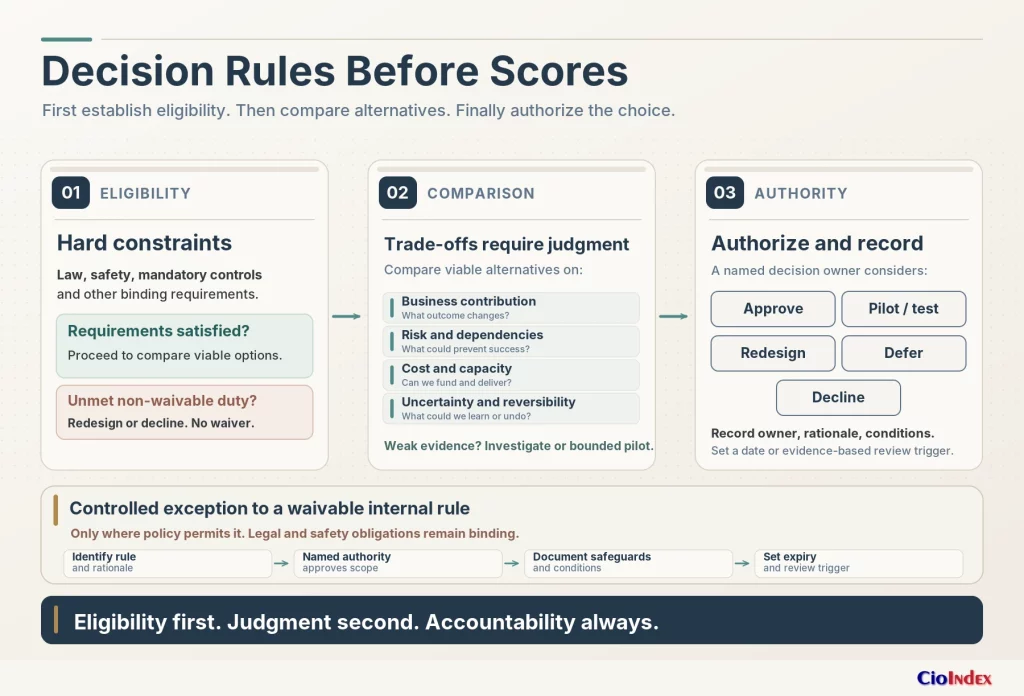
An IT strategy framework separates non-waivable obligations, comparison of viable investments, and accountable decisions; exceptions require limited authority and safeguards.
Step 5: Turn Approved Choices Into a Capability and Roadmap Handoff
At this point the framework has selected what deserves action; a strategy and roadmap team must define how and when to deliver it. For each approved choice, capture the capability change, necessary predecessors, accountable delivery owner, major constraints, funding assumptions, and the conditions that could stop or re-sequence work. Keep a visible link between the investment decision and the roadmap item so the rationale survives planning cycles.
The distinction matters. Gartner‘s April 2026 abstract on the IT strategic plan workbook describes the strategic plan as the means by which strategy outcomes will be delivered. That is compatible with treating the framework as the decision structure and the plan as its execution record; it does not establish a universally prescribed framework sequence.
Produce: an approved-initiative-to-capability handoff, with dependencies and decision history. Test: could a portfolio or delivery owner explain why an initiative is on the roadmap, what must precede it, and what would justify stopping it?
Step 6: Define Outcome Measures, Leading Indicators, and Guardrails
Measure three distinct things: whether work was delivered, whether the resulting IT capability performs, and whether the intended business outcome changed. Finishing a system implementation is evidence of delivery, not proof that customers or operating teams obtained the intended benefit.
For each strategic choice, record the measure, available baseline, desired direction or bounded target, source, owner, review date, and action triggered by a material deviation. Pair benefits with guardrails. Faster customer interactions may be unacceptable if security exposure, error rates, operating cost, or service availability deteriorate beyond agreed limits.
Treat causality carefully. If order reliability improves after a technology investment, the improvement may also reflect staffing, inventory policy, process changes, or shifts in demand. The framework should state the contribution hypothesis, what other explanations are plausible, and what decision would follow from contrary evidence.
Produce: a small outcome-and-guardrail scorecard connected to approved choices. Test: does every measure help someone decide to continue, adapt, stop, investigate, or revise the framework?
Step 7: Test the Framework on Realistic Decisions and Embed It in Governance
Return to the three representative decisions selected before construction. Ask different participants to apply the same rules to the same evidence. If outcomes diverge, identify whether the cause is acceptable discretion, missing evidence, unclear priorities, inconsistent terms, or conflicting decision rights. Revise the framework where its rules produce unnecessary ambiguity or bad choices.
Run at least one uncomfortable scenario: a compelling business proposal whose technical dependency is unready; a mandatory control that competes with a high-return project; and a promising innovation without a credible baseline. A framework that works only for obvious approvals is incomplete. Also test a decision with incomplete data: the right result may be investigate or pilot, not a forced approval or rejection.
Embed the accepted logic in existing investment, architecture, risk, and business-review meetings. Agree who maintains it, what changes require formal approval, and what events trigger revision—for example a new enterprise priority, an acquisition, a material incident, changed regulation, or repeated evidence that the rules select poor investments. Keep the decision structure reusable while allowing priorities and choices to evolve.
Produce: three decision-test records, resolved defects, a named framework owner, and a review cadence. Test: can a new proposal be processed consistently without the original designer having to interpret every rule?
What the Completed IT Strategy Framework Must Contain
A concise framework can be stronger than a long document, provided its decisions can be reproduced. Store detailed evidence in existing strategy, portfolio, architecture, and risk records rather than copying it into another binder.
| Framework component | Minimum question or output |
| Scope and strategic intent | Which business outcomes, risk conditions, and decisions are covered? |
| Capability model | What must IT enable, and what does current-versus-target evidence show? |
| Principles and decision logic | Which proposals are eligible, how are alternatives judged, and when is deferral appropriate? |
| Governance | Who proposes, challenges, decides, and authorizes exceptions? |
| Delivery handoff | How does a chosen capability change become an approved initiative with dependencies? |
| Measurement and learning | What evidence would continue, change, pause, or reverse a decision? |
These are connected domains rather than compulsory chapters. Represent them as a concise diagram, a decision protocol, and a small set of reusable records if that suits the organization. The design is complete when people can apply it, not when every heading has been filled in.
Worked Example: Three Investments, One Constrained Choice
The following is a hypothetical example. The organization, facts, alternatives, and decisions are illustrative; no operational results are being reported as observed outcomes.
A regional distributor wants more reliable next-day fulfilment and better online ordering. Business leaders have three proposals: A, launch a new ordering portal; B, improve inventory-data synchronization between warehouses and sales channels; and C, run a limited portal pilot using the existing data. The organization cannot responsibly fund or staff all three at full scale in the same period.
The objective is reliable customer promises, not a particular interface. Required capabilities include trustworthy inventory availability, consistent order status, and usable self-service. The first diagnostic question is whether current inventory mismatches materially prevent those outcomes. The decision team would inspect reconciliation failures, order exceptions, data-update delays, process handoffs, delivery complaints, integration dependencies, and the consequences of incomplete evidence.
| Alternative | Potential value | Material risk or dependency | Framework disposition |
| A. Full portal launch | Faster self-service and a new digital channel | May amplify unreliable availability data; larger commitment before the constraint is known | Defer if inventory reliability is not demonstrated |
| B. Synchronization repair | Improves a shared data capability used by several channels | Root cause may be process, policy, or source-data quality rather than software | Approve bounded diagnosis and remediation if evidence supports this constraint |
| C. Limited portal pilot | Tests whether customer access is the main friction at lower exposure | Must use controlled promises and measure both usefulness and data quality | Pilot conditionally when exposure and cost are manageable |
Suppose the evidence indicates that late inventory updates are a material cause of broken delivery promises. In that case, the framework favors establishing the data constraint and a bounded repair before funding A at full scale. C may proceed only if the pilot can operate within explicit data, security, and service guardrails. It does not automatically mandate B: if the root cause proves to be warehouse process discipline, an integration rewrite may be the wrong remedy.
The decision record names the business sponsor and CIO as accountable approvers under the assumed governance arrangement, with architecture and risk challenge. The roadmap handoff sequences diagnosis, minimum viable remediation, evidence review, then conditional channel expansion. The outcome review distinguishes project completion from inventory accuracy, on-time fulfilment, customer adoption, security, and ongoing cost.
What could reverse the decision? If reconciliation data shows inventory information is already reliable, while usability research demonstrates access is the binding constraint, A or C may move forward first. If the costs and risks of B prove disproportionate, an alternate process or architectural solution should be evaluated. The value of the framework is that it makes those changes explainable without rewriting the rules to favor a project.
For examples of strategic plans and applications beyond this single scenario, use the separate IT Strategy Examples collection.
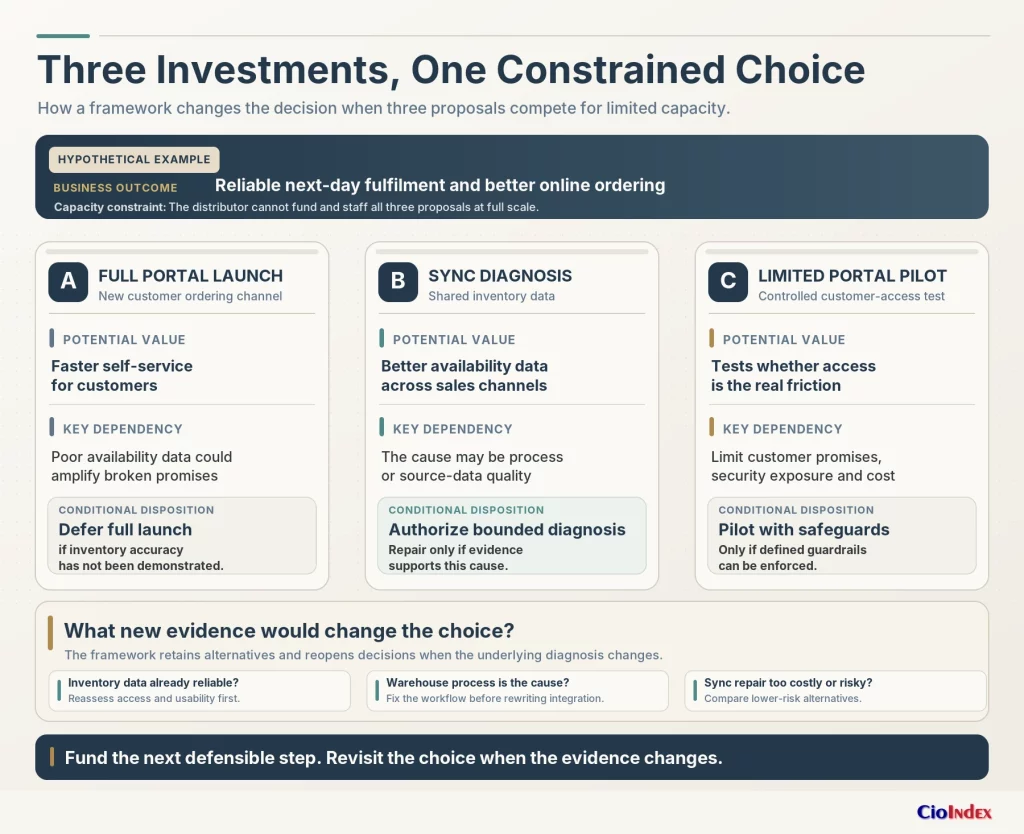
Illustrative distributor: a full portal launch may be deferred, inventory synchronization first investigated, and a limited pilot permitted only with safeguards. New evidence can reopen the choice.
A Copyable Decision Record for Your Next Strategy Meeting
Use the following compact record for one proposed investment. Complete it once for an ordinary proposal and again for a high-risk or uncertain proposal. It is a working prompt, not a claim that a separate downloadable tool has been functionally verified.
| Field | Record the answer |
| Strategic trigger and owner | Which outcome, risk, or opportunity requires a decision, and who is accountable? |
| Required capability and current gap | What must be possible; what evidence shows the current limitation? |
| Alternatives and constraints | What realistic options exist; what is mandatory or infeasible? |
| Decision and rationale | Approve, pilot, redesign, defer, or decline—why this option now? |
| Dependencies and authority | What must happen first; who authorizes and challenges the choice? |
| Outcome test and revision trigger | Which measures, guardrails, review date, and evidence could change the choice? |
Do not force a numerical score where the available evidence is poor. Record unknowns explicitly, assign an evidence owner and date, and make investigate a valid interim outcome. A reusable worksheet or tool can later implement these fields, but its functionality must be verified separately before claiming that it works.
Stress-Test the Framework Before Calling It Finished
A quality review should challenge the framework’s behavior, not merely check whether its sections exist. Run these tests in the next investment or governance workshop:
- Missing evidence: A proposal has strong advocacy but no trustworthy baseline. Does the framework call for investigation or a bounded pilot instead of manufacturing certainty?
- Conflicting priorities: A growth opportunity competes with a resilience exposure and a limited delivery team. Can leaders distinguish mandatory constraints, strategic preference, and available capacity?
- Exception pressure: A major sponsor requests a standards exception. Does the framework identify the legitimate authority, expiry condition, and non-waivable obligations?
- Dependency reversal: The presumed technical bottleneck turns out to be a process or data-quality issue. Can the decision change without losing its rationale?
- Unfavorable outcomes: Delivery finishes on time but business results remain flat. Does the scorecard trigger examination of adoption, hypotheses, and rival causes rather than declaring success?
For each test, record the decision, its evidence, disagreements, the rule invoked, and whether the rule needs repair. A failed stress test is useful feedback; resolve material contradictions before wide rollout. A lightweight framework may need only a page of rules and one meeting cadence, while a complex regulated enterprise may need formal decision records and independent risk challenge.
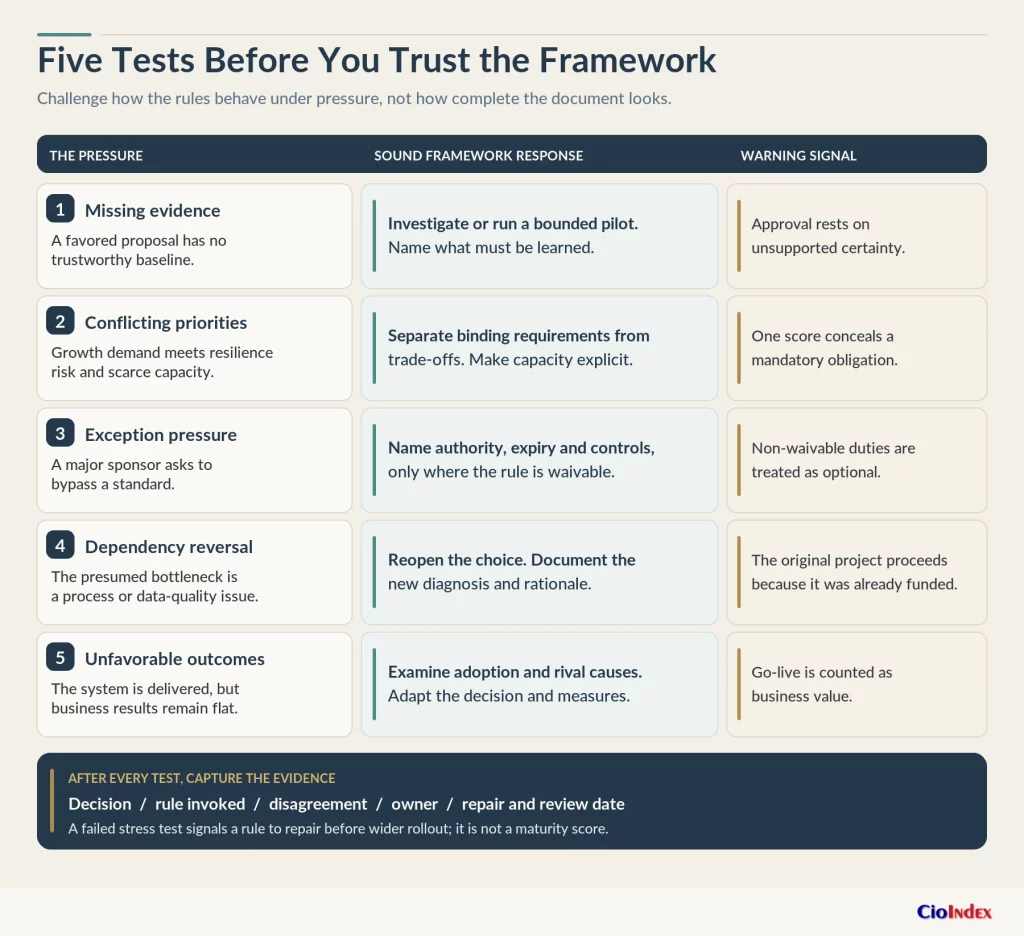
Five stress tests show how to challenge an IT strategy framework using missing evidence, competing priorities, exception requests, changing dependencies and weak outcomes.
Common Failures to Avoid
A framework that names strategic themes but cannot choose between proposals is incomplete. Replace broad wishes such as “modernize platforms” with the criteria and constraints that would change an actual funding decision. A framework that jumps from business goals directly to projects misses shared capabilities and hidden dependencies. A framework that relies on one fixed scoring formula can suppress judgment about compliance, uncertainty, and reversibility. And a framework whose scorecard reports only completed initiatives cannot demonstrate whether the intended capabilities or outcomes improved.
The remedy is consistent: make each relationship, condition, owner, alternative, and review trigger explicit enough to test. Preserve worthwhile disagreement rather than forcing unanimity or another generic layer of bureaucracy. The strongest evidence of readiness is a traceable decision that people outside the drafting team can reproduce and reasonably challenge.
What to Do After the Framework Is Designed
Use the resulting decision structure to guide strategic planning, portfolio choices, and ongoing governance. If you need a reusable starting resource, try the IT Strategy Framework download; its full content and functional behavior should be checked before relying on it as a complete replacement for the method explained here. The IT Strategy Template helps document the resulting plan; the broader How to Create IT Strategy toolkit covers the wider strategy-development process.
Review the framework whenever a material business assumption, obligation, technology dependency, or outcome changes. The purpose is a decision system that can survive a new planning cycle while remaining accountable to evidence.
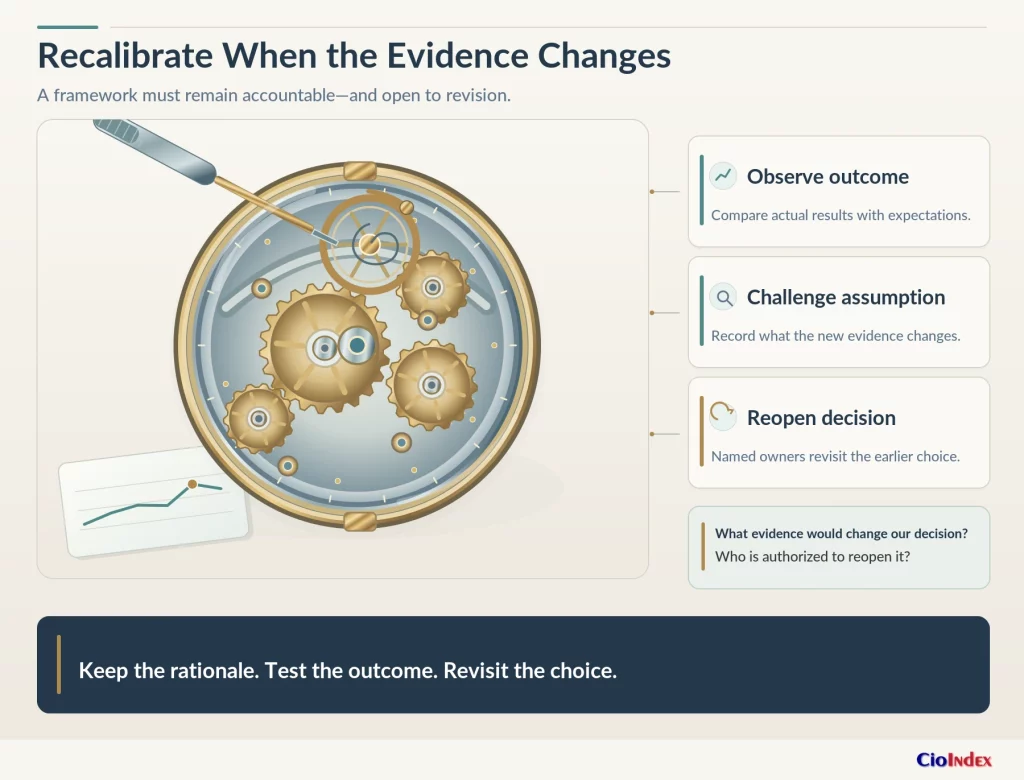
When new evidence changes assumptions or outcomes, accountable leaders can revisit an IT strategy framework’s earlier choices.
References and Further Reading
- Saroff, D. and Johnston, G. (2024) ‘Six steps to creating a successful IT strategy: A guide for CIOs‘, CIO, 15 October. Relevant to business context, current-state assessment, gap analysis, and roadmap design; this article does not claim its seven-step method is IDC’s.
- Gartner (2026) ‘Toolkit: IT Strategic Plan Guide and Workbook‘, 7 April. Public abstract distinguishes the strategic plan’s delivery role from strategy outcomes; the full toolkit was not inspected.
- ISACA (2019) ‘COBIT 2019 Framework: Governance & Management Objectives‘. Primary publisher overview of the separate enterprise IT governance and management framework; the full publication was not inspected.