
ITIL is easier to apply when its components are treated as parts of one management system rather than as a catalogue of processes. This article explains what each major component does, how the components connect, and how CIOs can use them without creating unnecessary bureaucracy.
An executive review asks why a service is failing. The support team has missed targets, a release is unstable, or users are abandoning a new capability. Someone proposes a new process, a stricter control, or another ITIL practice. The response sounds disciplined because it uses framework language. Yet it may address the wrong layer of the problem.
A practice can be well documented while a value stream remains fragmented. A lifecycle activity can be well managed while one of the four dimensions is ignored. A service desk can improve response time while employee effort and trust deteriorate. Local progress is real, but it is not the same as end-to-end value.
That is the central idea of this article: the power of ITIL comes from component alignment, not component accumulation. ITIL contains several complementary models because no single model can answer every management question. The Value System defines the whole. Governance directs it. Guiding principles shape judgment. The four dimensions test completeness. The lifecycle locates the work. Value chains and value streams show how work moves. Practices supply the capabilities. Continual improvement uses evidence to correct the system.
Once those roles are clear, ITIL stops looking like overlapping terminology and starts functioning as an operating language for digital products and services.
ITIL Framework Components at a Glance
ITIL is a service-management framework for governing and continually improving how an organization designs, builds, transitions, operates, delivers, and supports digital products and services. Its Value System, lifecycle, four dimensions, guiding principles, value flows, governance, practices, and improvement mechanisms answer different management questions but combine to help stakeholders co-create value.[1]
The following map provides the quickest way to understand how the principal ITIL framework components fit together.
| Component | The management question it answers | What it contributes |
| ITIL Value System | What is the whole management system trying to turn into value? | A common system boundary connecting demand, opportunity, governance, principles, activities, practices, and improvement. |
| Governance | Who evaluates choices, directs action, and monitors results? | Decision rights, accountability, risk acceptance, priorities, and oversight. |
| Guiding principles | How should people make decisions when the framework does not prescribe one answer? | Reusable heuristics for value, iteration, collaboration, simplicity, holistic thinking, and optimization. |
| Four dimensions | Have we designed the change or service holistically? | A completeness test across people, technology, partners, and value streams/processes. |
| Product and Service Lifecycle | Where is the product or service work occurring? | Eight activities spanning discovery through support. |
| Value chain and value streams | How does work move from demand or opportunity to an outcome? | An operating flow and the outcome-specific paths through activities and practices. |
| Management practices | What organizational capability is required to perform the work well? | People, processes, information, technology, partners, and knowledge organized for a purpose. |
| Continual improvement | What evidence should change the system next? | Feedback, learning, prioritization, correction, and adaptation. |
This table is a CIO Index synthesis, not an official ITIL model. It brings official constructs into one executive map so that leaders can ask the right question before selecting a remedy.
The First Source of Confusion: ITIL v3, ITIL 4, and ITIL (Version 5)
Many organizations use ITIL language inherited from different generations. That is not necessarily a problem. The problem arises when concepts from those generations are combined without stating which model is being used or what question it answers.
ITIL v3, refreshed in 2011, organized its core guidance around five service lifecycle stages: Service Strategy, Service Design, Service Transition, Service Operation, and Continual Service Improvement.[4][7] This made service management easy to explain as a lifecycle, but it also encouraged some organizations to treat stages as departmental handoffs or as a one-way project sequence.
ITIL 4 shifted the center of gravity from a lifecycle-centered architecture to the Service Value System and Service Value Chain. It emphasized value co-creation, four dimensions, seven guiding principles, value streams, and practices that could be combined in different ways.[4][5] The change supported more iterative, product-oriented, Agile, DevOps, and digitally integrated operating environments.
ITIL (Version 5) builds on that foundation. Official guidance says the Value System, guiding principles, four dimensions, and practices remain central, while a new Product and Service Lifecycle gives organizations a clearer end-to-end view of digital products and services.[1][2] The lifecycle contains eight activities: Discover, Design, Acquire, Build, Transition, Operate, Deliver, and Support.[2]
| Generation | Organizing emphasis | Useful question today | Boundary to preserve |
| ITIL v3 / 2011 | Five-stage service lifecycle | Which historical lifecycle language, roles, and processes are embedded in the organization? | Do not present the five stages as the current Version 5 architecture. |
| ITIL 4 | Service Value System, Service Value Chain, dimensions, principles, practices, and value streams | How does demand move through adaptable activities and capabilities toward value? | Do not assume the value chain and lifecycle are the same model. |
| ITIL (Version 5) | Value System plus an eight-activity Product and Service Lifecycle | How are products and services governed and managed across their full evolution? | Treat the transition as continuity with refinement, not a reason to discard functioning ITIL 4 capabilities. |
The practical response is not to purge every older term. It is to control meaning. A team can still use a useful ITIL 4 value stream, an established v3 process name, or an existing practice model if everyone understands how that element fits within the current management system. CIO Index maintains a broader collection of ITIL resources for readers who need version-specific or implementation material.
Version control removes a terminology error. Role control removes an implementation error. Leaders need both.
Why ITIL Needs More Than One Model
A recurring criticism of ITIL is that it contains too many models. The real issue is treating every construct as another layer of documentation rather than as an answer to a different problem.
Consider a cloud-based employee support product. Leaders may need to know:
- whether the product still solves a valuable employee problem;
- who owns risk, funding, and performance decisions;
- whether the design accounts for people, data, technology, suppliers, and workflow;
- whether a problem sits in discovery, build, transition, operation, delivery, or support;
- how an employee request moves across the end-to-end value stream;
- which capabilities—such as service desk, knowledge management, supplier management, information security, or measurement—must perform reliably;
- what evidence should trigger a correction.
One process map cannot answer all seven questions. Neither can a lifecycle diagram, a governance charter, or a list of practices. ITIL needs several models because digital products and services are simultaneously investments, operating systems, stakeholder experiences, technology architectures, supplier ecosystems, flows of work, and governed risks.
The mistake is not that ITIL has multiple components. The mistake is to flatten those components into a list and then assume that adopting more items means becoming more mature.
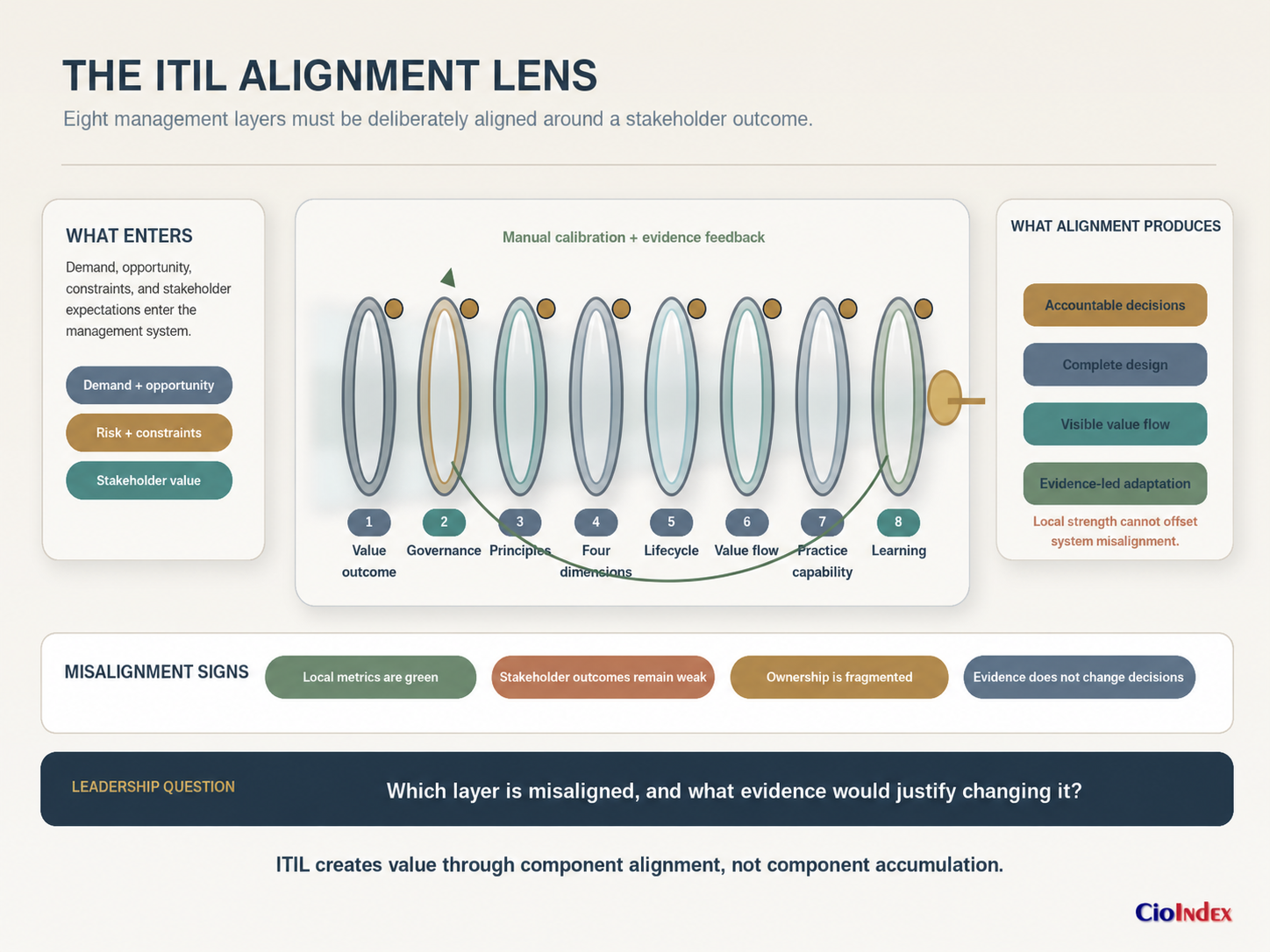
A mature ITIL implementation is better judged by coherence. Can the organization connect a stakeholder outcome to an accountable owner, a product or service boundary, a lifecycle position, an outcome-specific value stream, the four dimensions, required practice capabilities, decision evidence, and a feedback loop? If not, more process can increase activity without improving the management system.
The CIO Index ITIL Component Stack™
The CIO Index ITIL Component Stack™ is an editorial model for seeing the framework as eight aligned layers. It is not official ITIL terminology, and it does not replace the official architecture. Its purpose is diagnostic: it helps leaders locate the management question that has not been answered.
| Layer | Role | Typical failure when the layer is weak |
| 1. Value outcome and system boundary | Defines the stakeholder outcome, product/service scope, demand, opportunity, and value expectations. | Teams optimize activity without agreeing on whose value or which outcome matters. |
| 2. Governance and accountability | Establishes decision rights, priorities, risk ownership, funding, and oversight. | Tradeoffs are deferred, ownership is ambiguous, or metrics are reported without consequences. |
| 3. Guiding principles | Provides consistent judgment across different contexts. | Teams follow rules mechanically or make locally rational decisions that conflict. |
| 4. Four-dimensional completeness | Tests whether design and change are balanced across the operating system. | Technology is implemented without the people, supplier, information, or workflow conditions required for success. |
| 5. Lifecycle position | Locates the product or service work and its current management need. | Discovery, transition, operation, delivery, and support concerns are mixed or addressed too late. |
| 6. Value flow | Connects demand or opportunity to an outcome through activities and handoffs. | Queues, rework, fragmented ownership, and invisible delays persist between capable teams. |
| 7. Practice capability | Supplies the resources and methods needed to perform specific work. | A value stream depends on a capability that is absent, underdeveloped, or optimized in isolation. |
| 8. Improvement and learning | Converts evidence into prioritized correction and adaptation. | The organization measures activity but does not change decisions, designs, or behaviors. |
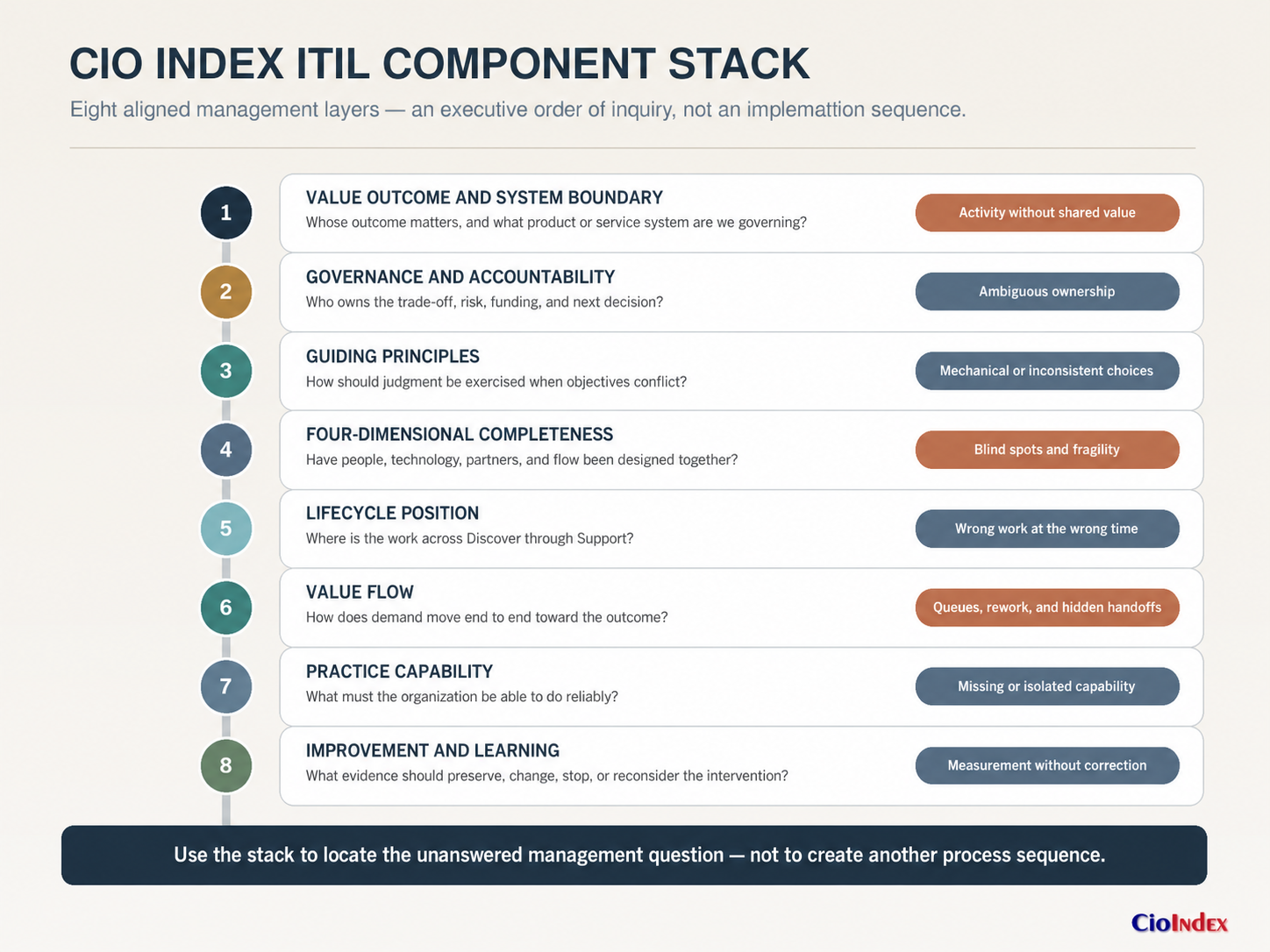
The component overview above explains the principal ITIL constructs. The Component Stack™ gives those constructs an executive order of inquiry: what outcome matters, who directs the system, how judgment is exercised, whether the design is complete, where the work sits, how it moves, which capabilities perform it, and what evidence changes it. Later, the Missing-Layer Diagnostic uses the stack to locate weakness; the executive intervention sequence converts that diagnosis into action; and the ITIL Alignment Review Record preserves the decision and its evidence.
The stack is not a sequence that every initiative must follow mechanically. It is a way to test alignment. A weakness at any layer can undermine strengths elsewhere.
For example, a technically strong incident-management capability cannot compensate for an unclear product boundary, inaccessible knowledge, a supplier contract that rewards the wrong behavior, or governance that accepts no owner for recurring failure. Conversely, a well-designed governance structure cannot create value if the operating value stream lacks the capabilities to perform the work.
The executive implication is simple: diagnose the missing layer before expanding the ITIL footprint.
The ITIL Value System: The Whole Management System
The ITIL Value System is the broadest organizing construct. In ITIL 4, the Service Value System brought together guiding principles, governance, the service value chain, practices, and continual improvement.[4][5] Version 5 retains the Value System as a central part of the framework while extending the view of products and services through the Product and Service Lifecycle.[1][2]
The Value System matters because it prevents service management from being reduced to operations. It frames how an organization converts demand and opportunity into value through coordinated direction, activity, capability, and learning.
For a CIO, the Value System is useful as a management boundary. It asks leaders to identify:
- the demand or opportunity entering the system;
- the stakeholders participating in value co-creation;
- the products and services through which value is realized;
- the governance decisions that constrain or enable action;
- the principles that guide decentralized judgment;
- the operating activities and value streams that perform the work;
- the practices that provide capability;
- the evidence and improvement mechanisms that adapt the system.
This is why a practice-first implementation is often too narrow. If a team begins by documenting incident management, change enablement, or service-level management without defining the relevant outcome and system boundary, it may build a competent capability into an incoherent operating model.
The Value System also changes how leaders interpret performance. A metric belongs inside a system of purpose and evidence. Faster ticket closure has meaning only when it contributes to a valued outcome and does not create an unacceptable effect elsewhere. A highly available platform can still fail its business purpose if users cannot complete the work it exists to support.
The whole-system question is therefore not “Did the process perform?” It is “Did the system convert demand or opportunity into value under acceptable cost, risk, experience, and operational conditions?”
A whole-system boundary is necessary, but it is not self-directing. Once leaders know what outcome and product or service system they are governing, they must establish who can make tradeoffs, accept risk, allocate resources, and require correction.
Governance and Accountability: Who Directs the System
Governance prevents the Value System from becoming a collection of well-intended but uncoordinated activities. It establishes how the organization evaluates conditions and options, directs priorities and behavior, and monitors performance and conformance.
In practical terms, governance clarifies who can approve, reject, defer, fund, accept risk, set policy, demand evidence, grant exceptions, and require correction. It also identifies who owns the product or service outcome when responsibility crosses product, operations, security, finance, suppliers, and business functions.
This is not a case for centralizing every operating decision. Governance should make the consequential decisions explicit while allowing teams to act within clear boundaries. Without that clarity, teams can improve their own metrics while unresolved tradeoffs accumulate between them.
The governing question is not merely, “Did each team follow its process?” It is, “Who owns the end-to-end outcome, which risks and dependencies have been accepted, and what evidence can change the decision?”
Governance supplies direction, but direction alone cannot prescribe the right choice in every context. Distributed teams still need a consistent way to exercise judgment when speed, assurance, cost, experience, and resilience pull in different directions.
The Guiding Principles: How Judgment Travels Across the System
ITIL 4 established seven guiding principles that continue to shape the framework: Focus on value; Start where you are; Progress iteratively with feedback; Collaborate and promote visibility; Think and work holistically; Keep it simple and practical; Optimize and automate.[4][5]
The principles are not slogans to place on a wall. They are decision heuristics for situations in which the framework cannot prescribe one universally correct design.
- Focus on value keeps an improvement connected to stakeholder outcomes rather than internal activity.
- Start where you are prevents teams from discarding working capabilities because a target model looks cleaner.
- Progress iteratively with feedback limits the risk of designing a large management system before testing whether it works.
- Collaborate and promote visibility exposes dependencies, tradeoffs, queues, risks, and competing interpretations.
- Think and work holistically protects the end-to-end outcome from local optimization.
- Keep it simple and practical challenges controls, reports, workflow states, and approvals that add burden without changing a decision or reducing risk.
- Optimize and automate puts automation after an understanding of purpose and flow, reducing the chance that waste or error is simply accelerated.
Their value becomes visible when legitimate objectives conflict. A release team wants speed. Security wants stronger assurance. Operations wants recoverability. Product leadership wants a promised capability. Finance wants cost certainty. No practice can make that tradeoff on its own.
The principles help decision-makers reason consistently across the conflict. Focus on value clarifies the outcome. Think and work holistically exposes second-order effects. Progress iteratively suggests a phased release. Collaborate and promote visibility makes the accepted risk explicit. Keep it simple and practical challenges controls that do not materially change exposure.
This is how judgment travels across the ITIL system. The principles give distributed teams a shared way to interpret context without pretending that every situation deserves the same procedure.
Consistent judgment still does not guarantee a complete design. A decision can follow the principles and remain unworkable because it ignores a critical people, technology, supplier, information, workflow, or process condition. The four dimensions provide that completeness test.
The Four Dimensions: The Completeness Test
The four dimensions of service management are Organizations and People, Information and Technology, Partners and Suppliers, and Value Streams and Processes.[4][5] They provide a disciplined way to challenge incomplete designs.
Organizations and People
This dimension covers structures, roles, skills, capacity, culture, communication, incentives, authority, and behavior. Many technology initiatives underinvest here because the technical design is easier to specify than the behavioral operating system.
For an AI support product, the people question is not limited to training users. It includes who owns knowledge quality, who approves sensitive use cases, how support agents challenge automated answers, which teams resolve recurring causes, and whether incentives reward rapid closure over durable resolution.
Information and Technology
This dimension covers information, knowledge, data, applications, platforms, infrastructure, integration, automation, security, and technical architecture. It asks whether technology and information are fit for the value outcome—not merely whether a tool has been deployed.
In the same AI support example, the relevant questions include data quality, retrieval accuracy, identity and access, auditability, model monitoring, integration with case systems, knowledge freshness, observability, and recovery.
Partners and Suppliers
This dimension covers external relationships, sourcing models, contracts, responsibilities, performance, dependencies, and ecosystem risk. A service can be internally well managed and still fail because accountability crosses supplier boundaries that the operating model does not control.
The practical test is whether contracts, escalation paths, data obligations, support commitments, continuity arrangements, and improvement incentives reinforce the outcome. A vendor service-level agreement may be green while the customer-facing value stream remains broken.
Value Streams and Processes
This dimension covers how work is organized, sequenced, measured, controlled, and improved. It includes formal processes, but it is broader than process documentation. It asks whether the route from demand to outcome is visible and whether activities, decisions, practices, and handoffs work together.
The four dimensions should be applied to every material lifecycle and value-stream decision. They are not four departments and should not become four independent workstreams. Their purpose is to expose dependencies.
The dimensions test whether a design can work as a whole. The value stream tests whether the work can move as a whole.
A useful executive test is: Which dimension would a technically focused team be most likely to underdesign? That question often reveals the condition that will later appear as adoption resistance, supplier failure, knowledge debt, control breakdown, or operational fragility.
Once the design is complete enough to be credible, leaders need to locate the work across the evolution of the product or service. That is the Product and Service Lifecycle’s job.
The Product and Service Lifecycle: Where the Work Is
The Version 5 Product and Service Lifecycle provides a current end-to-end view across eight activities: Discover, Design, Acquire, Build, Transition, Operate, Deliver, and Support.[2]
| Lifecycle activity | Primary management concern | Example questions |
| Discover | Understand needs, opportunities, context, and viability. | Whose problem are we solving? What evidence shows the need? What constraints and alternatives matter? |
| Design | Shape the product, service, experience, controls, architecture, and operating model. | What must be true across all four dimensions? How will value, risk, usability, and operability be designed? |
| Acquire | Obtain external products, services, capabilities, or resources. | What should be bought, partnered for, licensed, or sourced? What obligations and dependencies will result? |
| Build | Create or configure the required product and service components. | What is being developed, integrated, tested, and documented? What technical and operating debt is being accepted? |
| Transition | Move a change safely into its intended operating environment. | Are users, support, monitoring, knowledge, suppliers, controls, and recovery mechanisms ready? |
| Operate | Run and control the product and its enabling environment. | Is the product stable, secure, observable, cost-effective, and governed under real conditions? |
| Deliver | Make the service and its outcomes available to consumers. | Can consumers access, use, and realize the intended service outcome? Are commitments being met? |
| Support | Help users, restore service, resolve issues, and sustain effective use. | Can problems be diagnosed and resolved? Is knowledge improving? Are recurring causes being removed? |
Official commentary describes the lifecycle as holistic and flexible rather than a rigid one-way sequence. Value can involve work in more than one activity, and products and services may move iteratively as evidence changes.[6]
That flexibility matters. A product in operation may return to discovery because stakeholder needs changed. A support pattern may trigger design work. A supplier failure may require acquisition and transition activity. A security exposure discovered during build may force a new design decision. Treating the lifecycle as a gated waterfall would recreate the very silo behavior the model is meant to help leaders see.
The lifecycle is most useful for location. It tells leaders where the management need sits and what kind of evidence should exist at that point. It does not, by itself, reveal the complete path that a particular demand follows across teams, activities, decisions, and practices. That is the job of the value stream.
The Value Chain and Value Streams: How Work Moves Toward an Outcome
ITIL 4 defined six Service Value Chain activities: Plan, Improve, Engage, Design and transition, Obtain/build, and Deliver and support.[5] Organizations combine these activities, together with practices, into value streams that convert a specific demand or opportunity into value.
As Version 5 is introduced, many organizations will continue to use their ITIL 4 value-chain and value-stream designs during the transition. The important conceptual distinction is this:
The lifecycle locates the work; the value stream shows the motion of work toward a particular outcome.
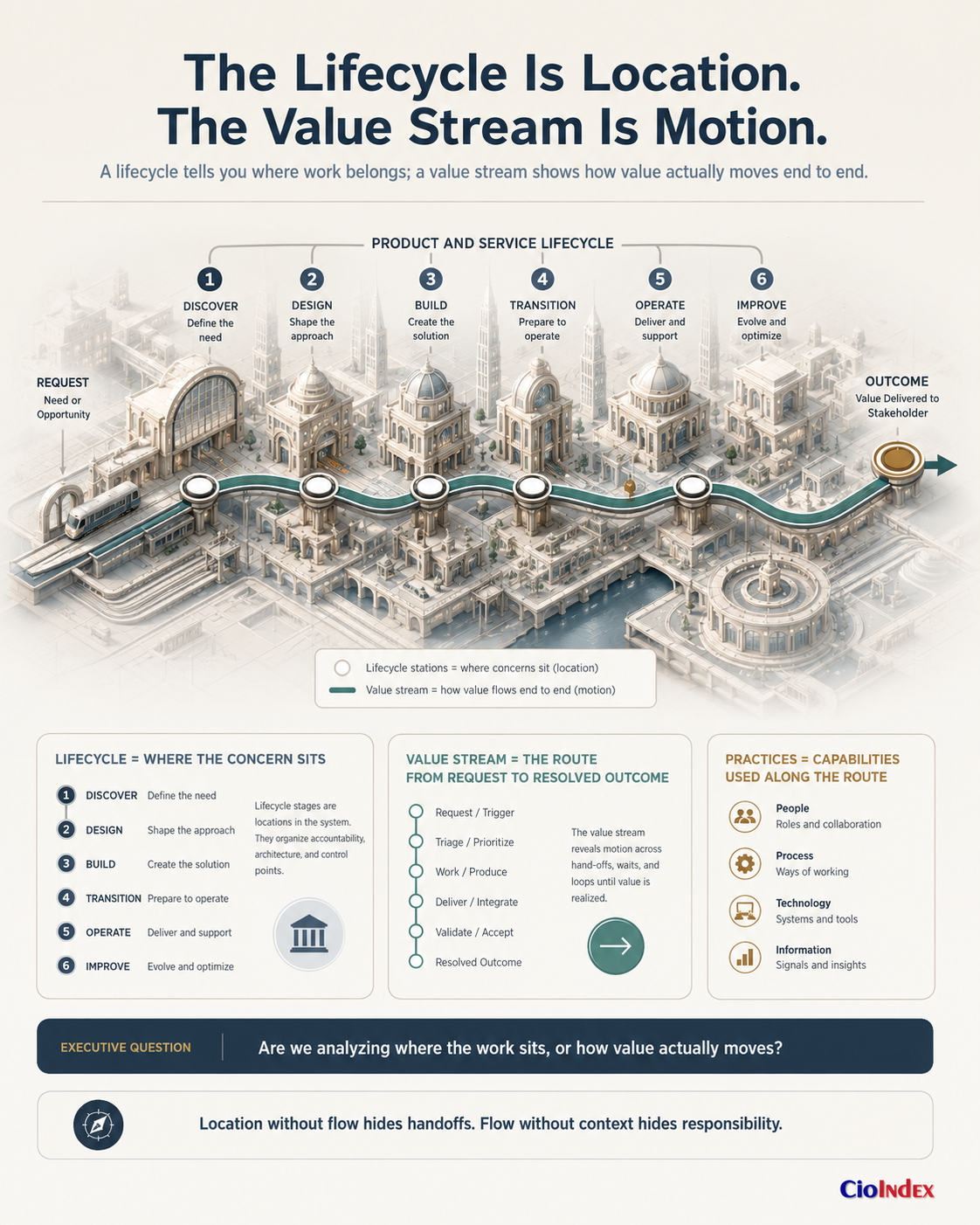
A lifecycle activity such as Support tells leaders where a management concern sits. A value stream such as “restore an employee’s access to a critical application” shows the end-to-end route: request intake, identity verification, diagnosis, approval where needed, access change, confirmation, communication, evidence capture, and learning. That route may use several lifecycle activities and several practices.
This distinction prevents two common mistakes.
The first is turning the lifecycle into a departmental map. Discover does not belong only to strategy. Build does not belong only to development. Support does not belong only to the service desk. Different roles participate based on the outcome and context.
The second is treating a process as the whole customer journey. Incident management may provide essential capability inside a restoration value stream, but it does not represent every interaction, decision, technical action, supplier dependency, communication, and evidence requirement involved in restoring value.
A value-stream review should make five things visible:
- the demand, opportunity, or trigger;
- the stakeholder outcome and completion condition;
- the activities and decisions required to reach it;
- the practices and resources enabling those activities;
- the measures, risks, exceptions, feedback, and ownership at each handoff.
This is where ITIL connects naturally with value-stream mapping, product management, Agile, DevOps, enterprise architecture, and experience management. Those disciplines do not need to be replaced by ITIL. They can contribute methods and evidence inside a governed service-management system.
A visible flow is still only a design until the organization has the capabilities to perform it. Practices supply those capabilities; they do not replace the flow.
Management Practices: The Capabilities That Perform the Work
ITIL (Version 5) retains 34 management practices, with adjustments and two broad groupings: Product and Service Management Practices and General Management Practices.[3] A practice is best understood as an organizational capability for accomplishing work, not merely as a sequential process.[4]
That distinction is consequential.
A process describes a flow of activities. A practice includes the broader resources needed to perform a purpose well: roles, skills, information, technology, suppliers, methods, policies, controls, knowledge, measures, and improvement mechanisms. A practice may support many value streams, and one value stream may depend on many practices.
Consider change enablement. If it is treated only as an approval workflow, the organization may optimize the number and speed of change records while neglecting deployment design, testing, observability, recovery, product ownership, supplier coordination, architecture, and user communication. Those capabilities may sit in several practices and dimensions.
The stronger view is:
A practice is capability, not itinerary.
It tells the organization what it must be able to do reliably. It does not automatically define the complete end-to-end route that a particular stakeholder demand should follow.
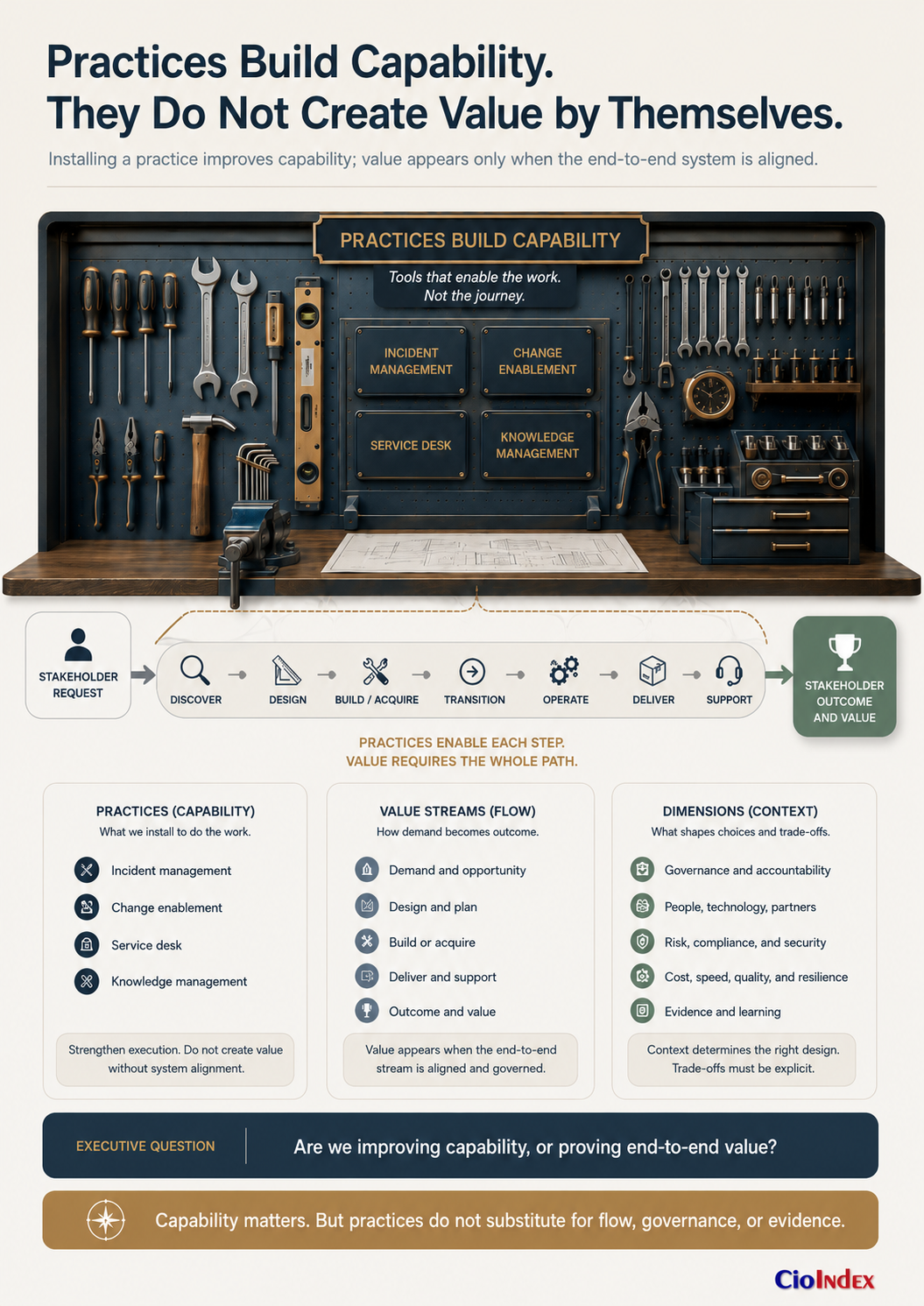
This also changes how practices should be implemented. Instead of asking, “Have we implemented incident management?” leaders should ask:
- In which value streams is this capability required?
- What outcomes and risks should it influence?
- Which roles, information, technology, partners, and controls are necessary?
- What is the minimum capability needed now?
- Which measures establish local performance, and which measures test the wider outcome?
- Who owns improvement when the practice performs locally but the value stream still fails?
Practice maturity is useful only when connected to the work it enables. A highly mature practice that adds delay, creates unnecessary handoffs, or optimizes the wrong measure can reduce value.
Capability without flow becomes a silo. Flow without capability becomes aspiration.
Even strong capabilities and well-designed flows can preserve the wrong assumptions. The final layer is therefore evidence and learning: the ability to determine whether the system is producing the intended outcome and what should change next.
Continual Improvement: How Evidence Changes the System
Continual improvement turns operating evidence into learning. It asks whether an observed result justifies preserving, adapting, expanding, or stopping an intervention. It should operate across the Value System, lifecycle, dimensions, value streams, and practices—not as a separate improvement department waiting for ideas.
The relationship with governance matters. Improvement without governance can create many local initiatives that compete for capacity or optimize conflicting goals. Governance without improvement can preserve controls and investment choices long after their assumptions have expired.
A disciplined review distinguishes four levels of evidence:
- Capability evidence: A practice or control exists and has an owner. This does not establish that it is used well.
- Local performance evidence: A process metric changed. This does not establish that the end-to-end outcome improved.
- Outcome evidence: A relevant product, service, experience, risk, or business measure improved. This does not, by itself, prove that ITIL caused the change.
- Repeatability evidence: Improvement persists across cycles and contexts while risks remain controlled. This supports confidence in the management system but does not make the result universal.
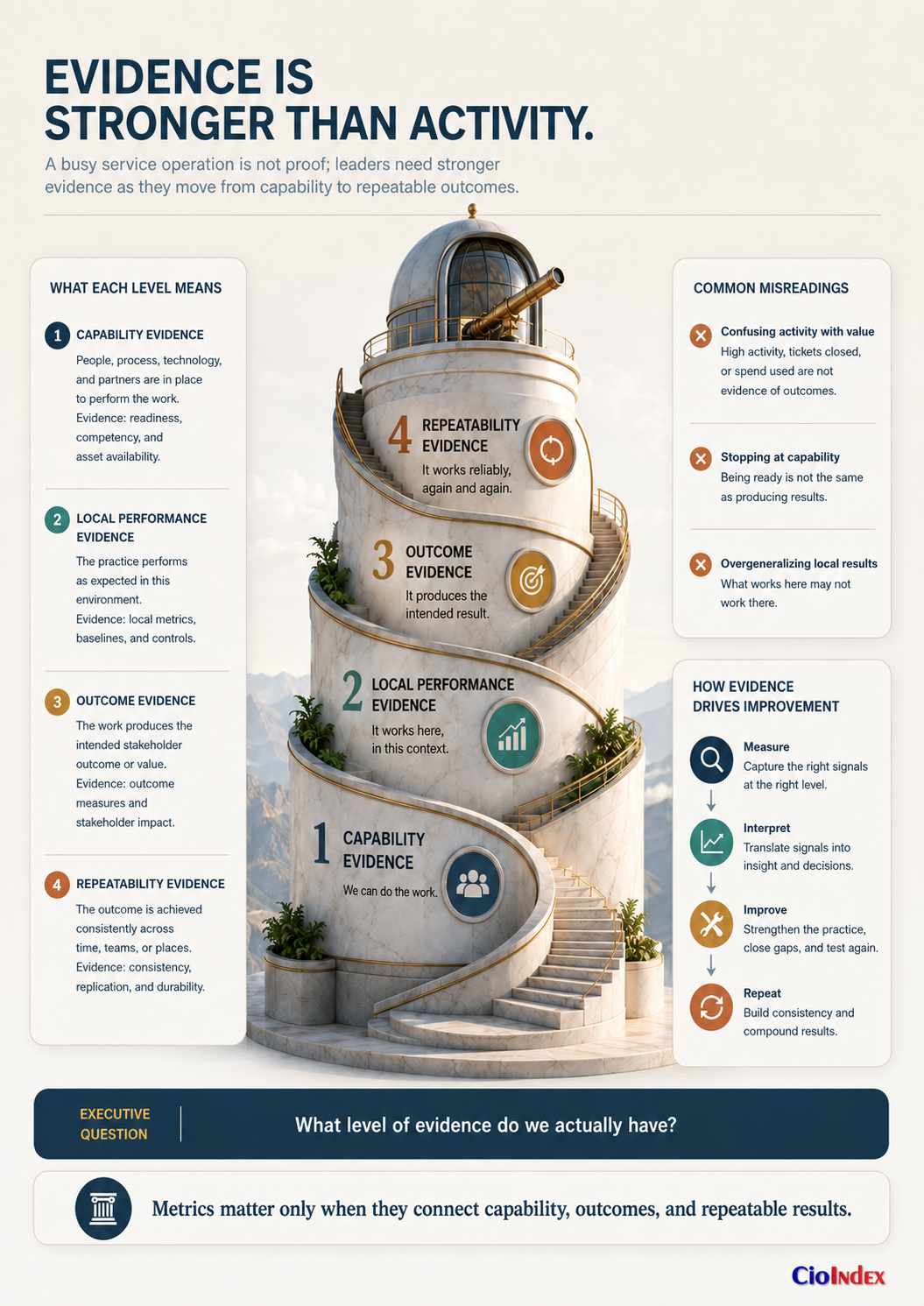
This claim ladder protects leaders from false confidence. A green dashboard can be accurate and still support a poor conclusion because it measures only one level of the system.
A measure becomes management evidence only when it can change a decision. The final review question is therefore: What does this evidence establish, what does it not establish, who is accountable for its interpretation, and what should the organization preserve, change, expand, stop, or reconsider?
How the Components Work Together: An AI Employee Support Example
The following is an illustrative composite, not a PeopleCert or customer case study.
Imagine an enterprise introduces an AI-enabled employee support product. It answers policy and technology questions, retrieves knowledge, opens cases, and helps service-desk agents draft responses. Within three months, first-response time improves and the percentage of cases marked closed increases.
The dashboard is green. Employees, however, report that they repeat questions, receive inconsistent answers, and cannot tell when a human has taken ownership. Security identifies excessive information exposure in some responses. HR says policy interpretation is unreliable. Support agents reopen cases under new identifiers because the automated closure logic makes the original metric look better.
A practice-only response might add incident procedures or retrain the service desk. The Component Stack™ changes the inquiry. The problem is no longer “Which process should we add?” It is “Which layer of the product and service system is failing, and what evidence should govern the response?”
The outcome and ownership must be corrected first
Leaders first define the outcome and boundary. Is the product meant to reduce support cost, improve employee resolution, increase self-service, shorten time away from productive work, or pursue several of these goals under explicit tradeoffs? Which employee populations, knowledge domains, channels, and risk categories are inside the product boundary?
That clarification exposes the governance gap. Someone must own the combined outcome, accept or reject the risk of incorrect policy answers and information disclosure, suspend unsafe automation, and reconcile HR, security, product, platform, supplier, service-management, and employee-experience evidence. Without that accountability, every team can own a component while no one owns the tradeoff.
The guiding principles then shape the response. Focus on value challenges closure rate as the primary outcome. Start where you are protects useful service-desk knowledge and escalation paths. Progress iteratively with feedback supports a bounded rollout. Collaborate and promote visibility makes the disagreement between the dashboard and employee experience visible. Think and work holistically prevents the AI model from being managed separately from the service it enables.
The diagnosis crosses design, lifecycle, flow, and capability
The four dimensions reveal why a technically successful model can still produce a weak service. Organizations and People exposes agent roles, knowledge ownership, escalation authority, and employee trust. Information and Technology exposes data quality, retrieval, access controls, integration, model monitoring, and observability. Partners and Suppliers exposes vendor obligations, model support, data handling, and escalation. Value Streams and Processes exposes the actual route from a question to a resolved employee outcome.
The lifecycle locates the work across Discover, Design, Acquire, Build, Transition, Operate, Deliver, and Support. Discovery may need to revisit the user problem. Design may need to change the experience, controls, handoff, and measurement model. Acquisition may need to correct supplier obligations. Build may need new integrations and safeguards. Transition must validate readiness. Operation must monitor performance and risk. Delivery must make the capability usable. Support must resolve failures and capture learning. The issue does not belong to one activity.
The value stream then follows a specific outcome: “The employee obtains an accurate, authorized answer or reaches a qualified human owner.” Mapping that route reveals how questions are classified, knowledge is retrieved, risk is assessed, humans are engaged, cases are created, ownership is communicated, resolution is confirmed, and feedback changes the system. Queues and handoffs that remain invisible in a practice metric become visible in the flow.
Practices provide the capabilities required inside that flow: service desk, incident management, knowledge management, information security management, supplier management, monitoring and event management, service-level management, measurement and reporting, relationship management, and continual improvement. None is the whole solution.
Evidence determines the intervention
The organization keeps useful operating measures but adds evidence that tests the wider outcome: first-contact resolution quality, employee effort, repeat contact, escalation accuracy, unsafe-answer rate, knowledge defects, time to accountable human ownership, and outcome confirmation. Those measures are reviewed together, with explicit owners and decisions.
The lesson is not that ITIL automatically solves AI support. It is that the framework separates different management failures so leaders do not mistake a real local improvement for a complete service outcome. The green response-time metric was accurate. The strategic conclusion drawn from it was weak.
The Missing-Layer Diagnostic™
When a digital product or service outcome is weak, use the following diagnostic before adding documentation, controls, tools, or practices.
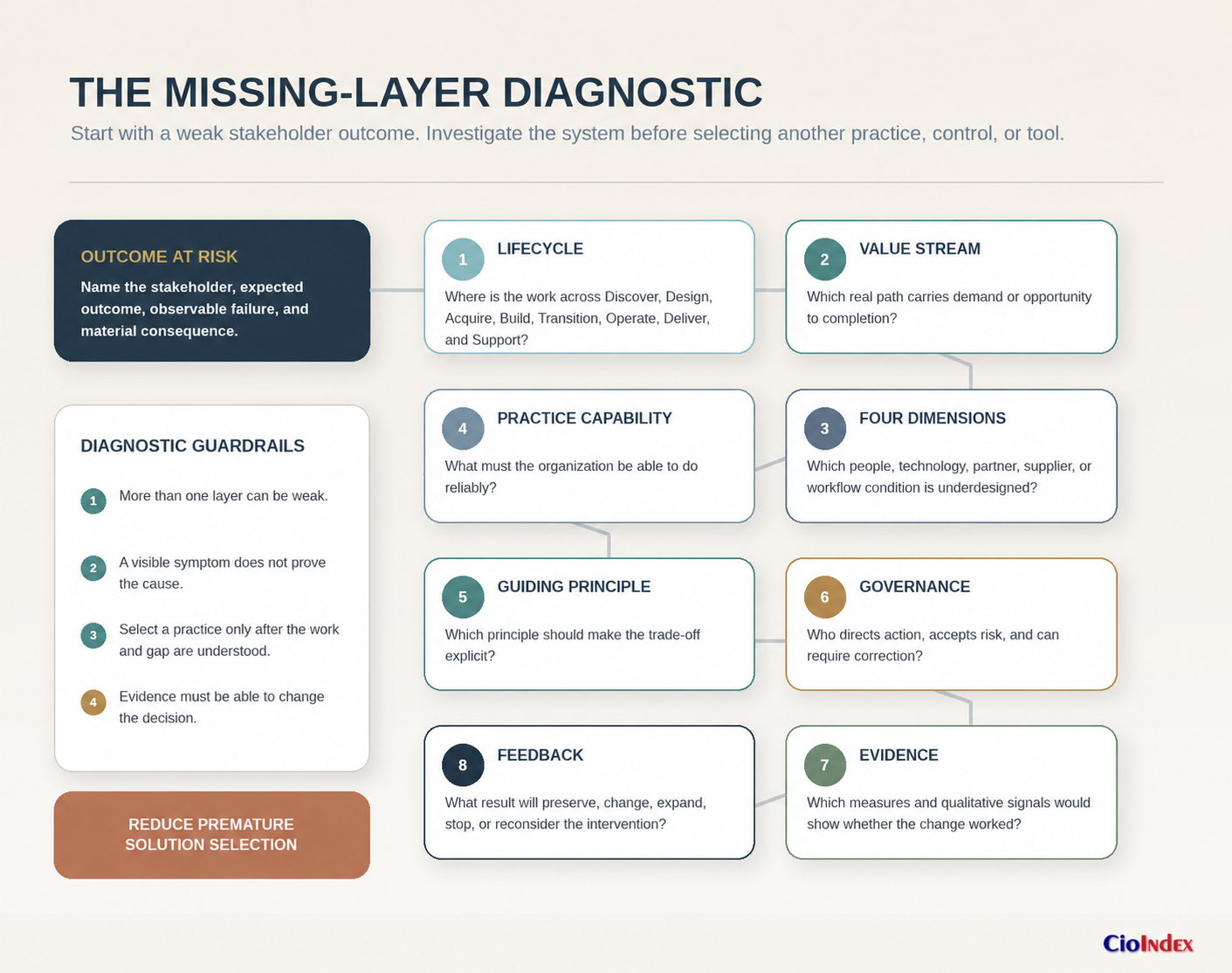
- What value outcome is failing? Name the affected stakeholder, expected outcome, observable failure, and material consequence. Avoid starting with an internal metric or framework label.
- Where in the lifecycle is the work? Identify the relevant Discover, Design, Acquire, Build, Transition, Operate, Deliver, and Support activities. A problem can span several activities.
- Which value stream produces the outcome? Trace the actual path from demand or opportunity to completion. Include decisions, handoffs, queues, exceptions, suppliers, communications, and confirmation of value.
- Which dimension is under-designed? Test Organizations and People, Information and Technology, Partners and Suppliers, and Value Streams and Processes. Do not assume the visible technical symptom identifies the missing dimension.
- Which practice capability is absent or weak? Select a practice only after the work and gap are understood. Define the minimum capability, owner, inputs, outputs, controls, and evidence required.
- Which guiding principle should shape the tradeoff? Use the principles to make competing objectives and design assumptions explicit. They illuminate judgment; they do not remove it.
- Who governs the decision and evidence? Identify who directs action, accepts residual risk, resolves cross-functional conflict, monitors the outcome, and can require correction.
- What feedback closes the loop? Define the measures, review cadence, thresholds, qualitative evidence, exceptions, and decisions that will show whether the change worked and whether it created a new problem elsewhere.
This diagnostic is a CIO Index recommendation derived from the relationship among the framework components. It is not an official ITIL assessment and does not guarantee improved performance. Its value is to reduce premature solution selection.
Decision Stress Test: Is the Cloud ERP Ready to Launch?
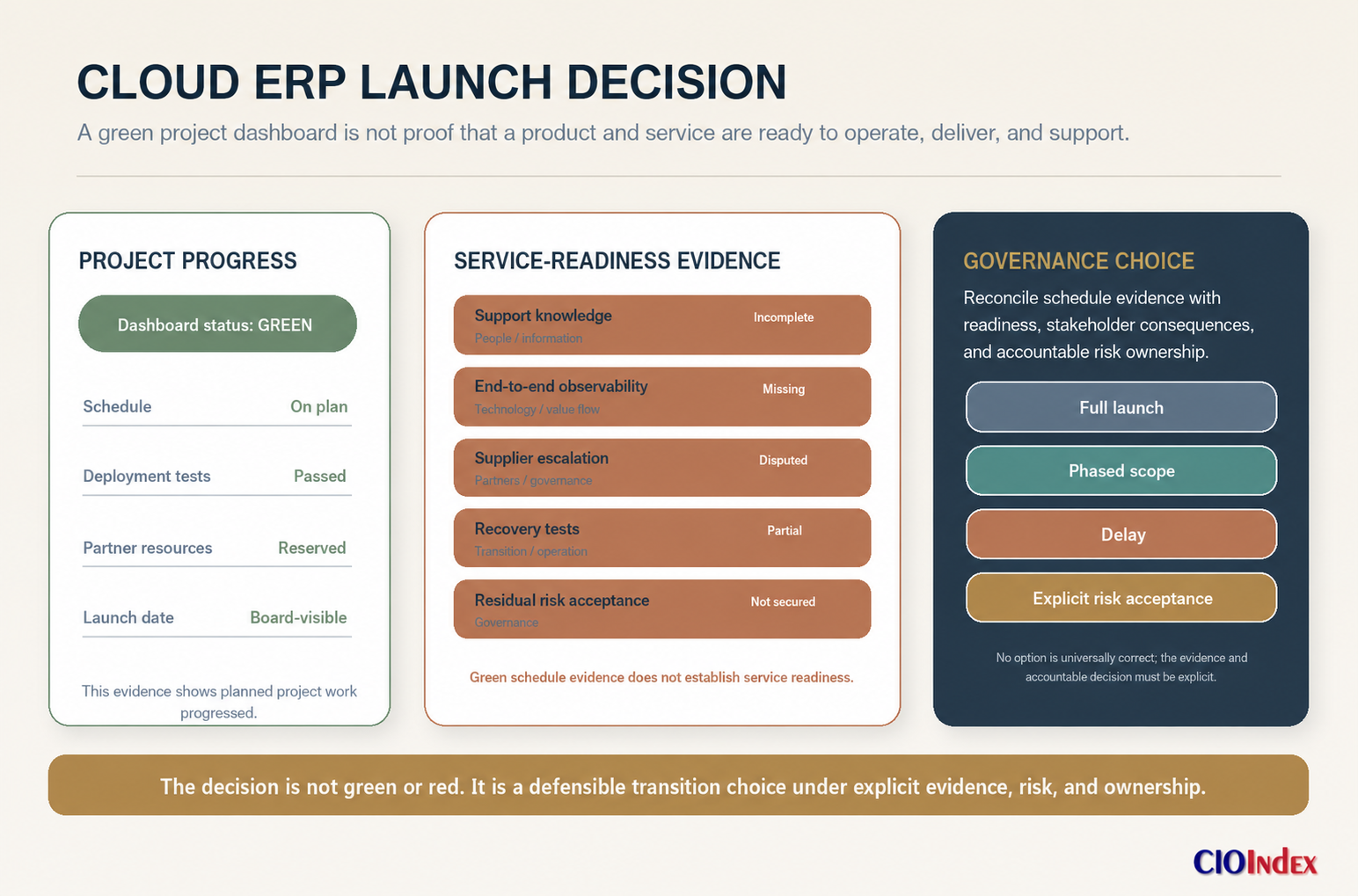
Consider a cloud ERP program that is on schedule and has passed its technical deployment tests. The announced launch date is visible to the board, the implementation partner has reserved resources, and finance wants to avoid another month of program cost. The project dashboard is green.
The service-readiness evidence is not. Support knowledge is incomplete. Business-critical transactions are not covered by end-to-end observability. Supplier escalation responsibilities remain disputed. Recovery tests exclude several integrations, and business continuity owners have not accepted the residual risk.
The schedule metric establishes that planned project work has progressed. It does not establish that the product and service are ready to operate, deliver, and support. The Missing-Layer Diagnostic makes the gap explicit:
- the lifecycle locates weaknesses across Transition, Operate, Deliver, and Support;
- the four dimensions expose missing people, information, supplier, and workflow conditions;
- the value stream shows how a failed transaction would move across business operations, the platform team, the software provider, and the systems integrator;
- the required practices supply release, deployment, service validation, monitoring, supplier, incident, continuity, and knowledge capabilities;
- governance must choose among a full launch, phased scope, delay, or explicit risk acceptance.
From Diagnosis to Intervention: Applying ITIL Without Creating Bureaucracy
The Missing-Layer Diagnostic identifies where the management system is weak. The next task is to intervene without turning ITIL into a large compliance program. Start with a consequential outcome and add only the management capability needed to improve it.
- Confirm the outcome and system boundary. Record the stakeholder, product or service, demand or opportunity, expected value, constraints, material risks, and the decision now required.
- Locate the work in the lifecycle. Identify the activities involved and the readiness, operating, delivery, or support evidence that should exist at each.
- Map the value stream. Follow one real demand to its outcome. Make decisions, handoffs, queues, rework, suppliers, systems, communications, exceptions, and completion criteria visible.
- Test the four dimensions. Convert missing people, information, technology, partner, supplier, workflow, and process conditions into an explicit gap register rather than general implementation concerns.
- Select the minimum practice capability. Reuse fit-for-purpose capabilities first. Strengthen or add only the roles, methods, information, technology, controls, and knowledge the value stream requires.
- Apply the guiding principles to the design tradeoffs. Document how value, existing strengths, iteration, visibility, holistic effects, simplicity, optimization, and automation influenced the choice.
- Govern the intervention and its evidence. Assign decision rights, risk ownership, measures, review cadence, exception paths, stopping conditions, and the person or forum that can require correction.
- Review the end-to-end outcome and reconsider. Adjust the layer that the evidence implicates. The right response may be a design change, supplier decision, role clarification, value-stream redesign, product-boundary change, control, practice improvement, phased rollout, or withdrawal of the initiative.
A lightweight ITIL Alignment Review Record can preserve the outcome, lifecycle position, value stream, dimension gaps, practice owners, principle-based tradeoffs, accepted risks, measures, evidence, decisions, and next review date. The artifact is useful only when it changes or governs a decision; it should not become another report produced for its own sake.
Common Ways Organizations Misuse the ITIL Components
The most common failures are not missing terminology. They are substitutions in which one component is expected to do another component’s job.
| Misuse | Hidden error | Corrective response |
| Counting practices as maturity | Coverage is mistaken for coherence or value. | Tie practice capability to the outcomes and value streams it enables. |
| Treating the lifecycle as a waterfall | A location model becomes a rigid one-way project sequence. | Use the lifecycle flexibly and allow evidence to send work back to earlier activities. |
| Turning dimensions into departments | Four completeness lenses become four disconnected work packages. | Reconcile the dimensions in one integrated product or service design. |
| Using principles as decoration | A stated principle changes no choice. | Require the principle to simplify, stage, expose, or redirect an actual decision. |
| Confusing a practice with an end-to-end flow | Capability is mistaken for the complete stakeholder journey. | Map the value stream and place practices inside it. |
| Automating before understanding the flow | Waste, error, or weak control is accelerated. | Clarify purpose, demand, decisions, exceptions, and evidence before automation. |
| Governing conformance without governing outcomes | Process adherence becomes the only visible success measure. | Govern value, experience, risk, cost, and the conditions for correction. |
| Improving local metrics without counter-metrics | Work is shifted, reclassified, deferred, or made harder elsewhere. | Pair local measures with outcome, experience, risk, cost, and recurrence evidence. |
The Executive Governance Test
A CIO does not need to chair every ITIL discussion, but the management system should make six questions answerable:
- Which stakeholder outcome and product or service boundary does this decision serve?
- Which management layer is weak, and what evidence supports that diagnosis?
- Where does the work sit in the lifecycle, and how does it move through the value stream?
- Which dimension and practice capability most constrain the outcome?
- Who owns the tradeoff, accepted risk, evidence, and next decision?
- What result will cause the organization to preserve, change, expand, stop, or reconsider the intervention?
If these questions cannot be answered, the organization may be using ITIL terminology without operating an aligned ITIL system.
Frequently Asked Questions
What are the main components of the ITIL framework?
The current ITIL architecture includes the Value System, Product and Service Lifecycle, four dimensions, guiding principles, management practices, governance, and continual improvement. Organizations transitioning from ITIL 4 may also continue to use the Service Value Chain and outcome-specific value streams. These constructs are complementary: they define the system, guide decisions, test completeness, locate work, organize flow, supply capabilities, and enable learning.[1][2]
Is the ITIL service lifecycle still relevant?
Yes, but the version matters. The five-stage Service Strategy, Service Design, Service Transition, Service Operation, and Continual Service Improvement model belongs to ITIL v3/2011. ITIL (Version 5) introduces an eight-activity Product and Service Lifecycle. Older lifecycle language can remain useful for understanding existing operating models, but it should not be presented as the current architecture.[2][4][7]
How is the Product and Service Lifecycle different from the ITIL 4 Service Value Chain?
The Product and Service Lifecycle locates work across Discover, Design, Acquire, Build, Transition, Operate, Deliver, and Support. The ITIL 4 Service Value Chain describes adaptable operating activities that can be combined into value streams. In practical terms, the lifecycle shows where product and service work sits, while a value stream shows how work moves toward a specific outcome.[2][5]
Are ITIL practices the same as processes?
No. A process describes a flow of activities, while an ITIL management practice is a broader organizational capability that can include people, roles, information, technology, partners, policies, methods, controls, and processes. Practices enable many value streams; they should not be mistaken for complete end-to-end customer or product journeys.[4]
Which ITIL component should an organization implement first?
Do not start by selecting a component from a catalogue. Start with a stakeholder outcome and product or service boundary, then diagnose the relevant lifecycle activity, value stream, dimension gap, governance decision, and required evidence. Strengthen a practice only when the analysis shows which capability the outcome requires. This is a CIO Index application recommendation, not a universal official sequence.
ITIL Works as a System, Not a Parts Catalogue
ITIL becomes bureaucratic when its components are treated as deliverables to implement. It becomes useful when they are treated as distinct but connected ways of seeing and managing the same product or service system.
The Value System defines the whole. Governance gives it direction and accountability. Guiding principles help people exercise judgment. The four dimensions expose incomplete design. The lifecycle locates the work. Value streams reveal how work moves. Practices provide the capabilities. Continual improvement turns evidence into learning.
The resulting standard for adoption is not how many ITIL terms appear in a process library. It is whether leaders can trace a real demand or opportunity through an accountable, complete, capable, measurable, and improving system to a stakeholder outcome.
Before adding another practice, control, or workflow, leaders should therefore ask: Can we identify the failing stakeholder outcome, the missing management layer, the accountable decision owner, the evidence required, and the condition that would cause us to reconsider the intervention?
That is the shift from implementing ITIL components to using ITIL as a management system.
Editorial note — July 2026: This article uses ITIL (Version 5) as the current framework context. Version 5 evolves ITIL 4 rather than discarding it, and ITIL 4 remains available during a phased transition. The article therefore distinguishes the current Product and Service Lifecycle from the five-stage ITIL v3 service lifecycle and the ITIL 4 Service Value Chain.[1][2]
References
- ITIL / PeopleCert. “ITIL Foundation (Version 5).”
- Roman Jouravlev and Adam Griffith, ITIL / PeopleCert. “ITIL Foundation (Version 5), What’s New?” 2026.
- ITIL / PeopleCert. “New ITIL Explained for Certified Professionals.” 2026.
- University Information Technology, University of Utah. “ITIL 4 History, Guiding Principles, and Best Practices.” Updated January 30, 2026.
- Claire Agutter. ITIL Foundation Essentials, ITIL 4 Edition. IT Governance Publishing, 2020.
- ITIL / PeopleCert. “The New ITIL Product and Service Lifecycle Model—Views from the Front Line.” 2026.
- CIO Index. “Introduction to ITIL V3.”